Brissopsidae
Lambert, 1905, p.41
Genre type : Brissopsis Agassiz, 1840
Description succincte de la famille : système apical tétrabasal, ethmolytique. Périprocte allongé, inframarginal. Pétales courts et assez creusés.



| Brissopsis Ag. (genus nov.) Ambitus cordatus ; ambulacra supra depressa, impar simplex, paria substllata, extus conjuncta ; discus ambulacralis zonula circumdatus. Differt ab Amphideto ambulacris in summo vertice non amplioribus. |
|
|
Genus Brissopsis (Agassiz,1840). Form elongated, subcylindrical ; ambulacral areas straight, short, and wide, converging near the summit of the test ; peripetal fasiole flexuous, closely surrounding the ambulacral areas ; two or four genital pores, the posterior larger than the anterior pair ; five ocular plates disposed nearly equally apart in a |
pentagonal form around the genital openings ; subanal fasciole wide, and situate at a considerable distance below the anal opening ; single ambulacrum lodged in an anteal sulcus ; the basal portions of the ambulacra are wide and naked ; the tubercles are very uniform in size, and are crenulated and perforated. Three living species ; the rest are fossil in the tertiary rocks. |
|
CXXXXI. Genre. - BRISSOPSIS. Agass. 1847. Oursins renflés, ovoïdes. Sommet central ou excentrique en avant. Sillon impair peu accusé. Pétales inégaux, les antérieures droits et passablement divergents. Deux fascioles, l'un péripétale entourant les ambulacres, l'autres sous-anal formant un anneau placé à la base de la face postérieure. Des terrains tertiaires et de l'époque actuelle. Nota. Au point de vue des fascioles, ce genre est voisin des Brissus, et c'est ce qui lui a valu le nom de Brissopsis ; mais il en diffère notablement par son sommet ambulacraire médian, ses |
pétales antérieurs bien moins divergents et par la présence d'un sillon antérieur. Le type de cette espèce est pour nous le B. lyrifera (Catal. rais. Tab. XVI. fig. 12). Parmi les espèces fossiles énumérées ci-dessous la plupart nous laissent des doutes sur la présence des fascioles. Ce n'est donc que sur la foi de leur aspect général et de la forme et de la position de leurs pétales que nous les citerons ici. Le genre Cyclaster Cotteau nous paraît coïncider de tous points avec le genre Brissopsis ainsi réduit.
|

|
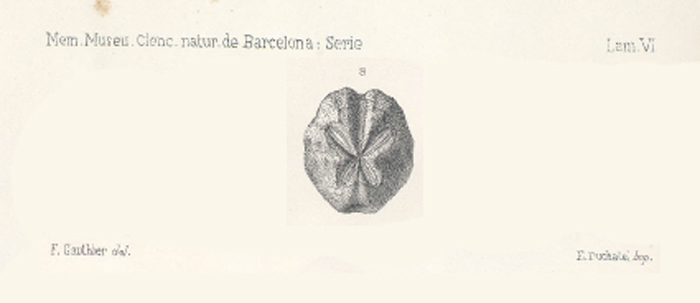
Brissopsis Almerai Lambert Pl. VI, fig. 8 Test remarquablement polygonal, rétréci et échancré en avant par le sillon, et en arrière par une dépression sous-anale ; deux autres dépressions s'étendent sur les flancs, du voisinage de l'apex au bord, et augmentent le nombre des angles de l'ambitus. Le type mesure 39 mill. de longueur sur 35 de largeur et 24 de hauteur. Face supérieure assez renflée, apex subcentral, dominé par les crêtes intérambulacraires ; sillon assez large et profond, bien limité sur ses bords. Pétales inégaux, les latéraux droits, profonds, nettement fermés et zone porifère à peine moins développée en avant ; les postérieurs un peu moins divergents, mais à peine séparés par une crête interambulacraire près de laquelle les zones porifères sont un peu moins développées. Face inférieure sub-convexe, avec saillie centrale, près de l'extrémité du plastron ; le sillon, atténué en dessous, aboutit au péristome excentrique en avant. Face postérieure étroite, présentant sous le périprocte ovale une aréa sensiblement déprimée, Tubercules du genre ; fasciole péripétale très sinueux, élargi à la traversée des aires ambulacraires ; le sous-anal en anneau un peu bilobé par suite de son inflexion dans l'aréa postérieure. |
Cette espèce se distingue facilement du B. lusitanicus par les caractères qui viennent d'être indiqués. Localité : Montjos ; étage Langhien. planche VI, d'après Lambert (extrait)
|
|
Brissopsis almerai Lambert,1928 - Miocène, El Monjos, Espagne, 37 mm |
 |
 |
 |
 |
 |
|
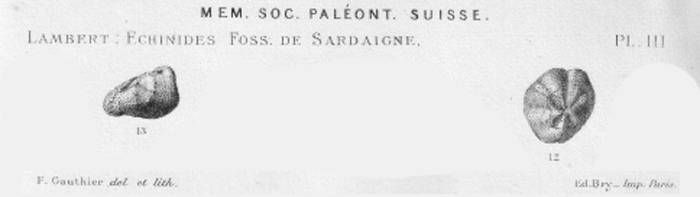
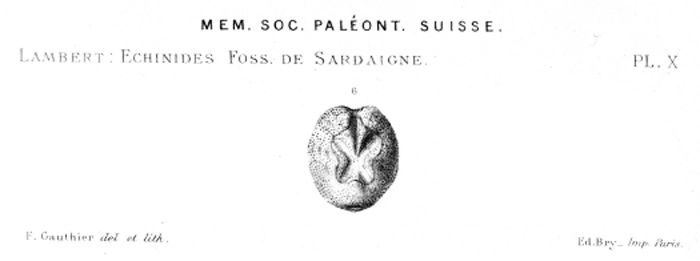
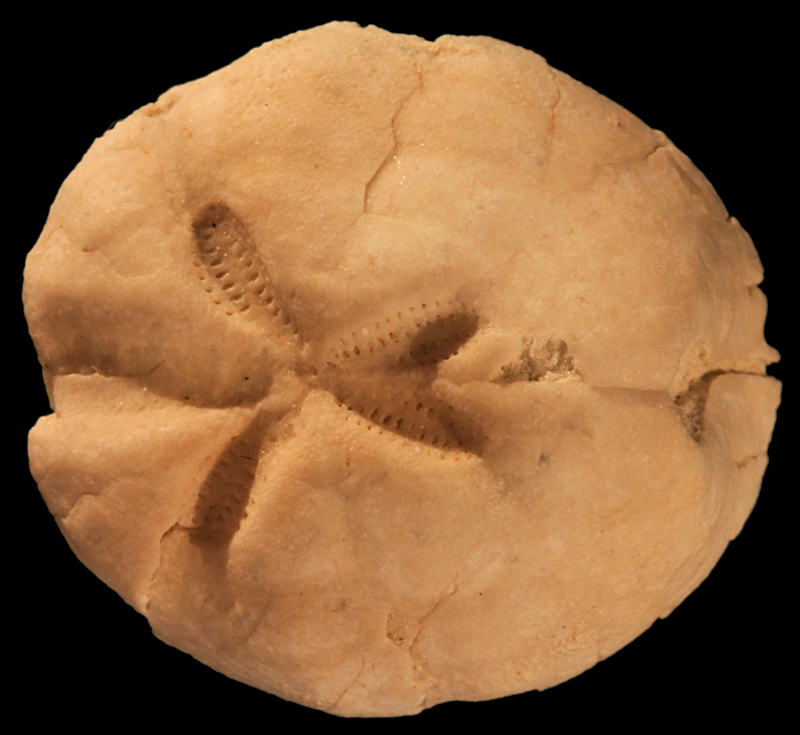
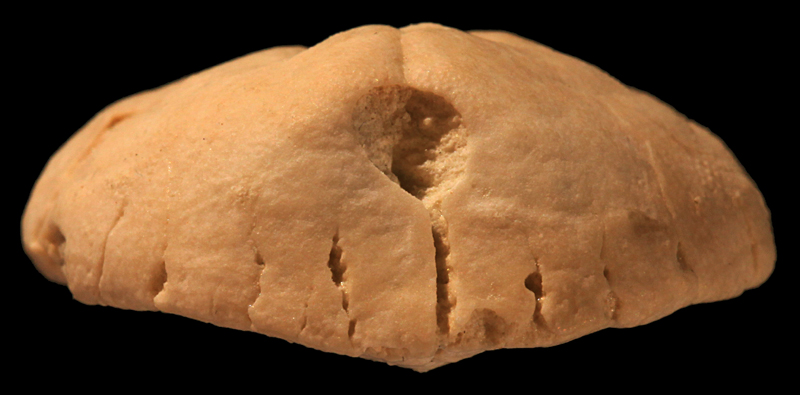
BRISSOPSIS CONSOBRINUS Lambert. (Pl. III, fig. 12, 13; Pl. X, fig. 6). Petite espèce ovale, déprimée, mesurant 28min de longueur et environ 11 de hauteur, très voisine du B. crescenticus auquel, à l'exemple de Cotteau, j'avais d'abord pensé la réunir, mais qui en diffère par son test moins régulièrement ovale, avec ambitus subsinueux au passage des ambulacres antérieurs pairs; apex légèrement excentrique en arrière. Pétales pairs égaux, un peu plus larges que ceux du B. crescenticus, les antérieurs plus droits, les postérieurs sensiblement plus rapprochés du périprocte ; péristome moins excentrique en avant. Cette petite espèce est également voisine du B. sardicus, qui en diffère par sa forme plus courte, plus élargie en avant, plus haute et ses pétales pairs inégaux, les postérieurs plus courts. Par suite d'une erreur d'étiquette un individu déformé et accidentellement acuminé en arrière de cette espèce a été figuré dans ce Mémoire pl. III, figures 11 et 13 sous le nom erroné de Opissaster Scillae. Sur la figure 12 une portion de gangue, située entre les deux ambulacres postérieurs a été prise par le |
dessinateur pour une partie de l'interambulacre impair, en sorte que les pétales sont séparés et trop écartés. LOCALITÉ. Calcaires marneux de Nigolosu (Planargia); étage Hevétien. Planche III et X (extrait)
|
|
Brissopsis consobrinus Lambert,1908 - Miocène supérieur, Florinas, Sardaigne, Italie, 27 mm |
 |
 |
 |
|
Brissopsis consobrinus Lambert,1908 - Miocène supérieur, Florinas, Sardaigne, Italie, 27 mm |
 |
 |
 |
 |
|
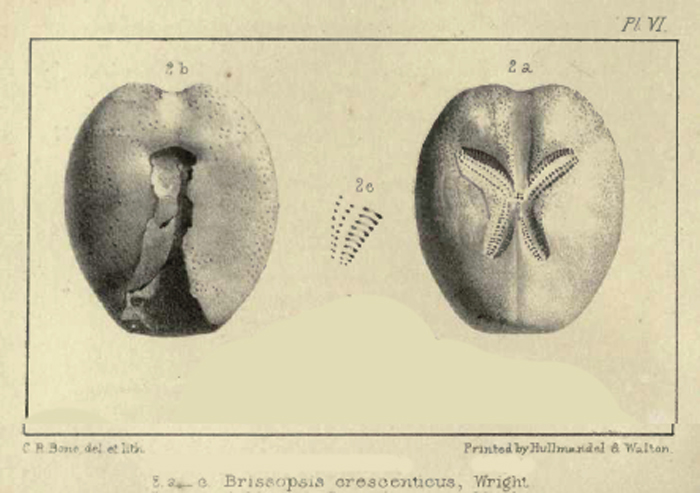
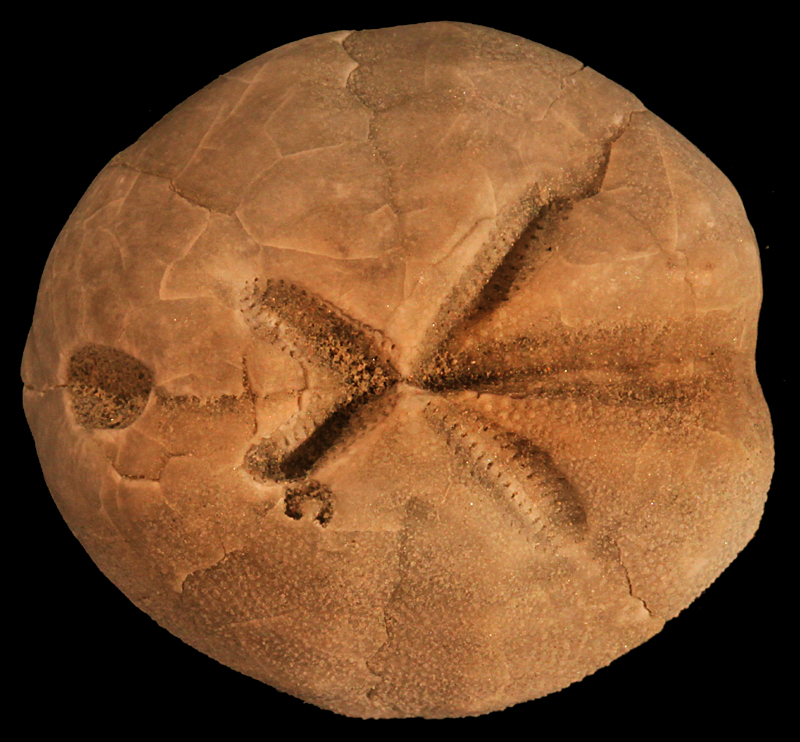
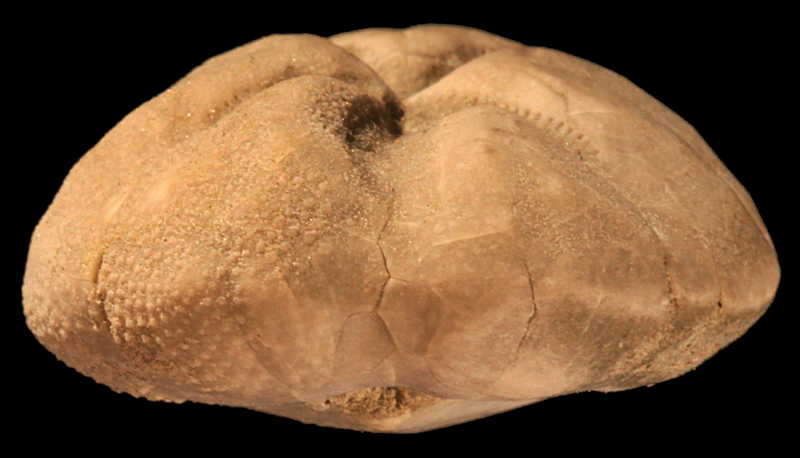
Brissopsis crescenticus (Wright, n. sp.). Pl. VI. fig. 2 a-c. Test oblong, rounded before and truncated behind ; flattened on the dorsal surface, and deeply indented by the ambulacral areas ; the ambulacrum forms and anteal sulcus ; the anterior and posterior ambulacra on each side form two lateral crescents that abut at the longitudinal line ; the antero-lateral pair are the longest and widest, they curve fowards and backwards, and the posterior pair curve backwards and forwards ; the anterior pair form an angle of 45°, the posterior pair an angle of 65° ; the apical disc lies in a depression formed by the confluence of the apices of all the ambulacra ; the posterior border is squarely truncated, with the anal opening in its upper angle ; the base is convex, with few tubercles and wide naked spaces formed ty the basal portions of the ambulacra ; the mouth is situated in the anterior third. Dimensions. - Antero-posterior diameter 1 6/10 inch, transverse diameter 1 4/10 inch, height 8/10ths of an inch. Description. - The most remarkable feature in this species consists in the mode of arrangement of the ambulacra ; the anterorior and posterior areas of each side curve in opposite directions and form crescents, the convexities of which are directed towards the middle line of the test, and give value to the name proposed. The antero-lateral pair form an angle of 45° ; they are about the same length as the posterior pair, but are a little broader and are more divergent : there are nineteen pars of holes in the external zone, and fourteen in the inner ; the posterior pair are nearly parallel with each other, and have a slight curve forwards to form the posterior horm of the crescent ; they are not so much developed as the anterior pair ; the external zone of holes contains fifteen pairs, but the inner zone (2c) is imperfectly developed, from their close approximation to those of the opposite area : the apical disc is small ; the four genital holes are large, the anterior pair being more closely approximated than the posterior pair ; it is situated nearer the anterior than the posterior border and lies in a confluent depression, in which the apices of all the areas freely converge. The single ambulacrum is rather longer, but not so wide as the anterior pair ; its lateral row of single holes, with their accompanying tubercles, are small and indistinctly seen, and it froms and inconsiderable anteal sulcus : the posterior border is |
squarely and obliquely truncated, and in its upper part near the dorsal surface is the large anal opening : the base is rather convex ; the sternal portion of the single interambulacrum is slightly prominent, and ornamented with a few rows of rather larger tubercles disposed in zigzag lines : the basal tracks of the ambulacral areas are entirely naked, and where they ternate around the mouth five petaloid poriferous radii are observed. The mouth, of moderate size, is in the anterior third ; the peripetal fasciole is narrow and indistinct ; the subanal fasciole is much broader, and remote from the anus, but the test is unfortunately broken in this region ; the tubercles are nearly all of the same size, but a few larger ones occupy the sides, front, and base. Affinities and differences. - The flatness of the dorsal surface, the deep depressions made by the petaloid portion of the ambulacral areas, and the double crescent formed by them, readily distinguish B. crescenticus from its congeners. So few fossil species of this genus have been figured or described, that we can only compare it with the other forms obtained from the same bed, from both of which it differs in many well-marked characters. Locality and stratigraphical position. - It was collected from bed No. 4, the calcareous sandstone at Malta, where it is rare. Planche VI (extrait)
|
|
|
http://coldb.mnhn.fr/catalognumber/mnhn/f/j01002 spécimen MNHN.F.J01002 crédit RECOLNAT (ANR-11-INBS004) Jocelyn FALCONNET Lambert,1915, p.173, pl.14, fig.4-6 |
|
|
|
|


|
Brissopsis crescenticus Wright,1854 - Helvétien, Logu Doru, Sardaigne, 37 mm |
,%20Italie,%2037%20mm.jpg) |
,%20Italie,%2037%20mm.jpg) |
,%20Italie,%2037%20mm.JPG) |
,%20Italie,%2037%20mm.JPG) |
,%20Italie,%2037%20mm.JPG) |
|
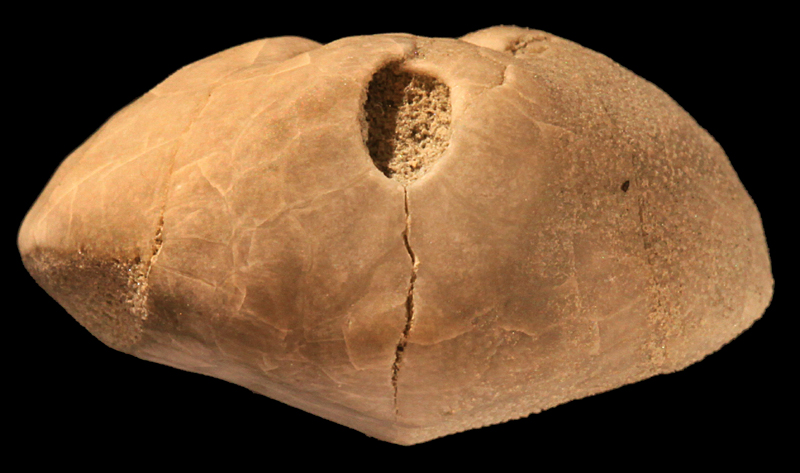
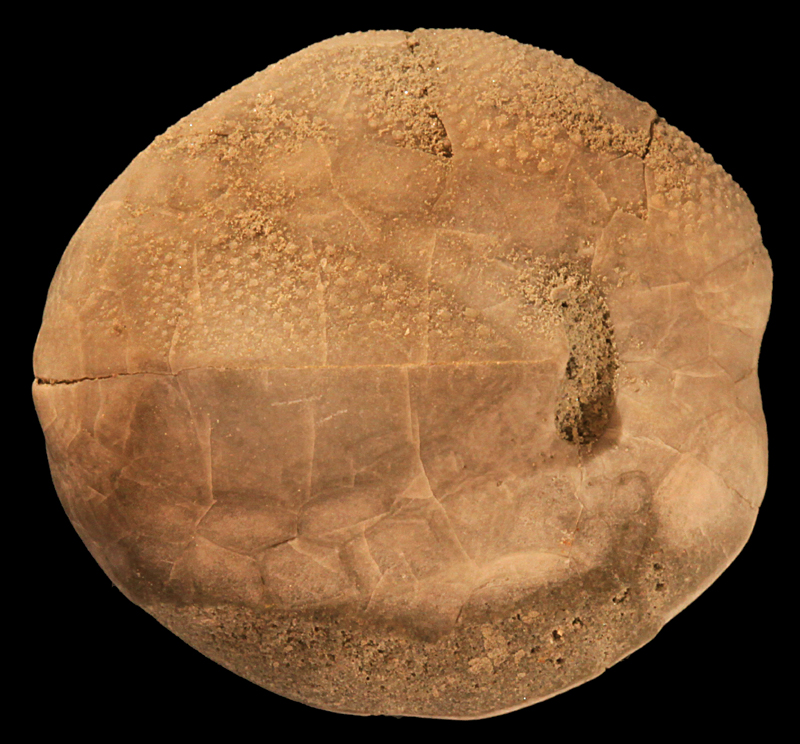
Brissopsis crescenticus Wright,1854 - Miocène, Sesimbra, Portugal, 30 mm |
 |
 |
 |
 |
|
Brissopsis crescenticus Wright,1854 - Lower Globigerina limestone, Gozo, Malte, 35 mm |
%20crescenticus%20Wright%201854,%20apical,%20Lower%20Globiderina%20limestone,%20Gozo,%20Malte,%2035%20mm.jpg) |
|
Brissopsis crescenticus Wright,1854 - Lower Globigerina limestone, Gozo, Malte, 23 mm |
 |
|
Brissopsis crescenticus Wright,1854 - Miocène, Florinas, Sardaigne, 34 mm |
 |
 |
 |
 |
 |
|
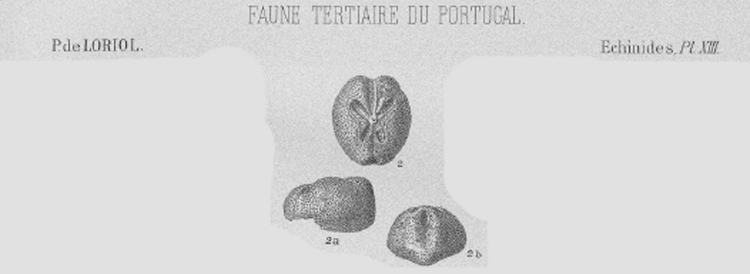
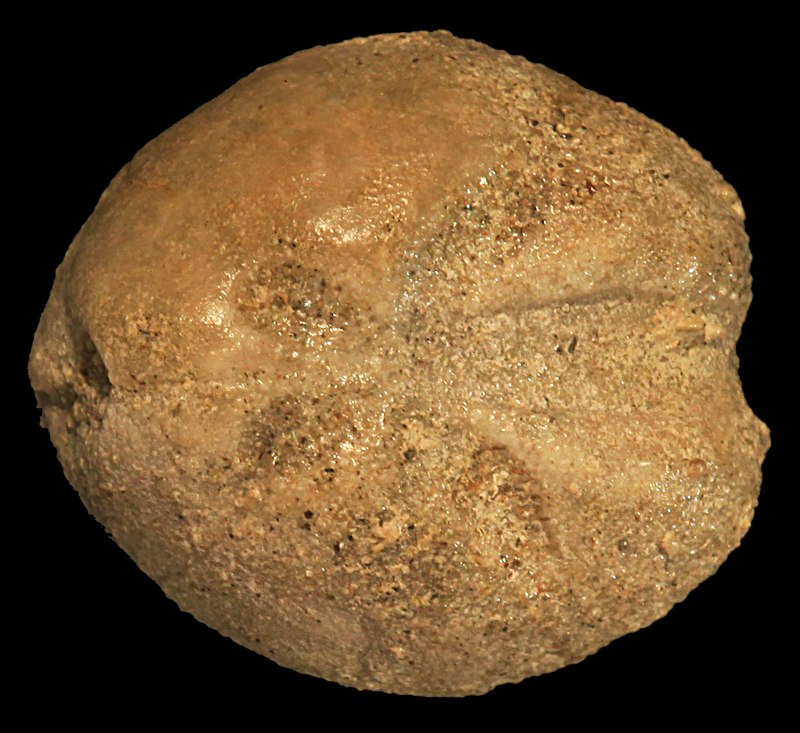
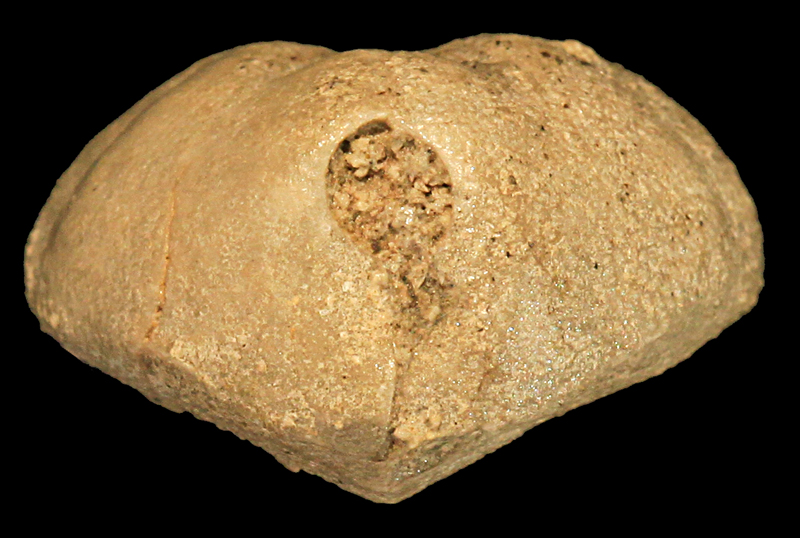
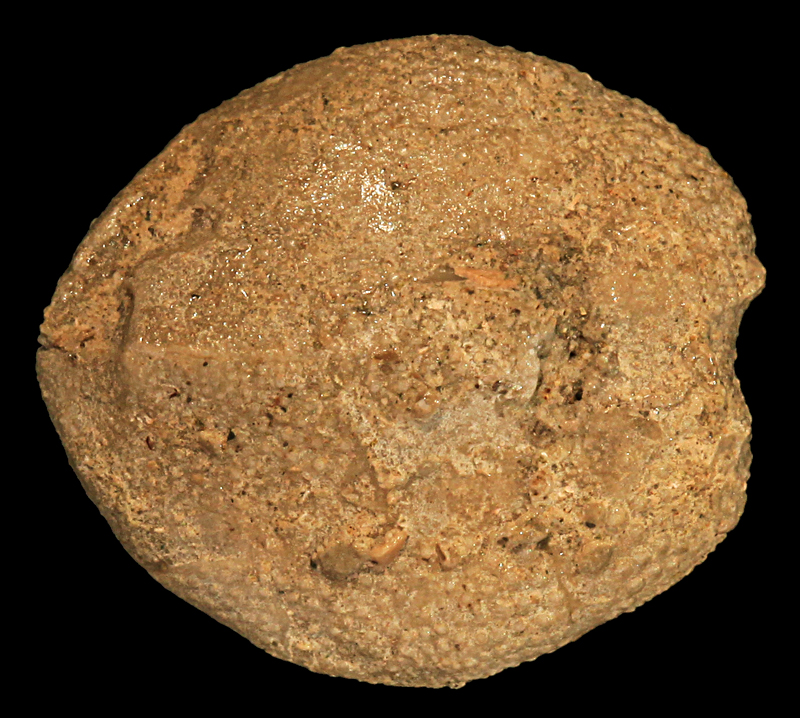
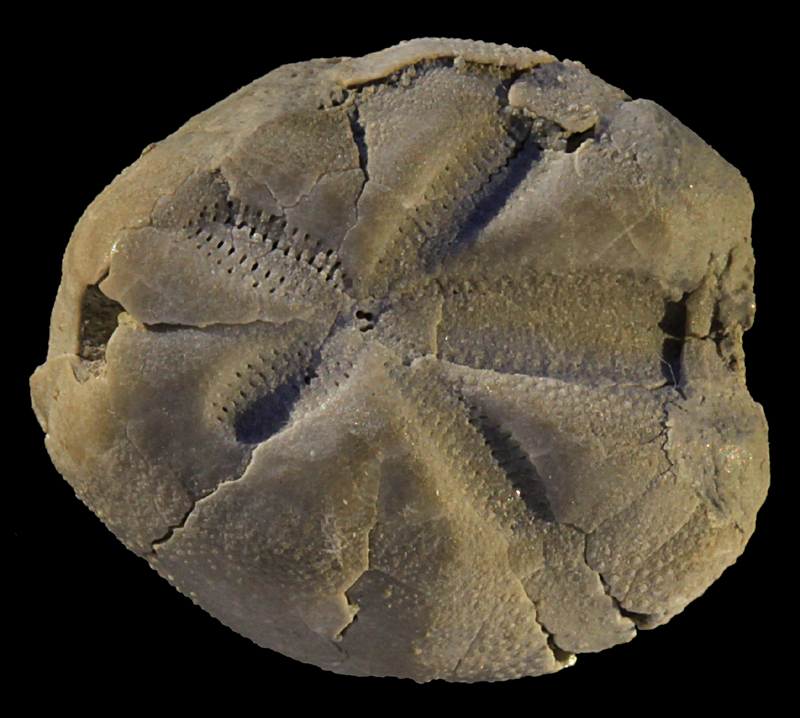
brissopsis lusitanicus, P. de Loriol, 1896 Pl. XIII, fig.2
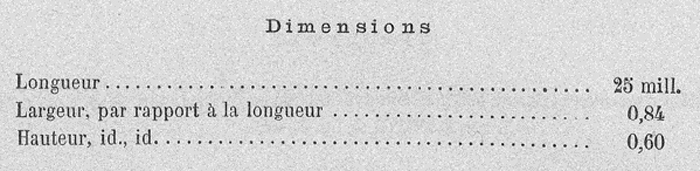
Test oblong, rétréci et échancré en avant, rétréci et tronqué verticalement sur la face postérieure. La plus grande largeur se trouve au milieu des aires interambulacraires postérieures paires. Face supérieure uniformément déclive en avant, à partir de l'extrémité de l'aire interambulacraire postérieure impaire, où se trouve l'apex. Face inférieure renflée sur le plastron. Pourtour très arrondi. Appareil apical presque central. Quatre pores génitaux bien ouverts, les deux antérieurs contigus. Le madréporide, très étroit d'abord, passe entre les deux pores génitaux postérieurs, et s'élargit en arrière en devenant pyriforme. Ambulacre impair court, composé de pores très petits; il est logé dans un sillon étroit mais rapidement et profondément creusé, puis affaibli près du pourtour qu'il échancre cependant assez fortement; ses parois sont presque abruptes. Ambulacres pairs spatutiformes, surtout les antérieurs, relativement courts, étroits, et très creusés. Les antérieurs, assez divergents, sont très faiblement arqués en dehors; les zones porifères antérieures ont 16 paires de pores, dont les sept premières sont atrophiées et presque invisibles, les zones postérieures ont là paires de pores bien ouverts. La largeur de la zone interporifère est égaie à la moitié de la largeur de l'une des zones porifères; celles-ci sont larges. Les ambulacres postérieurs sont un peu plus courts que les antérieurs, et plus rapprochés; leurs zones porifères sont droites; on compte, dans les zones antérieures, 14 paires de pores bien développées et une atrophiée; dans les postérieures, onze paires et deux ou trois atrophiées. Les ambulacres n'étant pas séparés au sommet par les aires interambulacraires, il en résulte un espace enfoncé, au milieu duquel se trouve l'appareil apical. Aires interambulacraires antérieures paires en forme de côte étroite et assez renflée vers les bords du sillon; les postérieures paires ne sont ni renflées ni gibbeuses vers leur sommet 'lui est plutôt déprimé, et forme un angle aigu; la postérieure impaire. très étroite, n'est nullement carénée. A la face inférieure, les avenues ambulacraires sont très larges et lisses. Le plastron, fort réduit, est élevé et renflé, de sorte que la face postérieure se trouve beaucoup plus élevée que la face antérieure. Je ne connais pas le péristome, le test étant détruit dans sa région. Le périprocte est grand, ovale, allongé, ouvert immédiatement au sommet de la face postérieure. Fasciole péripétale assez large; il traverse raire interambulacraire impaire à peu de distance du périprocte, puis serre de très près les ambulacres pairs; il s'allonge eu avant dans les aires antérieures, en se rapprochant du sillon antérieur par un fort sinus, et il le traverse en ligne droite assez près du pourtour. Le fasciole sous-anal, distinct par places seulement, entoure le talon en paraissant passer à mi hauteur de la face postérieure. |
Tubercules très petits et serrés sur la face supérieure, plus développés et plus écartés au pourtour, surtout en avant; ils sont gros et très écartés â la face inférieure. Rapports et différences.—Je ne, connais qu'un seul exemplaire, dans lequel, malheureusement, la région autour du péristome se trouve très altérée; il est, du reste, très bien conservé. Voisin du Brissopsis Borsoni, (Sismonda) Agassiz, il s'en distingue par son appareil apical central et non excentrique en arrière, son sinon antérieur plus étroit, ses ambulacres antérieurs pairs plus courts, formant, entre l'antérieur et le postérieur de chaque côté, un angle moins ouvert et plus aigu ; les antérieurs pairs sont aussi moins arqués en dehors, plus divergents, et à peine plus longs que les postérieurs ; les aires interambulacraires sont aussi moins saillantes. M. Pomel a décrit des espèces du miocène d'Algérie qui sont également voisines du Briss. Borsoni, mais n'ont, malheureusement, pas été figurées. Un examen attentif des descriptions ne m'a pas permis de reconnaître, parmi elles, l'espèce que je viens de décrire. Dans le Briss. Tissoti, Pomel, le sillon antérieur est large et évasé, les ambulacres sont larges et courts, les antérieurs rejetés en dehors, la forme générale est plus large, (0,94, au lieu de 0,8.1). Le Briss. Delagei, Pomel, est tronqué obliquement en arrière et non verticalement, le sillon antérieur est évasé, élargi en avant, le plastron est moins renflé. On ne peut confondre l'espèce du Portugal avec le Briss. Nicoleti, Desor. Localité. Grillos, près Lisbonne, (VI a). Planche XIII (extrait)
|
|
Brissopsis lusitanicus de Loriol,1896 - Langhien, Penedo, Portugal, 18 mm |
 |
 |
 |
|
Brissopsis lusitanicus de Loriol,1896 - Langhien, Sesimbra, Setubal, Portugal, 24 mm |
 |
 |
|
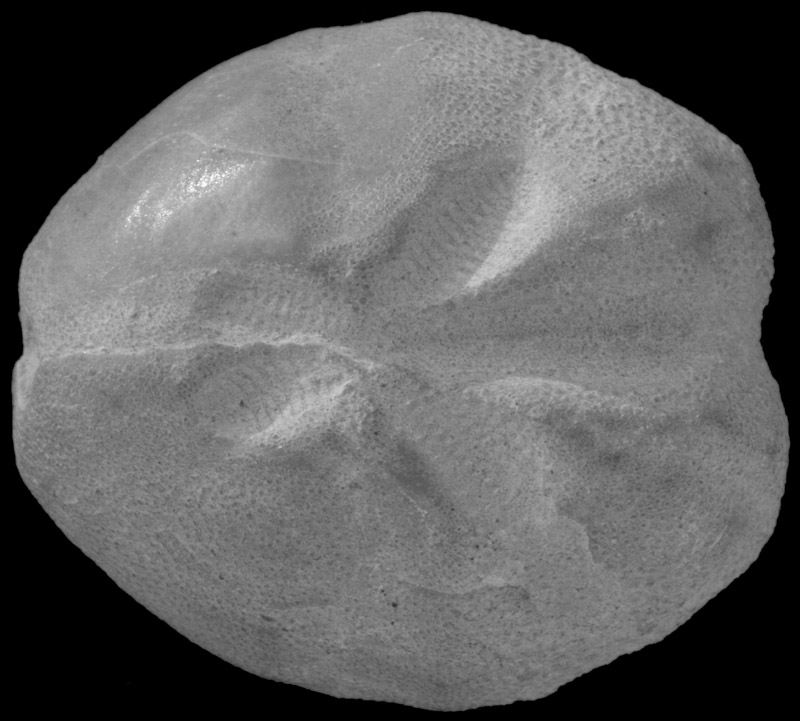
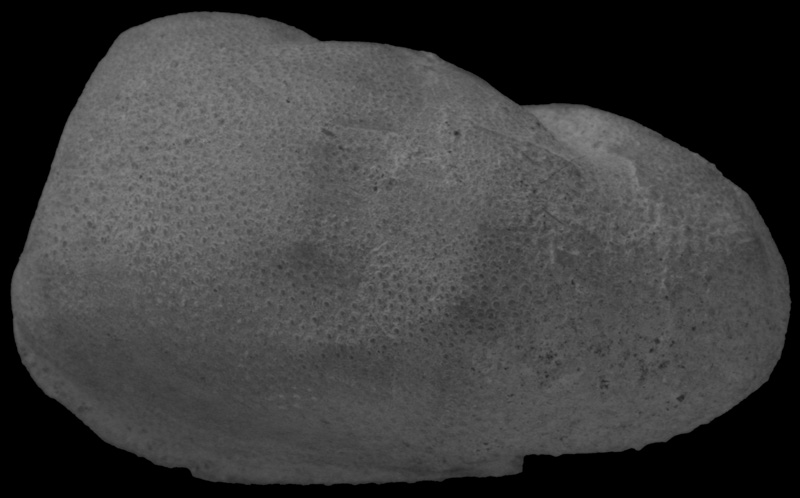
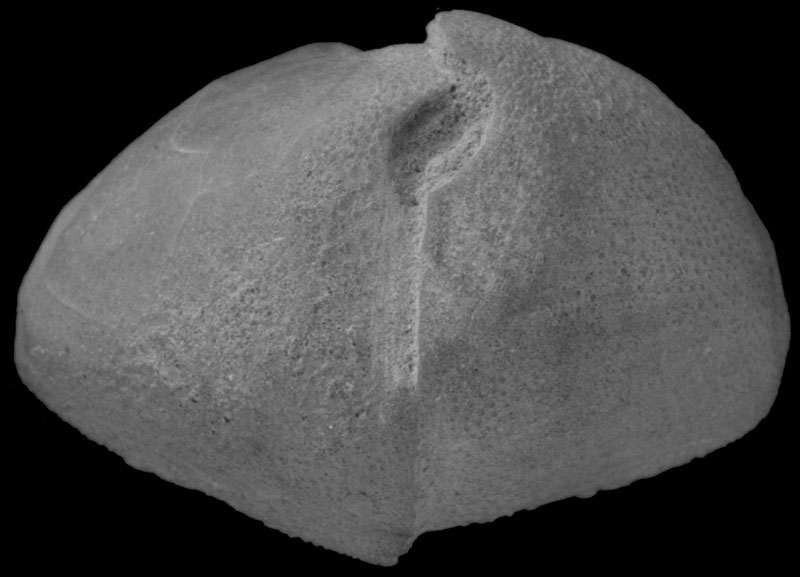
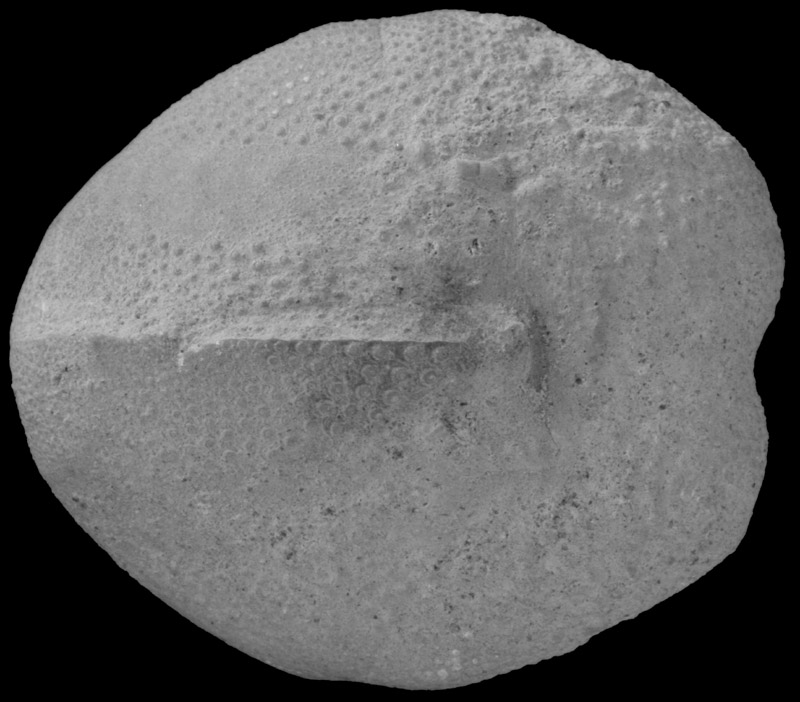
Brissopsis mediterranea Mortensen, 1913 - Miocène, Sesimbra, Portugal, 29 mm |
 |
 |
 |
 |
|
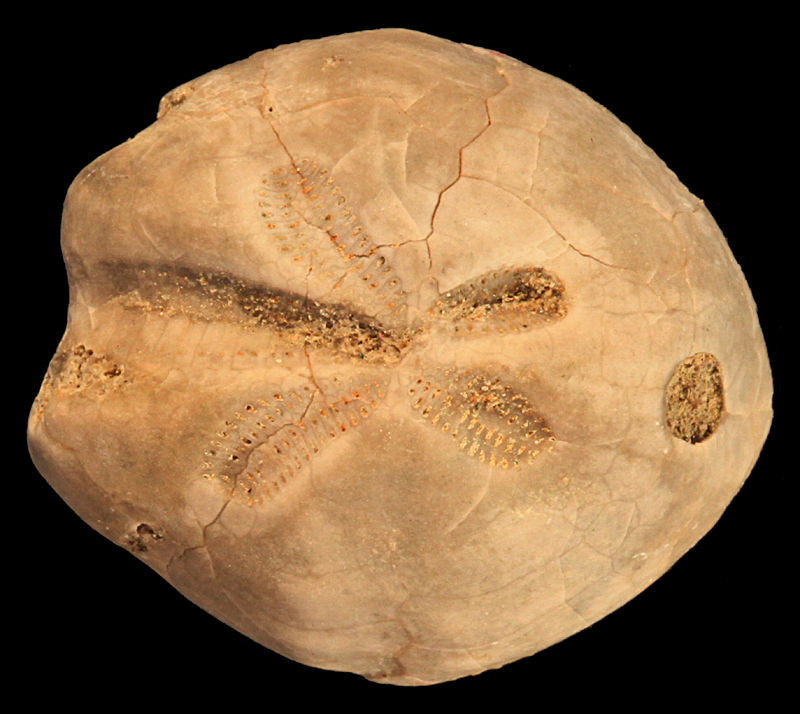
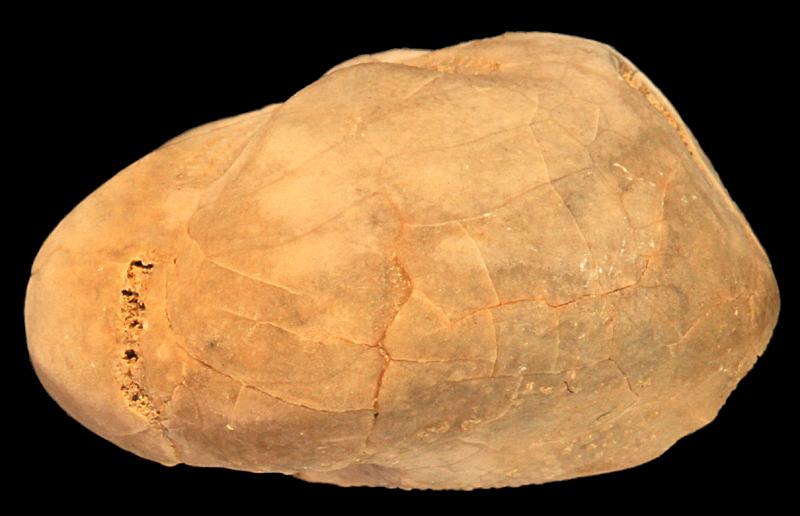
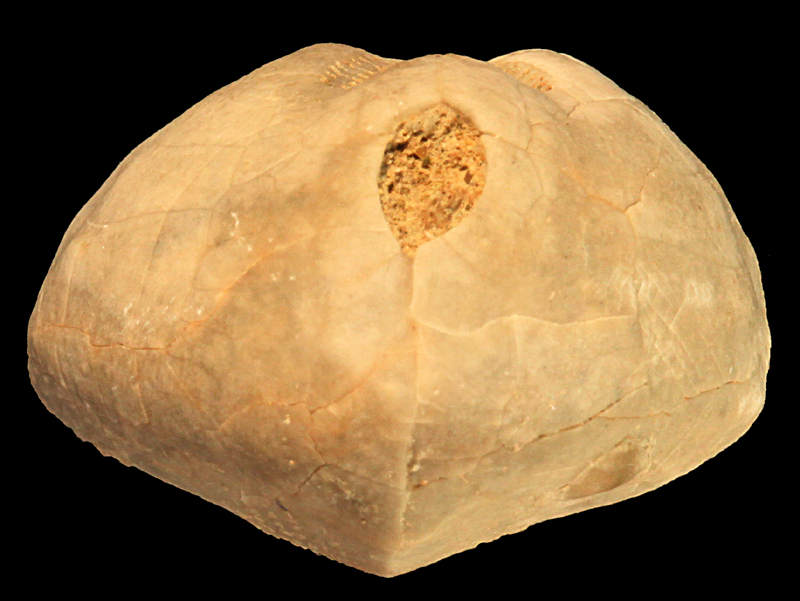
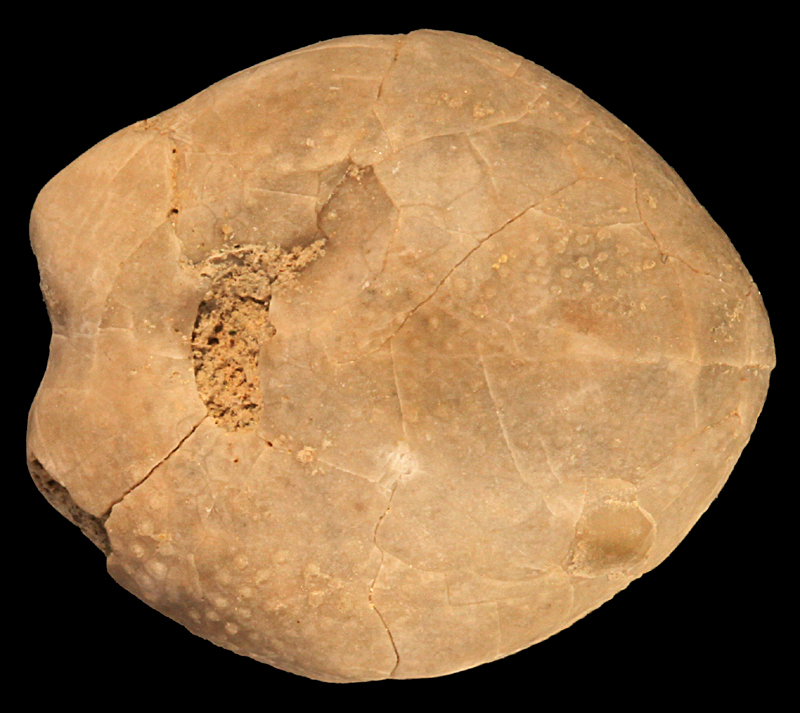
Brissopsis ottnangensis Hoernes,1875 - Miocène, Sesimbra, Portugal, 22 mm |
 |
 |
 |
 |