Cassidulidae
Agassiz l. in Agassiz l. & Desor, 1847, p.143
Genre type : Cassidulus, Lamarck, 1801, p.348
Description succincte de la famille : Système apical monobasal ou tetrabasal. Périprocte supramarginal à marginal, allongé ou transverse. Péristome transverse. Face orale plane. Bourrelets bien développés. Présence d'une zone granulaire nue sur interambulacre 5.



|
CASSIDULE (Cassidulus) Corps irrégulier, elliptique, ovale ou subcordiforme, convexe ou renflé, garni de très petites épines. Cinq ambulacres bornés et en étoile. Bouche subcentrale ; anus au-dessus du bord. Corpus irregulare, ellipticum, ovatum aut subcordatum, convexum vel turgidum, spinis exiguis obsidum. Ambulacra quinque, stellata, circumscripta. Os inferum, subcentrale, Anus suprà marginem. |
OBSERVATIONS. Les cassidules seraient des clypéastres, si elles n'avaient l'anus évidemment au-dessus du bord, et par là véritablement dorsal. Ceux des spatangues qui ont l'anus élevé dans le bord, pourraient être considérés comme ayant l'anus au-dessus du bord. Cependant ce serait à tort ; car, dans ces spatangues, l'anus est situé dans le haut d'une facette marginale, mais n'est pas réellement au-dessus du bord. C'est avec les nucléolites que les cassidules ont le plus de rapports, et peut-être devrait-on les réunir en un seul genre. Elles n'en diffèrent effectivement que par les ambulacres, lesquels sont bornés dans les cassidules, tandis que dans les nucléolites ils ne le sont pas. Mais sur les individus fossiles, il n'est pas toujours aisé de déterminer ce caractère des ambulacres. |
|
Genus CASSIDULUS Lamarck Cassidulus Lamarck, 1801. Système des animaux sans vertèbres, p.348. Type species by monotypy, Cassidulus cariboearum Lamarck. Synonym : Glossaster Lambert
generic description Small, low, elongate ; apical system monobasal, four genital pores ; petals slightly or well developed, straight, open or closing distally, poriferous zones of same petal usually unequal, ambulacral plates beyond petals single pored ; periproct supramarginal, longitudinal or transverse, with groove extending from opening to posterior margin ; peristome anterior, pentagonal, transverse ; bourrelets well developed ; phyllodes widened, single pored with slight crowding of pores, one or two or no occluded pores ; buccal pores present ; adorally, tubercles much larger, scrobicules often polygonal, with bosses eccentric anteriorly ; adorally, naked, often pitted area in terterambulacrum 5, ambulacrum III. Comparison with other genera. - Cassidulus is very similar to Rhynchopygus but differs in having a monobasal apical system as opposed to the tetrabasal system in Rhynchopygus. As Cassidulus occurs later, in the Tertiary, whereas Rhynchopygus is from the Upper Cretaceous, and since Cassidulus has a more advanced apical system, there is little doubt that it is descended from Rhynchopygus. Cassidulus differs from Rhyncholampas in having a smaller, more elongate test, narrower, nonlanceolate petals, a usually less posterior periproct, and phyllodes with fewer pores. It differs from Hypsopygaster in having more developed petals and less pointed bourrelets. Remarks. - This genus includes most of the Tertiary species that Lambert and Thiery referred to their Procassidulus, except for Twitchell's Cassidulus depressus, which Cooke (1959, p.64) considers a synonym of Eurhodia patelliformis (Bouve), Desor's Cassidulus amygdala, which also appears to be a Eurhodia, and Kew's Cassidulus mexicanus, which is a Rhyncholampas. Many of the pre-Tertiary species that Lambert and Thiery refer to Procassidulus, including the type species, have a tetrabasal apical system and |
should be referred to Rhynchopygus. All the Tertiary species that they refer to Rhynchopygus, except R. dyasteroides Duncan, have monobasal apical systems and should be referred to Cassidulus. Cooke (1959, pp.56-59) refers four species to Cassidulus (Cassidulus), but three of them, C. sabistonenis Kellum, C. gouldii (Bouve), and C. ericsoni Fischer, are very large, have well-developed phyllodes, and probably should be referred to Rhyncholampas. The fourth, C. trojanus is small but has more developed phyllodes than are usually found in Cassidulus. This species, like several others, has characters of both Cassidulus and Rhyncholampas and cannot be referred devinitely to either. These intermediate forms blur the distinction between the two genera. There are three American west coast species that belong to Cassidulus : C. ellipticus Kew, C. californicus Anderson, and C. ynezensis Kew. I have tudied all the type specimens of theses species, which are in the Museum of Paleontology at Berkeley, Calif. The two cotypes of Cassidulus ellipticus Kew are both poorly preserved, but the specimen figured in Kew's (1920) plate 39, figure 3a, c, d, shows the adapical surface and is herein designated the lectotype. The phyllodes are not visible on either of these specimens, but from the small size of the low and very elongated test, supramarginal, transverse periproct, and monobasal apical system this species should be referred to Cassidulus. The neotype of Cassidulus californicus Anderson also should be referred to Cassidulus. Althrough the specimen is poorly preserved, enough of one ot the phyllodes is visible to see that it is very simple, with only one pore occluded in each haf-ambulacrum. The test is small and elongate, and the apical system is monobasal. The specimen figured by Grant and Hertlein (1938, pl.4, fig.7 ; pl.30, fig.7) is wrongly referred by them to C. californicus. It differs from the latter in having a much larger, more inflated test, strongly lanceolate petals with more unequal poriferous zones in each petal, more anterior apical system, more marginal periproct lacking and adapical overhang, a less depressed peristome, and less developed bourrelets. Apparently it is a new pecies of Rhyncholampas. Kew's Cassidulus ynezensis is represented by one very poorly preserved specimen which is slightly crushed, with a large part of the adapical surface missing, and so badly weathered that no details are discernible of the phyllodes. Kew referred this species to Rhynchopygus, but since it has a monobasal apical system, it is a Cassidulus. Grant and Hertlein (1938, p.109) consider C. ynezensis as a synonym of C. californicus, but the two species are quite distinct. C. ynezensis is larger, lower, with sharper margin, smaller peristome, and narrower petals. Range and distribution. Range and distribution. - Eocene to Recent of worldwide distribution. |
Certains auteurs (Carter & Beisel par exemple) ont changé le genre de certaines espèces, les rangeant alors plutôt dans Eurhodia (cas C. trojanus), nous ne suivons pas cette opinion

|
Cassidulus (Rhynchopygus?) evergladensis Mansfield, n. sp. Plate 18, Figures 1-10 Test large, suborbicular, and moderately high; upper surface convex and broadly rounded, the posterior surface more gently inclined than the anterior; lower surface nearly flat except in the area surrounding the peristome, where it is shallowly concave. Apical system, situated opposite the peristome, is rather large, granular, and slightly elevated; so far as revealed, a genital pore is at the juncture of the petals and a smaller radial pore is opposite each petal. Ambulacral areas petaloid at dorsal portions. Petals rather long, extending nearly to the ambitus, expanding to about one-third their length from the apical system, then gradually contracting distally, and nearly closing at their extremities; poriferous zones rather wide, shallowly depressed; pores nearly equal in size and rounded in outline; pairs of pores conjugate. Interporiferous areas weakly tumid. Posterior interambulacrum weakly medially arched. Periproct rather large, longest transversely; supramarginal, the lower margin being about 4 millimeters above the ambitus; the upper arched margin slightly overhangs the aperture. Peristome excentric anteriorly, pentagonal, transversely elongate, and surrounded by a large welldefined floscelle with prominent bourrelets. The outer pores of the floscelle are more direct and more regularly placed; the inner ones are more irregularly placed and some of them are arranged in two rows. The surface of the test is closely set with scrobiculate tubercles. Dimensions: Cotypes (catalogue No. 371329, U. S. Nat. Mus.): Larger slightly crushed cotype with preserved periproct, length, 73 millimeters; width, 74 millimeters; height, 29 millimeters. Smaller cotype (posterior end broken off), width, 57 millimeters; height, 32 millimeters. Paratype (catalogue No. 371330, U. S. Nat. Mus.), length, 75 millimeters (posterior end broken) ; width, 64 millimeters; height, 35 millimeters. |
Occurrence: Station 1/1177, Tamiami Trail, 5 miles east of Carnestown and about 7 miles northeast of Everglades, Collier County, Fla. (type locality); station 1/1179, Tamiami Trail, 9 miles west of Pinecrest (sec. 13, T. 54 S., R. 32 E.), Monroe County, Fla. (paratype locality). Near Moore Haven, Glades County, Fla.; probably dredged from the canal. Only one fairly well preserved specimen, which was embedded in limestone, has been collected near Moore Haven; it is in the collection of the Florida Geological Survey. Cassidulus evergladensis resembles, in a general way, the figured type of Cassidubus (Pygorhynchus) alah bamensis Twitchell,20 a species collected at the Natural Bridge, St. Stephens, Washington County, Ala., but the lower surface of the test of that species is more concave longitudinally, and the periproct is at a greater distance above the ambitus. The same authors 21 refer the " St. Stephens limestone" (upper part) to the lower Oligocene. Planche 18 (extrait)
|

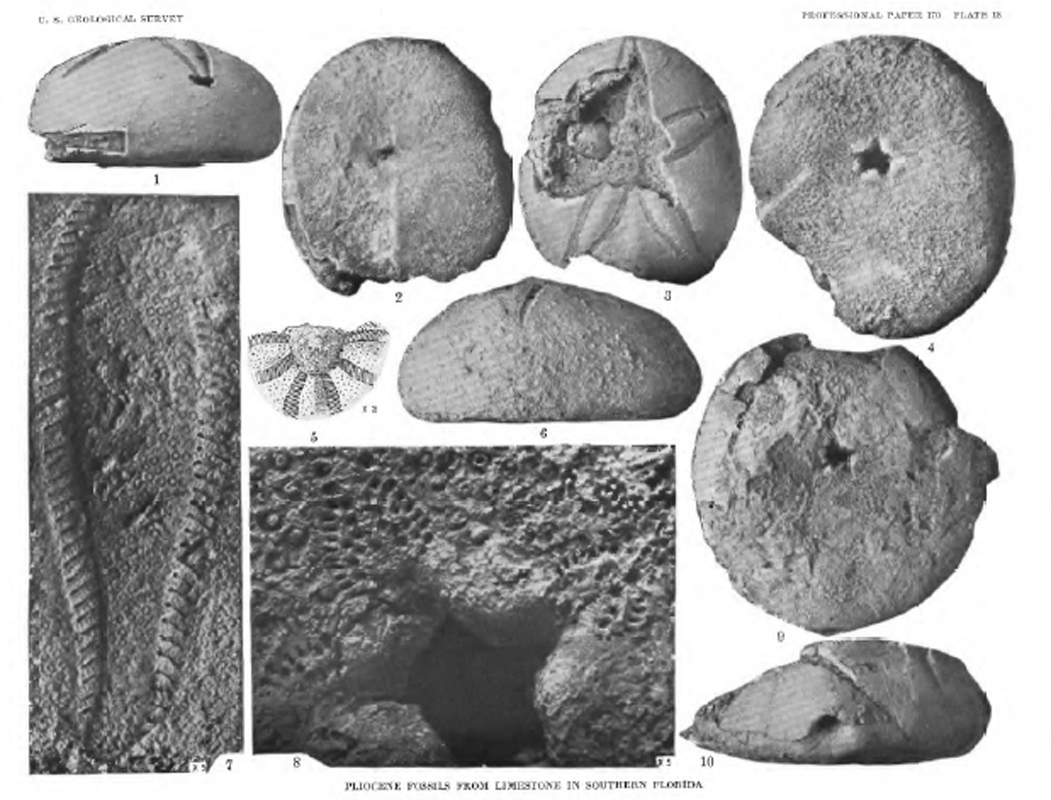
Cassidulus evergladensis (MANSFIELD,1932) - Miocène, Tamiami Fm, Comté de Charlotte, Floride, U.S.A., 82 mm |
 |
 |
 |
diagnose originale de l'espèce par Cotteau
Echinides fossiles des Pyrénées, in Leymerie & Cotteau
|
N° 38. Cassidulus ovalis, Cotteau, 1856. Espèce oblongue, ovale, légèrement renflée en dessus, subconcave en dessous, arrondie en avant, tronquée obliquement en arrière. Sommet excentrique en avant. Tubercules petits, serrés, plus développés près des pores buccaux. Anus supramarginal. Bouche s'ouvrant dans une dépression de la face inférieure, rapprochée du bord antérieur et |
correspondant au sommet. - Voisine par sa taille du C. lapis cancri, cette espèce s'en distingue par sa forme plus renflée, plus ovale, tronquée moins obliquement en arrière, par sa face inférieure plus déprimée au milieu. Boussan (Haute-Garonne). Coll. Leymerie
|
description de l'espèce par Cotteau
Paléontologie française, terrains éocènes, tome 1, p.519
|
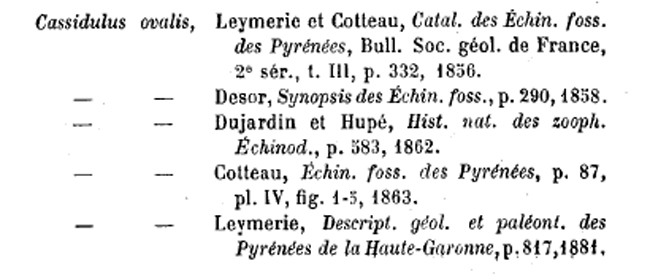
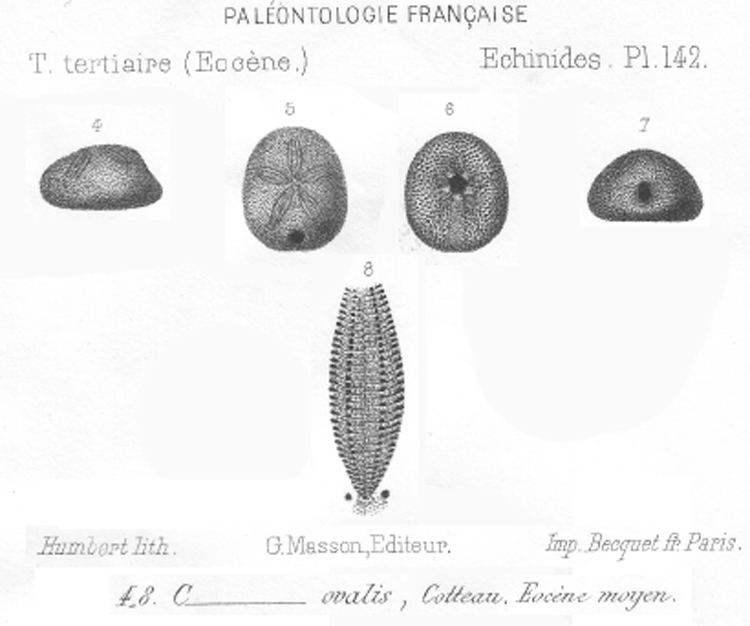
N° 132. - Cassidulus ovalis, Cotteau, 1856. Pl. 142, fig. 4-8
Espèce de petite taille, oblongue, ovale, légèrement renflée en dessus, subconcave en dessous, arrondie en avant. Aires ambulacraires sensiblement pétaloïdes. Zones porifères composées, à la face supérieure, de pores très inégaux, les internes ovales, subcirculaires, les externes obliques, allongés et unis aux premiers par un sillon. Un peu au-dessous de l'ambitus, les pétales ambulacraires s'interrompent brusquement ; les pores deviennent simples, beaucoup plus petits, sont disposés par paires obliques et disparaissent au milieu des tubercules ; ils se montrent de nouveau près du péristome et forment un floscelle très apparent. Tubercules crénelés, scrobiculés, très petits en dessus, augmentant de volume à la face inférieure qui présente, dans le sens du diamètre antéro-postérieur, une bande dépourvue de tubercules, marquée çà et là de petites dépressions irrégulières. Péristome un peu excentrique en avant, allongé, entouré de cinq bourrelets saillants, alternant avec les phyllodes porifères. Périprocte supramarginal, ovale, correspondant à une dépression assez sensible du test. Appareil apical subpentagonal, remarquable par la grandeur de la plaque madréporiforme ; plaques génitales, au nombre de quatre, largement perforées. Hauteur, 10 millimètres ; diamètre antéro-postérieur, 17 millimètres ; diamètre transversal, 15 millimètres. |
Rapports et différences. - Cette espèce se distingue nettement de ses congénères et notamment du C. lapis-cancri, par sa forme plus renflée, plus ovale et tronquée moins obliquement, par son périprocte allongé, par sa face inférieure plus déprimée. Localité. - Boussan (Haute-Garonne). Eocène moyen. Musée de Toulouse (Coll. Leymerie). Explication des figures. - Pl. 142, fig. 4, C. ovalis, vu de côté ; fig. 5, face supérieure ; fig. 6, face inférieure ; fig. 7, face postérieure ; fig. 8, aires ambulacraire antérieure grossie. Ces cinq figures sont copiées dans les Echinides des Pyrénées, pl. IV, fig. 1-5. Planche 142 (extrait)
|
Cassidulus ovalis (Cotteau,1856) - Illerdien, Huesca, 22 mm |
,%20apical,%20Huesca,%20Espagne,%20Illerdien,%2022%20mm.JPG) |
,%20amb,%20Huesca,%20Espagne,%20Illerdien,%2022%20mm.JPG) |
,%20periprocte,%20Huesca,%20Espagne,%20Illerdien,%2022%20mm.jpg) |
,%20oral,%20Huesca,%20Espagne,%20Illerdien,%2022%20mm.jpg) |
Cassidulus ovalis (Cotteau,1856) - Lutétien, Aspe, Alicante, Espagne, 36 mm |
,%20apical,%20Lutetien,%20Aspe,%20Alicante,%20Espagne,%2036%20mm.JPG) |
,%20Lutetien,%20Aspe,%20Alicante,%20Espagne,%2036%20mm.JPG) |
,%20periprocte,%20Lutetien,%20Aspe,%20Alicante,%20Espagne,%2036%20mm.JPG) |
,%20oral,%20Lutetien,%20Aspe,%20Alicante,%20Espagne,%2036%20mm.JPG) |
description de l'espèce par Cooke,1959
Cenozoic echinoids from Eastern United States, p.58
|
Cassidulus
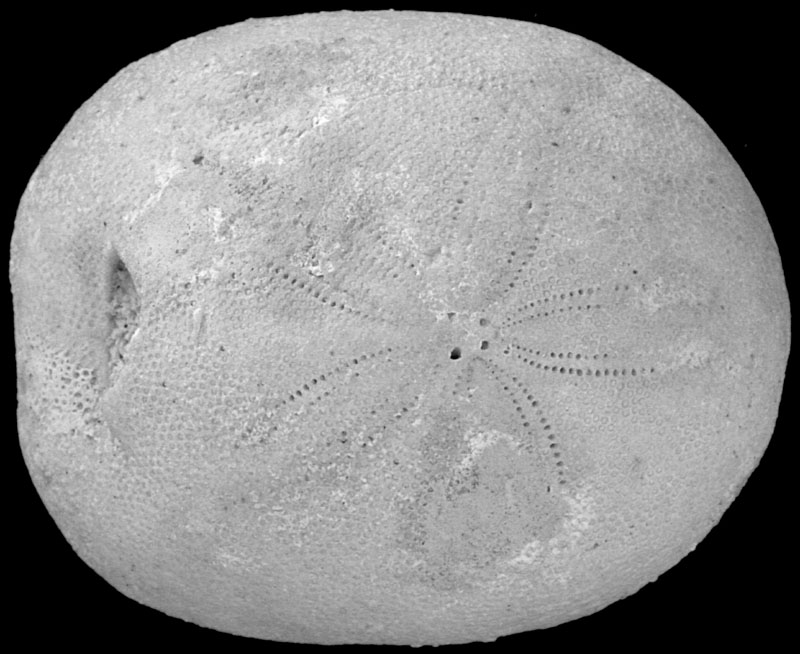
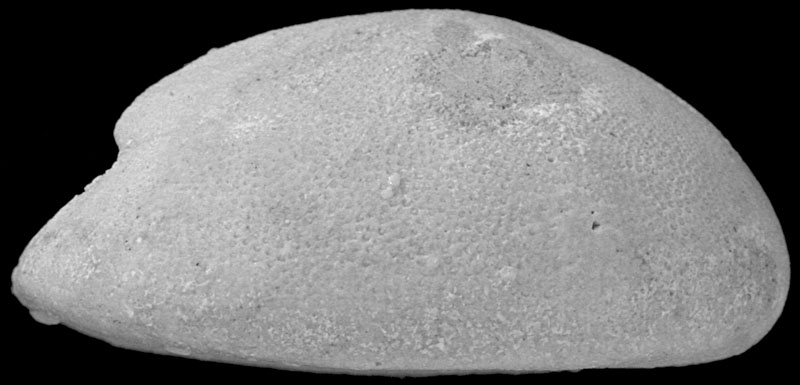
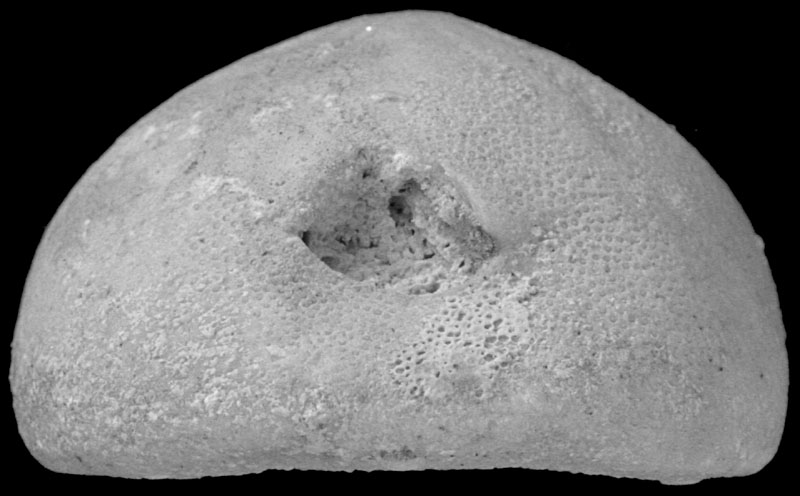
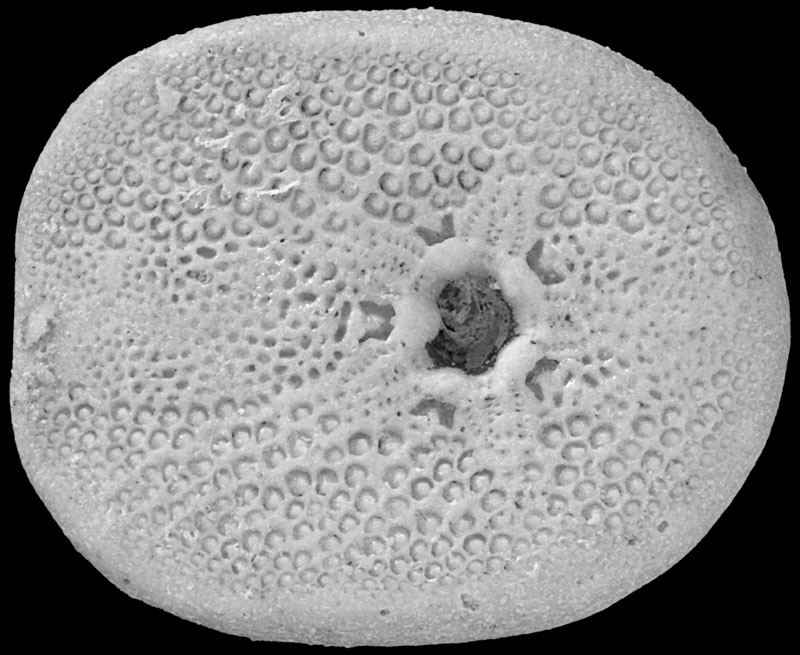
trojanns Cooke Cassidulus (Cassidulus) trojanus Cooke, 1942, Jour. Paleontology, v. 16 no. 1, p. 32, p1.2, figes 22-25. Outline subquadrate, wider behind than in front. Upper surface moderately inflated except behind the periproct, where there is a broad, shallow sulcus; rostrate above the periproct. Lower surface flat. Margin sente. Apical system slightly eccentric anteriorly; four genital pores; madreporite central. Petals lanceolate, of nearly equal length, extending somewhat more than halfway to the margin, open at the distal ends; pores round or oval; interporiferous zones wider than poriferous zones; outer poriferous zones of paired petals longer than the inner. Peristome farther forward than the apical system, pentagonal, slightly wider than long. Oral lobes swollen. Phyllodes about as long as the diameter of the peristomial opening. Periproct supra-marginal, transversely elliptical, flush, about one-third the way from the margin to the apex. Upper surface finely granulated between small tubercles; tubercles on lower surface much larger than on the upper, deeply sunken eicept on the margin, where they are much smaller. Longitidunal median band on base moderately vide, deeply pitted, Length 25.4 mm; width 22 mm.; height 11.4 mm. Occurrence.-Florida : Suwannee River below Troy Springs, Lafayette County (USGS 7347, type, C. W. Cooke). Suwannee River at Dowling Springs, Suwannee County (USGS 7338, C. W. Cooke). Road to Dowling Park 5 miles northwest of Mayo |
(USGS 11114, C. W. Cooke and Stuart Mossom). Perry road 5.2 miles west of Mayo (USGS 14537, C. W. Cooke). East aide of Steinhatchee River in Dixie County opposite Clara (USGS 12747, W. C. Mansfield and G. M. Ponton) ; USGS 14158, W. C. Mansfield and C. W. Mumm). 12 miles north o! Marianne (USGS 14182, W. C. Mansfield and C. W. Mumm). Taylor County rock pit near Mayo, Suwannee County (USGS 16913, G. M. Ponton). Suwannee River opposite Dowling Park (USGS 14003, W. C. Mansfield and F. S. MacNeil). Georgia : Miller County about 1 mile southeast o! Joe Shingler and about 5 miles west of Colquitt (USGS 8287, C. W. Cooke). Spring Creek at Colquitt (USGS 10168, C. W. Cooke and T. M. Prettyman.) Geoiogic unit.-Late Eocene, ()cala limestone. Type.-USNM 498996, from USGS 7347. Comparison.- Cassidulus trojanus is proportionately longer and narrower than C. gouldii, the peristome is smaller, and the petals are narrower. The petals are narrower than those of C. sabistonentis, the size is much smaller, and the periproct is farther forward. Planche 24 (extrait)
|

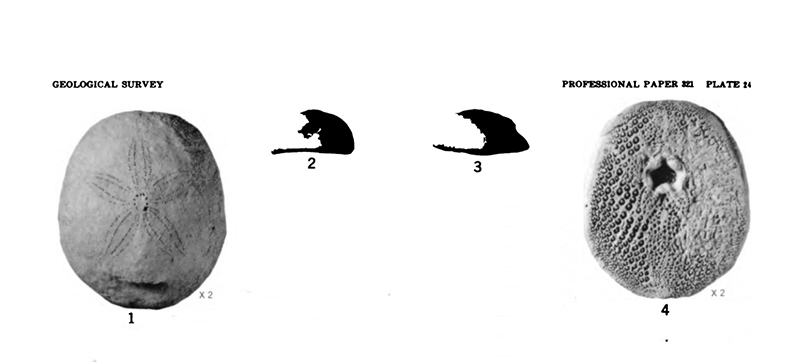
transfered in Eurhodia (Eurhodia trojana (Cooke,1942)) by Carter & Beisel (1987)
Cassidulus trojanus Cooke, 1942 - Eocène supérieur, Hernando Cty, Floride, 28 mm |
 |
 |
 |
 |
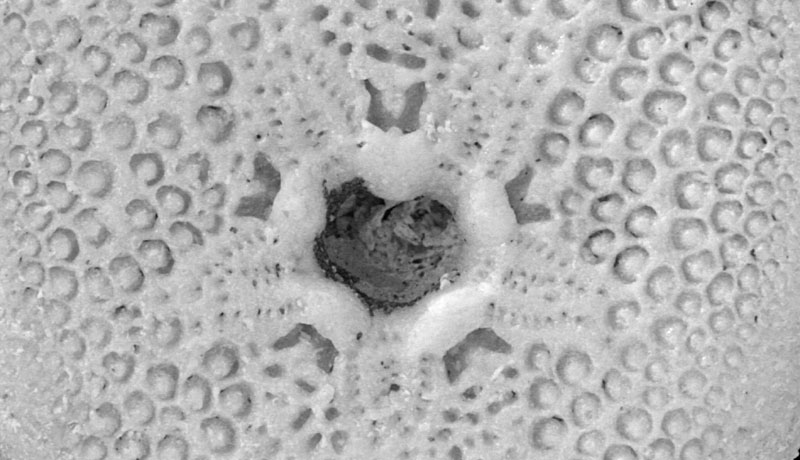 |
,%20apical,%20Eocène%20moyen,%20Lutétien,%20Finestrat,%20Alicante,%20Espagne,%2030%20mm.jpg) |
,%20ambital,%20Eocène%20moyen,%20Lutétien,%20Finestrat,%20Alicante,%20Espagne,%2030%20mm.JPG) |
,%20periprocte,%20Eocène%20moyen,%20Lutétien,%20Finestrat,%20Alicante,%20Espagne,%2030%20mm.JPG) |
,%20oral,%20Eocène%20moyen,%20Lutétien,%20Finestrat,%20Alicante,%20Espagne,%2030%20mm.JPG) |
Cassidulus santolayae (Sillero in Santoloya & Sillero,1994) - Lutétien, Aspe, Alicante, Espagne, 20 mm |
,%20apical,%20Lutetien,%20Aspe,%20Alicante,%20Espagne,%2020%20mm.JPG) |
,%20ambital,%20Lutetien,%20Aspe,%20Alicante,%20Espagne,%2020%20mm.JPG) |
,%20periprocte,%20Lutetien,%20Aspe,%20Alicante,%20Espagne,%2020%20mm.JPG) |
,%20oral,%20Lutetien,%20Aspe,%20Alicante,%20Espagne,%2020%20mm.jpg) |
description de l'espèce par Desor
Synopsis des échinides fossiles, 1858, p.290
| Amygdala Desor Actes de la Soc. helv. de sc. nat. 1853, p.277. - Grande espèce très allongée , tout d'une venue, uniformément convexe en-dessus. Sommet ambulacraire légèrement excentrique en avant. Périprocte allongé, sans bourrelets. Péristome grand, à bourrelets très apparents, dépourvus de tubercules. |
Terr. nummulitique de Blang
près d'Yberg (Canton de Schwytz). Rare. Mus. Zurich.
|
Eurhodia amygdala (Desor, 1863) - Eocène, Aspe, Alicante, Espagne, 23 mm |
,%20apical,%20Aspe,%20Alicante,%20Espagne,%2023%20mm.jpg) |
,%20amb,%20Aspe,%20Alicante,%20Espagne,%2023%20mm.JPG) |
,%20periprocte,%20Aspe,%20Alicante,%20Espagne,%2023%20mm.jpg) |
,%20oral,%20Aspe,%20Alicante,%20Espagne,%2023%20mm.JPG) |
Eurhodia amygdala (Desor, 1863) - Eocène, Aspe, Alicante, Espagne, 21 mm |
,%20apical,%20Eocene,%20Aspe,%20Alicante,%20Espagne,%2021%20mm.JPG) |
,%20ambital,%20Eocene,%20Aspe,%20Alicante,%20Espagne,%2021%20mm.JPG) |
,%20periprocte,%20Eocene,%20Aspe,%20Alicante,%20Espagne,%2021%20mm.JPG) |
,%20oral,%20Eocene,%20Aspe,%20Alicante,%20Espagne,%2021%20mm.jpg) |
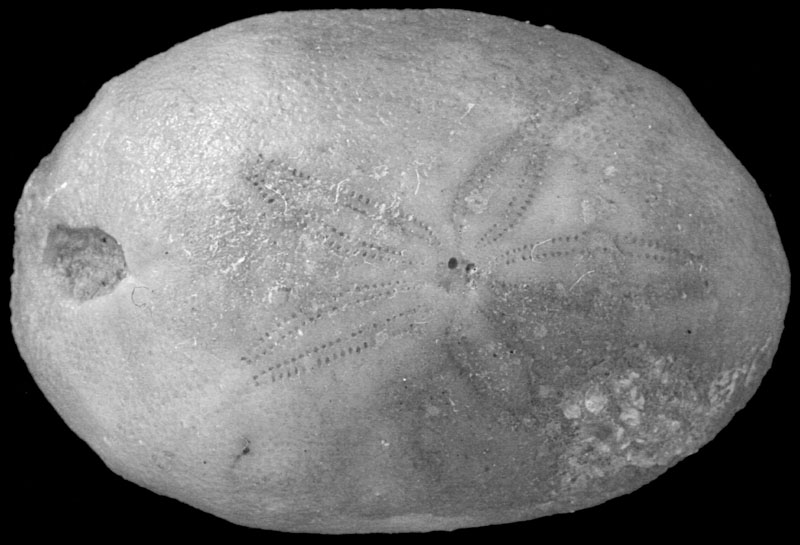
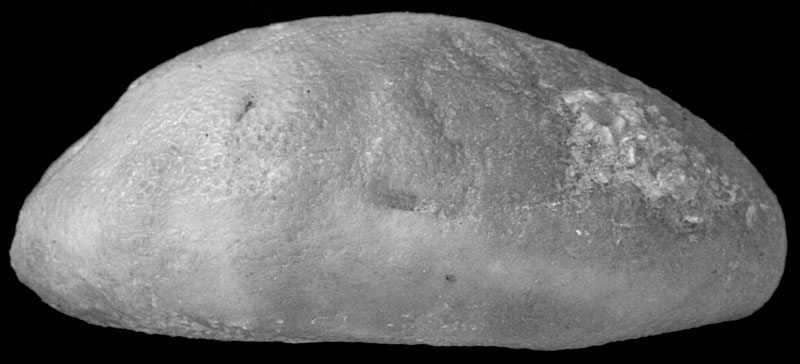
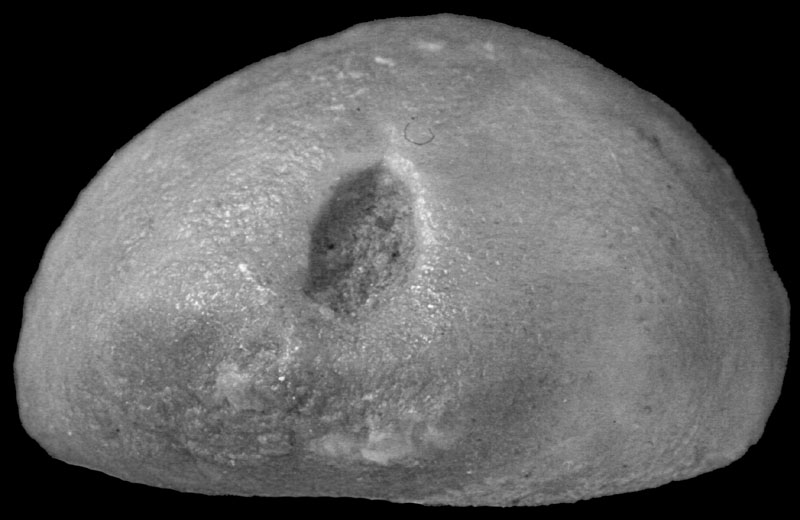
Eurhodia amygdala (Desor, 1863) - Eocène, Alicante, Espagne, 25 mm |
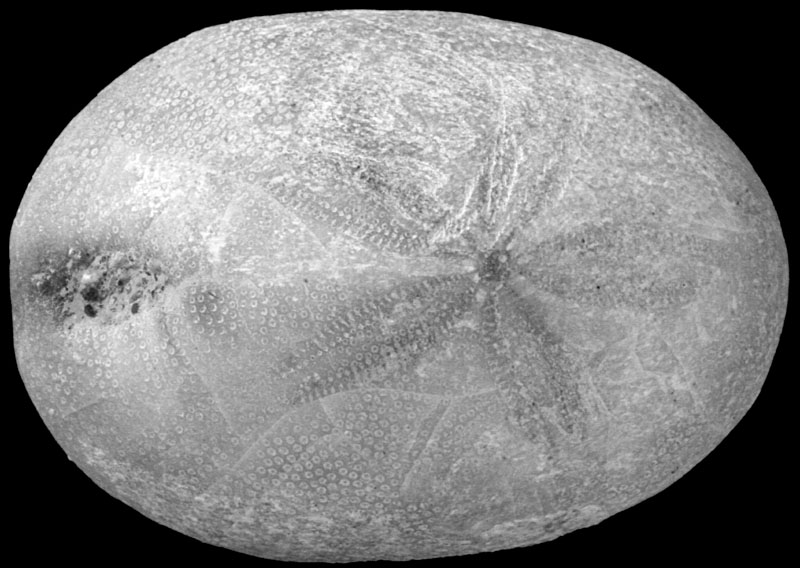 |
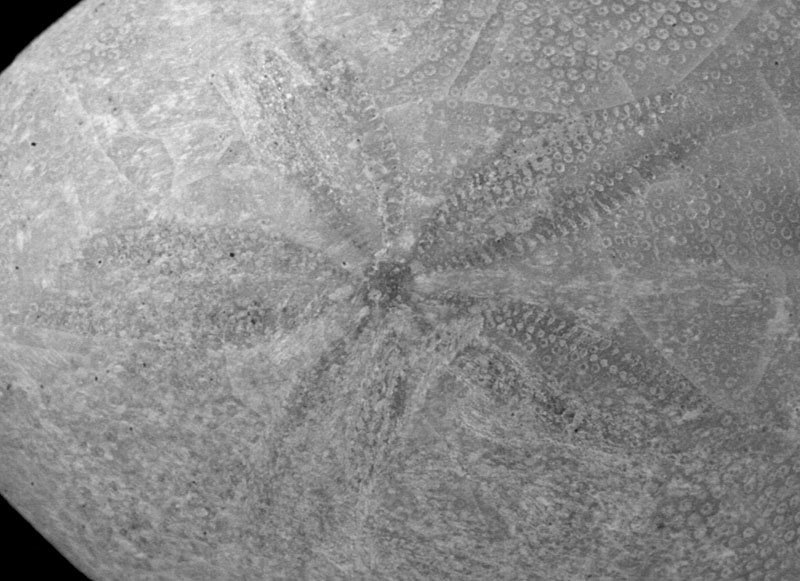 |
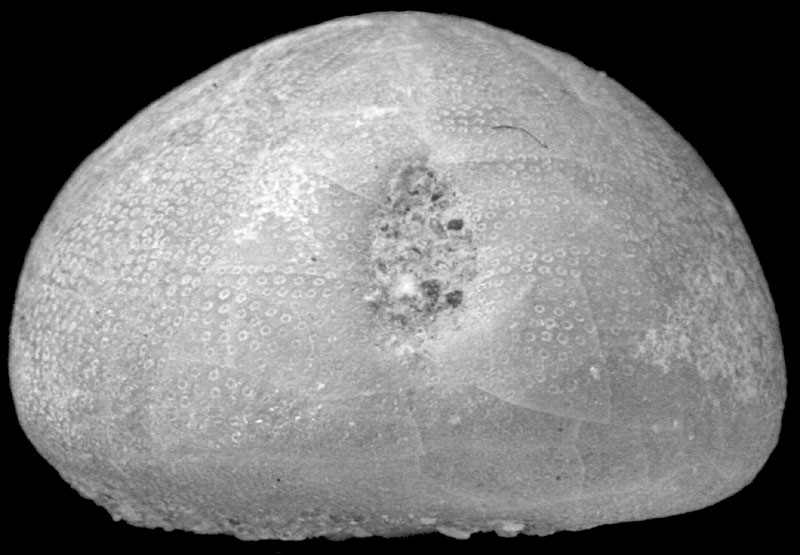 |
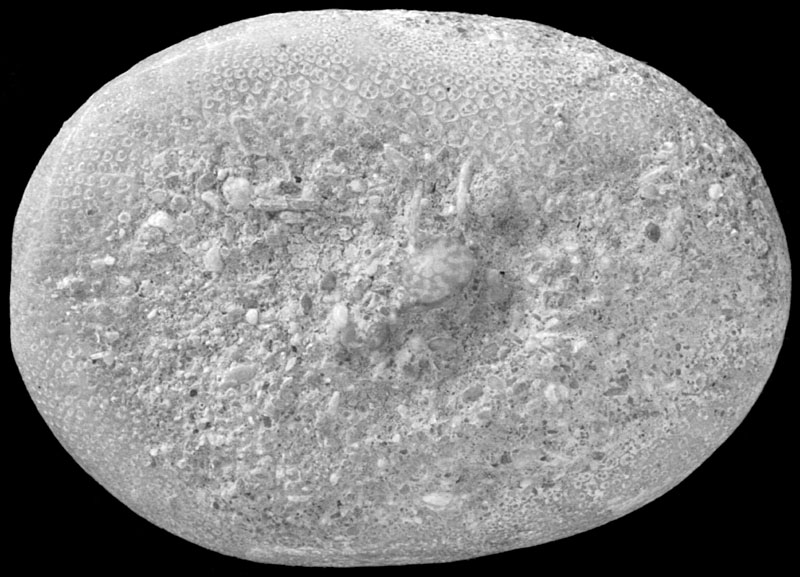 |
Eurhodia amygdala (Desor, 1863) - Eocène, Alicante, Espagne, 22 mm |
 |
 |
 |
 |
|
Cassidulus (Rhynchopygus ?) holmesi Twitchell, n. sp. Plate LXV, figures 3a-d. Determinative characters.—Test small, broadly oval, slightly truncated at the posterior end; upper surface convex, sides and ends rounded and inflated; under surface concave around the peristome. Ambulacral areas narrow, petaloid; petals nearly equal, partly open. Apex central; apical system excentric antériorly. Peristome excentric anteriorly, pentagonal, longitudinally elongate, with a floscelle. Periproct elliptical, transverse, supramarginal; located in a rather deep, oval indentation whose edges are almost flush with the posterior surface of the test. Dimensions.—Length 25 millimeters; width 22.5 millimeters; height 14 millimeters. Description.—Only a single specimen of this interesting species is known to the writer. It was found in the F. S. Holmes collection, now owned by the American Museum of Natural History, and as it was probably collected by Holmes is named in bis honor. The test is small, broadly oval, being but slightly longer than it is broad, slightly truncated at the posterior end. The upper surface is regularly convex, somewhat elevated, sides and ends sloping nearly uniformly to the rounded and inflated margin; under surface tumid around the margin, concave around the peristome; apex central. The ambulacral areas are rather narrow, dorsal portions petaloid; petals nearly equal in length, the posterior pair being but slightly longer than the others, nearly closing at the ends. The poriferous zones are rather broad, outer row of pores oval, inner row round, pairs of pores conjugate. The surface of the test is closely set with small tubercles in deep scrobicules, which are larger on the undcr surface except along a cribriform median band. The apical system is excentric anteriorly. There are four genital pores of which the anterior pair are nearer together than the posterior. No further details can be made out on the single specimen known. |
The peristome is excentric anteriorly, immediately beneath the apical system, pentagonal, longitudinally clongate, with a floscelle. The periproct is elliptical, transverse, supramarginal, located in a rather deep, oval indentation at the top of the slight posterior truncation. The edges of the indentation are almost even with the posterior margin. Below the periproct a vaguely defmed, broad, shallow groove entends downward across the margin. Related forms.—Cassidulus holmesi is not closely allied to any American form. Its broadly oval and uniformly convex form, nearly equal ambulacral petals, and the details of its periproct and peristome readily distinguish it. It does not appear to be closely related to any foreign form. Locality.—Santee River (?), S. C. Geologic horizon.—Probably in the McBean formation of Claiborne group, middle Eocene. The matrix is a fine-grained greensand such as is known to occur on Santee River. Collection.—American Museum of Natural History. Planche LXV(extrait)
|

Eurhodia holmesi (Twitchell in Clark,1915) - Eocène supérieur, Rose Hill, Caroline du Nord, U.S.A., 15 mm |
|
,%20apical,%20Eocene%20superieur,%20Rose%20Hill,%20Caroline%20du%20Nord,%20USA,%2015%20mm.JPG) |
,%20ambital,Eocene%20superieur,%20Rose%20Hill,%20Caroline%20du%20Nord,%20USA,%2015%20mm.JPG) |
,%20periprocte,%20Eocene%20superieur,%20Rose%20Hill,%20Caroline%20du%20Nord,%20USA,%2015%20mm.jpg) |
,%20oral,%20Eocene%20superieur,%20Rose%20Hill,%20Caroline%20du%20Nord,%20USA,%2015%20mm.jpg) |
|
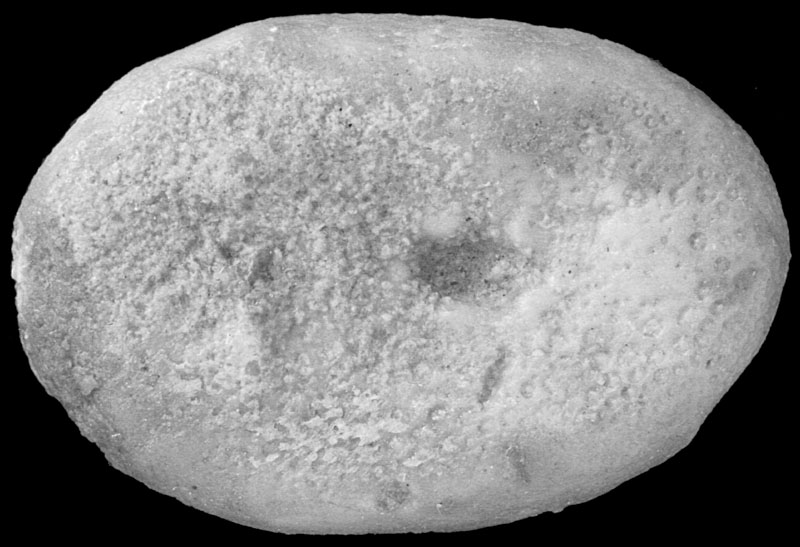
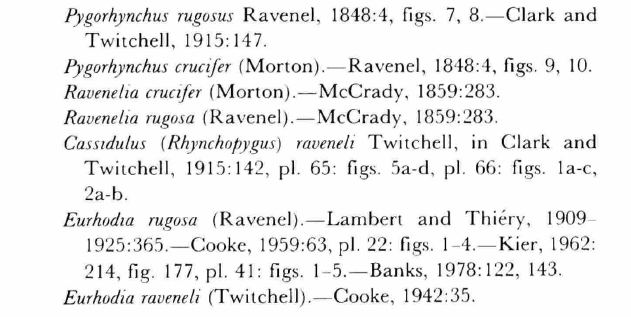
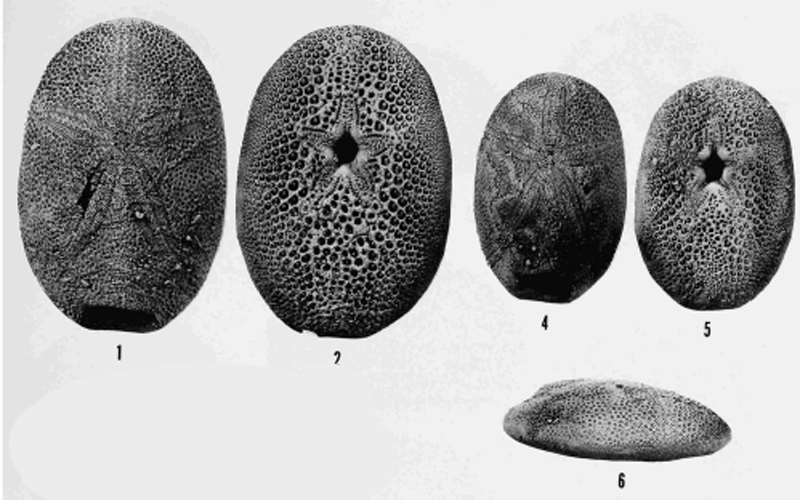
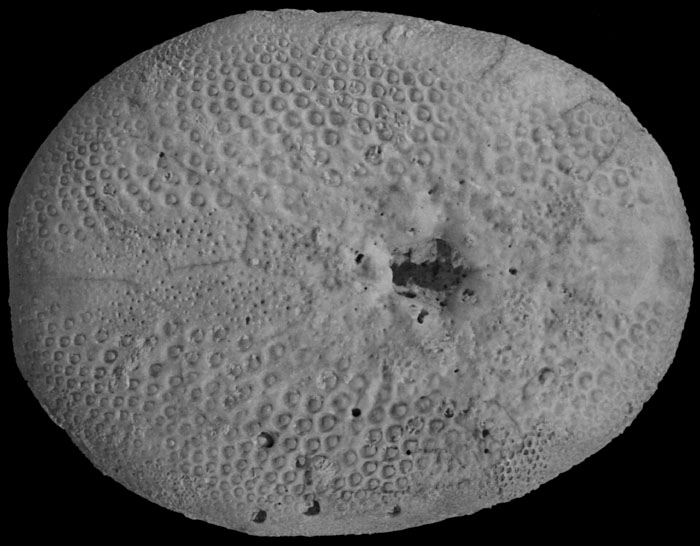
Eurhodia rugosa rugosa (Ravenel) Figures 7, 8; Plate 7: Figures 1-6
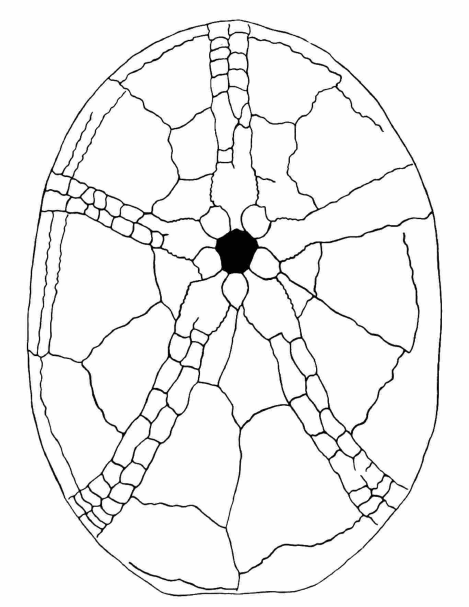
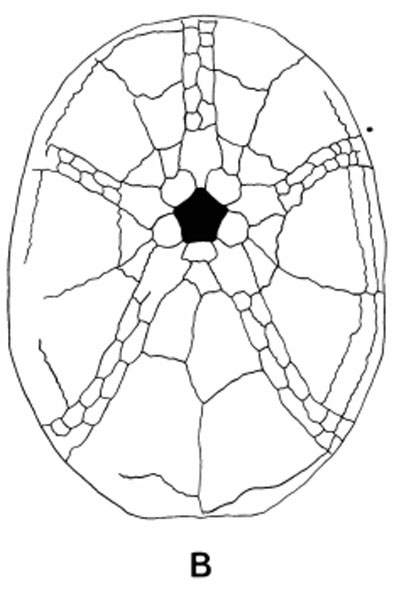
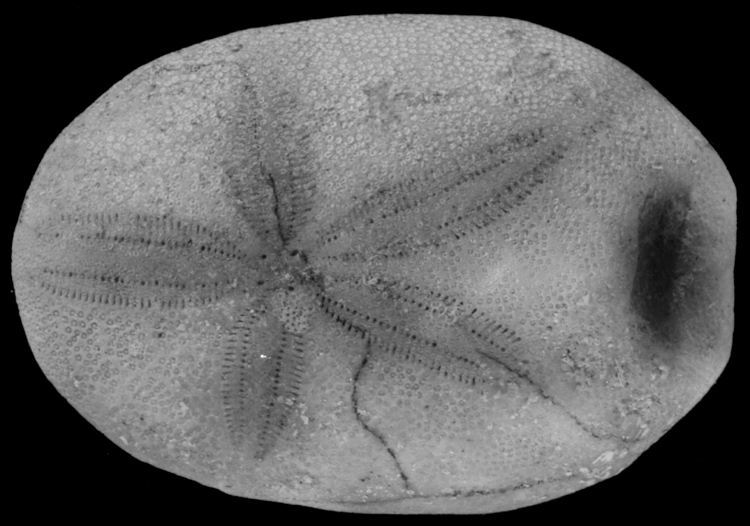
Material.-Description based on 70 specimens from Georgetown (locality 37). Dimensions from 38 specimens. Shape and size.-Length 16.4 to 62.5 mm, Z=30.69 mm, test elongate, width 66.16 to 83.27 (Z=74.49) percent L (SD=7.52, CV=33.59, N=38), sides relatively straight, posterior margin truncated; height 29.28 to 54.27 (k=44.44) percent L (SD=3.28, CV=25.35, N=38), smaller specimens higher relative to length than larger (Figure 7A). Trough extending downward from periproct; test depressed adorally along midline. Apical system.-Anterior, distance from anterior margin 42.78 to 54.35 (X=49.04) percent L (SD=4.93, CV=33.08, N=37); monobasal, 4 genital pores, present on smallest specimen. Ambulacra-Anterior petal extending almost to anterior margin; length 27.44 to 41.03 (X=35.71) percent L (SD=4.91, CV=42.63, N=32); width 9.12 to 14.33 (X=11.83) percent L (SD=1.15, CV=31.34, N=31); length of petals II, IV 23.33 to 37.20 (X=30.61) percent L (SD=3.60, CV=38.56, N=31); width 8.89 to 14.68 (X=11.58) percent L (SD=1.23, CV=34.42, N=32); length of petals V, I 34.15 to 44.91 (X=39.14) percent L (SD=5.02, CV=41.83, N=34); width 8.89 to 15.47 (X=11.82) percent L (SD=1.12, CV=31.98, N=33). Petals closing distally, poriferous zones equal, interporiferous zones slightly wider than single poriferous zone. Specimen 16.6 mm long with 60 porepairs in petal III, 54 in petal IV, 66 in petal V; specimen 48.2 mm long with 109 porepairs in petal III, 92 in IV, 119 in V; specimen 62.5 mm long with 112 porepairs in petal III, 110 in IV, 128 in V. Peristome.-Anterior of center, distance from anterior margin 33.71 to 40.22 (X=37.15) percent L (SD=4.39, CV=38.64, N=37); elongated longitudinally, height 10.36 to 15.06 (Z=12.74) percent L (SD=1.38, CV=35.79, N-35); width 8.57 to 13.25 (X=10.61) percent L (SD=1.19, CV=37.15, N=35). Bourrelets strongly developed (Plate 7: figure 2), peristomial opening vertically sided. Phyllodes single pored, approximately 26 pores in each phyllode, 6 in inner series in occluded plates in specimen 20.5 mm long; 30 in each phyllode, 8-9 in inner series in specimen 52.6 mm long. Periproct.-Supramarginal, transverse with trough extending posteriorly. Enclosed by interambulacral plates 8-12. Adoral surface.—Large, irregularly arranged pits (Plate 7: figure 2) in midzone of interambulacrum V; two-thirds of length of ambulacrum III extending from extremity of phyllode; first and second plates of interambulacra 2, 3 and in plate 3 adjoining ambulacrum III; a few pits in plates 1 and 2 in interambulacra 4, L Adorai plate arrangement in Figure 8. Type specimen.—In the same paper in which he erected Pygorhynchus rugosus, Ravenel (1848) referred a specimen (probably of this species) to Pygorhynchus crucifer Morton. Twitchell, in Clark and Twitchell (1915:142), erected a new species, Cassidulus raveneli, for this specimen. He considered Ravenel's P. rugosus too poorly illustrated
FIGURE 8.—Eurhodia rugosa rugosa (Ravenel), adorai plate arrangement in USNM 264588 from Santee Limestone at locality 37, X 2. |
and, because the type-specimen was lost, not worthy of recognition. Cooke (1942:35) accepted Twitchell's species but later (1959:63) used P. rugosus and considered Twitchell's C. raveneli as a synonym. Ravenel's illustrations of P. rugosus are clear enough to permit reasonable certainty that his species is the form found so commonly in South Carolina in the Santee Limestone. In order to determine which name to use for this species, a neotype is herein selected for Ravenel's P. rugosus: USNM 562300 from the Santee Limestone at USGS 18353 (locality 47) on the SanteeCooper diversion canal near Eadytown, Berkeley County, South Carolina (figured by Cooke, 1959: plate 22: figures 1-4). Figured specimens.—USNM 264044, 264045, 264588. Occurences.—Santee Limestone, South Carolina: Georgetown localities 37, 40-42, 45, 47, 48 ("middle zone"). Remarks.—This subspecies differs from E. rugosa ideali from the Castle Hayne Limestone in having far larger pits (compare Plate 7: figure 2 with Plate 7: figure 8) on its adoral surface, a narrower test in the larger specimens (Figure 7B), higher test on the smaller specimens (Figure 7A), and a longer petal III in the smaller specimens (Figure 7C). In ail their other characters including position of the peristome and apical system (Figures 7D, E), the subspecies are indistinguishable. E. rugosa rugosa occurs only in the Santee Limestone of South Carolina. Images d'après Kier 1980, fig in texte 8 et pl.7, fig.1-6
|

Eurhodia rugosa rugosa (Ravenel,1848) - Eocène, Caroline du Sud, USA, 52 mm |
|
,%20apical,%20Caroline%20du%20Sud,%20USA,%20Eocène,%2052%20mm.JPG) |
,%20amb,%20Caroline%20du%20Sud,%20USA,%20Eocène,%2052%20mm.jpg) |
,%20periprocte,%20Caroline%20du%20Sud,%20USA,%20Eocène,%2052%20mm.jpg) |
,%20detoral,%20Caroline%20du%20Sud,%20USA,%20Eocène,%2052%20mm.JPG) |
,%20oral,%20Caroline%20du%20Sud,%20USA,%20Eocène,%2052%20mm.JPG) |
|
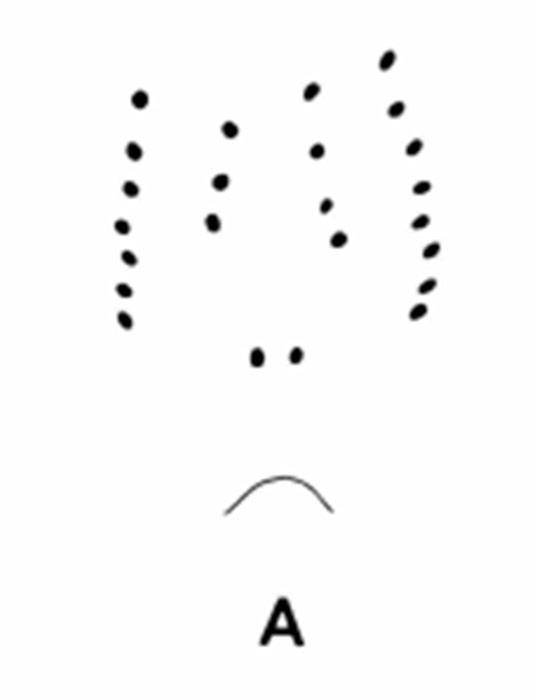
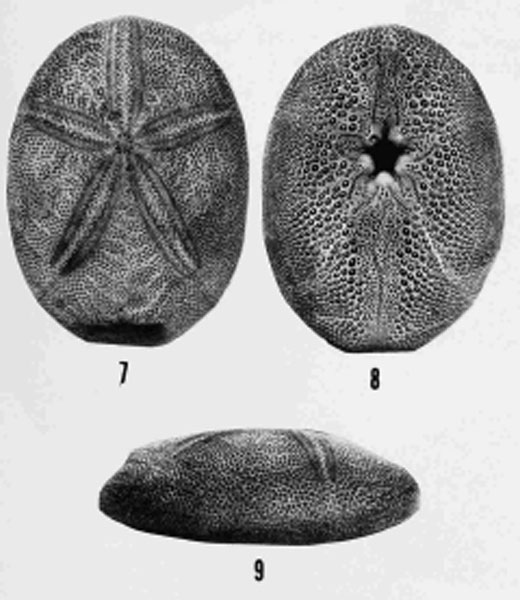
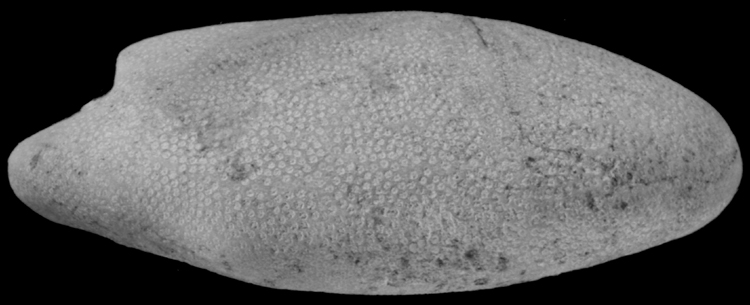
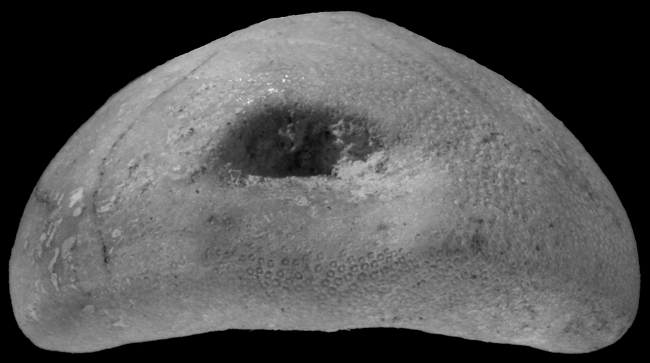
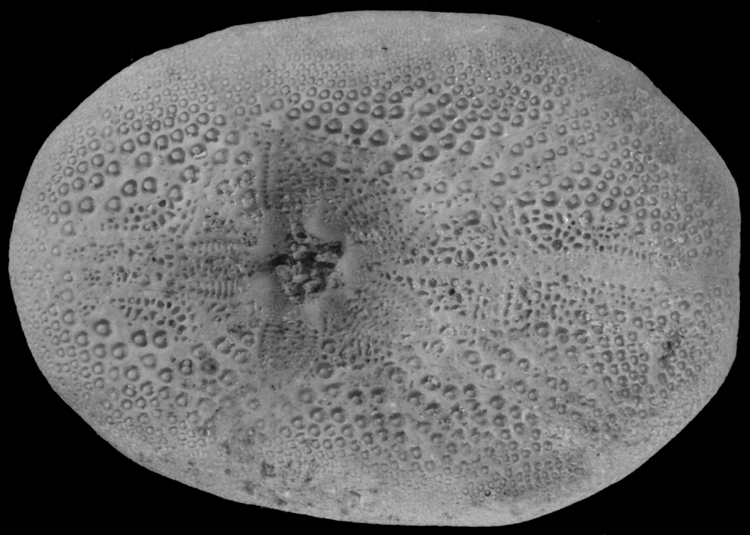
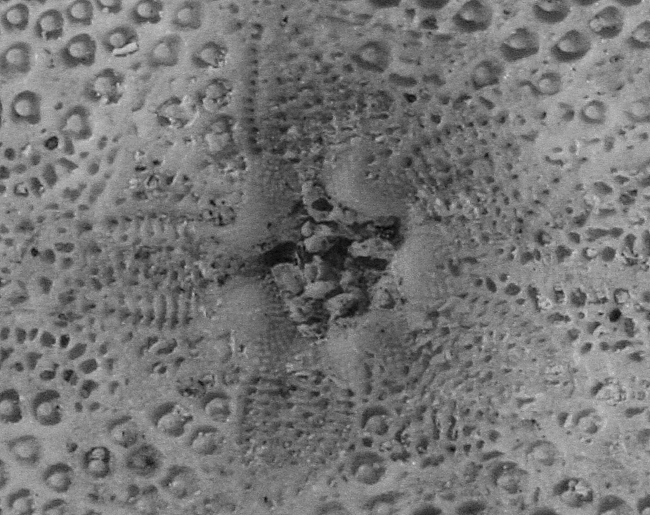
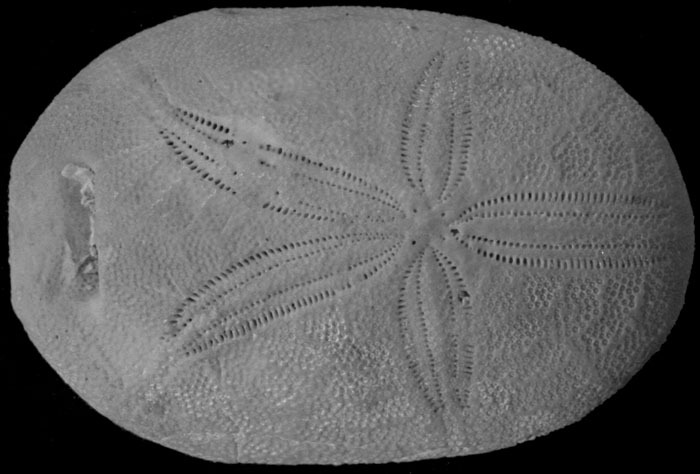
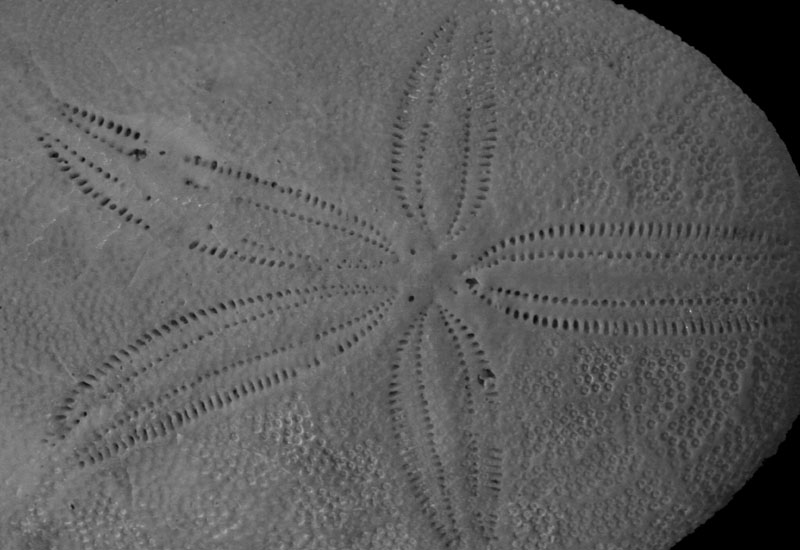
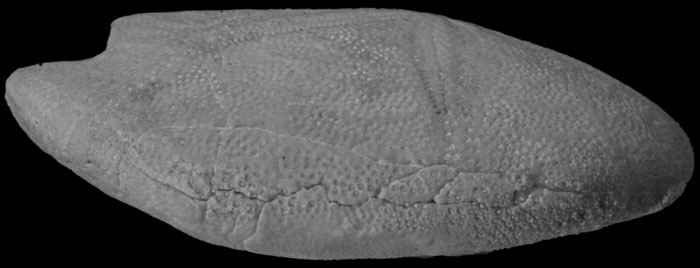
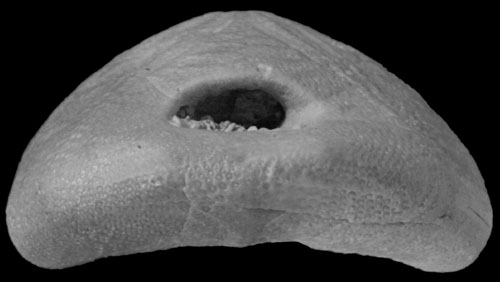
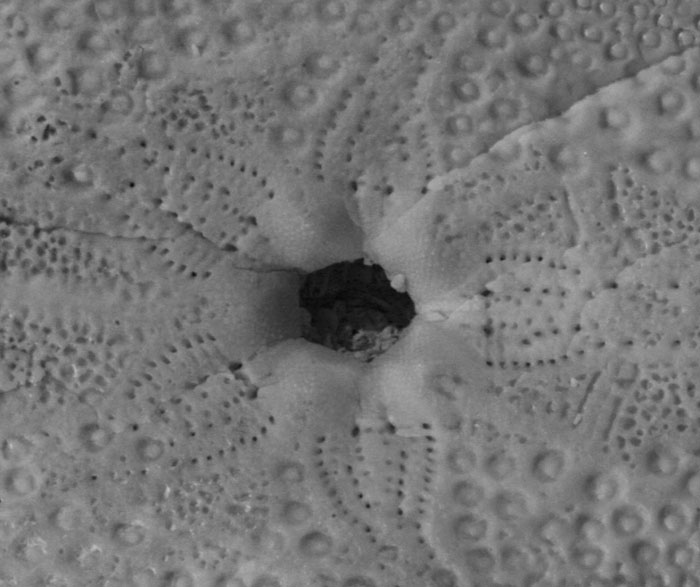
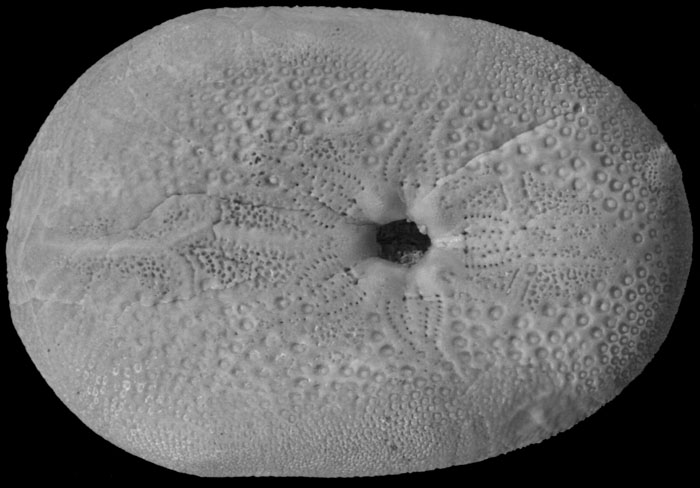
Eurhodia rugosa ideali, new subspecies Figures 7, 9 ; Plate 7 : figures 7-9 Material. - Description based on over 100 specimens from Ideal (locality 12). Dimensions from 48 specimens. Shape and Size. - Length 17.4 to 49.1 mm, x=31.60 mm, test elongate, width 69.26 to 80.26 (x=75.07) percent L (SD=5.76, CV=24.35, N=48), sides relatively straight and parallel in some specimens, in others sides widening posteriorly, posterior margin truncated ; height 32.92 to 44.83 (x=38.16) percent L (SC=2.34, CV=19.81, N=47). Trough extending downward from periproct ; test depressed adorally along midline. Apical System. - Anterior, distance from anterior margin 43.18 to 49.51 (x=46.08) percent L (SD=3.62, CV=24.79, N=45) ; monobasal, 4 genital pores, present on smallest specimen. Ambulacra. - Anterior petal extending almost to anterior margin ; length 30.46 to 59.30 (x=36.39) percent L (SD=4.19, CV=36.15, N=41) ; width 9.46 to 13.94 (x=12.18) percent L (SD=0.95, CV=24.94, N=44) ; length of petals II, IV 25.0 to 33.81 (x=29.95) percent L (SD=2.78, CV=29.13, N=40) ; width 9.46 to 13.94 (x=11.75) percent L (SD=0.92, CV=24.95, N=41) ; length of petals V, I 31.89 to 43.62 (x=37.82) percent L (SD=3.65, CV=30.51, N=41) ; width 9.12 to 13.46 (x=11.41) percent L (SD=0.94, CV=25.75, N=42). Petals closing distally, poriferous zones equal, interporiferous zones slightly wider than single poriferous zone. Specimen 17.4 mm long with 40 porepairs in petal III, 40 in petal IV, 50 in petal V ; specimen 48.9 mm long with 98 porepairs in petal III, 90 in IV, 110 in V. Peristome. - Anterior of center, distance from anterior margin 34.25 to 38.46 (x=36.43) percent L (SD=2.95, CV=25.61, N=48) ; elongated longitudinally, height 9.36 to 16.54 (x=12.53) percent L (SD=0.7, CV=18.43, N=47) ; width 7.14 to 14.02 (x=10.58) percent L (SD=0.71, CV=21.96, N=47). Bourrelets strongly developed. Phyllodes (Figure 9A) single pored, approximately 26 pores in each phyllode, 6 in inner series in occluded plates in specimen 23mm long ; 28 in each phyllode, 8-9 in inner series in specimen, 41.7 mm long. Periproct. - Supramarginal, transverse with trough extending posteriorly. Enclosed by interambulacral plates 8-12. Adoral Surface. - Small, irregularly arranged pits (Plate 7 : figure 8) in midzone of interambulacrum V ; two-thirds of length of ambulacrum III extending from extremity of phyllode ; first and second plates of interambulacra 2, 3 and in plate 3 adjoining ambulacrum III ; a few pits in plates 1 and 2 in interambulacra 4, 1. Adoral plate arrangement in Figure 9B. Type-Specimens. - Holotype USNM 264046 ; figured specimen USNM 264589. |
Occurences. - Castle Hayne Limestone, North Carolina : localities 2, 5, 8, Rose Hill locality 11, Ideal Cement Company quarry localities 12, 26, 28 ("early and late zones"). Remarks. - Specimens of this subspecies are distinguished from specimens of Eurhodia rugosa rugosa by their much smaller pits on the adoral surface (compare Plate 7 : figure 2 with Plate 7 : figure 8). In Eurhodia rogosa ideali the specimens are wider in the larger specimens, although having similar width to length ratios in the smaller specimens (Figure 7B). The width-to-length ratio decreases with increase in size in E. rugosa rugosa. Small specimens of E. rugosa ideali have lower tests than in E. rugosa rugosa but larger specimens have imilar heights (Figure 7A). Finally, specimens of E. rugosa ideali commonly have petal III shorter in the smaller specimens than E. rugosa rugosa (Figure 7C). In all other characters the subspecies are indistinguishable including width, height, and position of the peristome (Figure 7D), location of the apical system in large specimens (Figure 7E), width of all petals and length of all petals except petal III, number of porepairs in the petals, and numbers of pores in the phyllodes. E. rugosa ideali occurs in the Castle Hayne of North Carolina and E. rugosa rugosa occurs in the Santee Limestone of South Carolina. Images d'après Kier 1980, fig in texte 9A-B et pl.7, fig.7-9 (holotype USNM 264046)
|
 |
 |
 |
 |
 |
Eurhodia rugosa (Ravenel,1848) ideali Kier,1980 - Eocène, Castle Hayne formation, Pender County, Caroline du Nord, 38 mm |
 |
 |
 |
 |
 |
 |
|
Eurhodia rugosa (Ravenel,1848) depressa Kier,1980 |
|
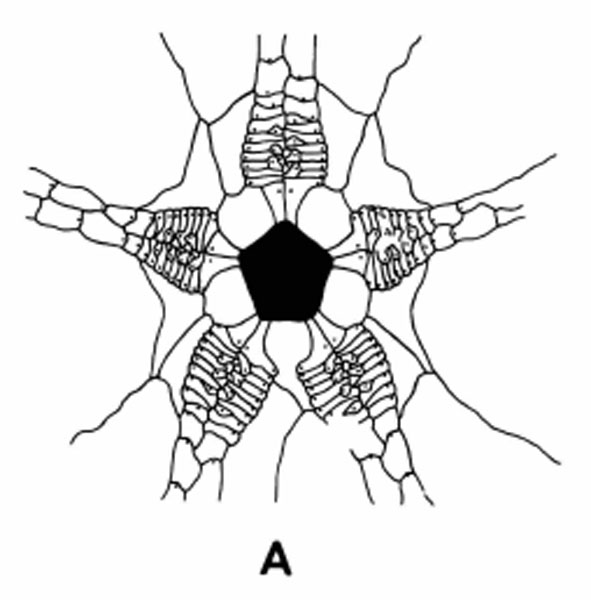
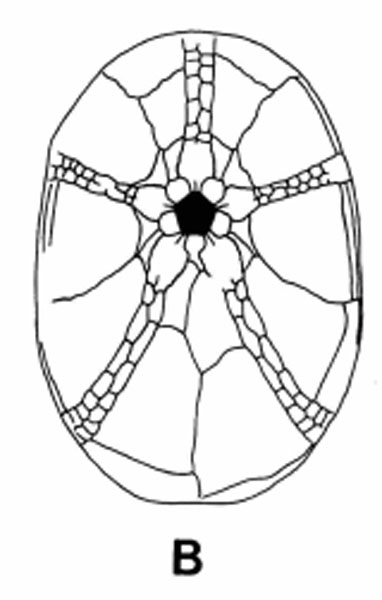
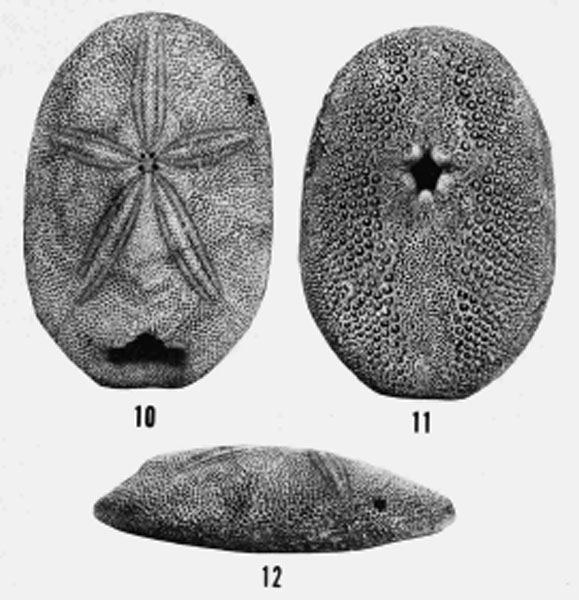
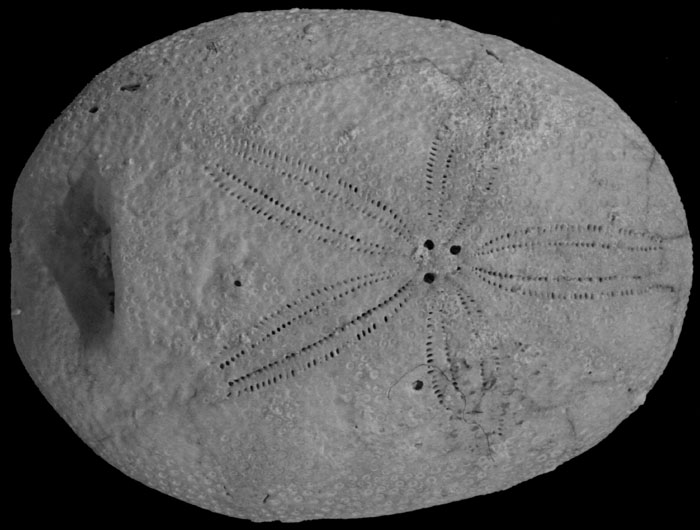
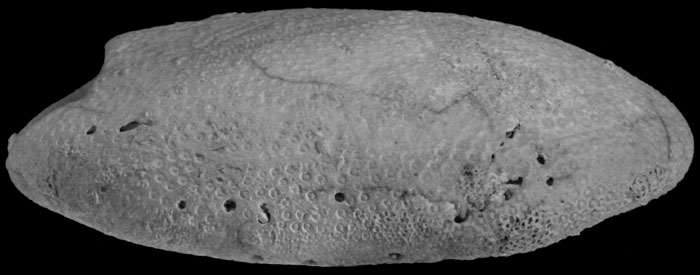
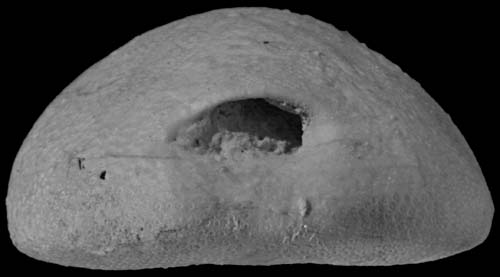
Eurhodia rugosa depressa, new subspecies Figures 7A, 10, 21, 22 ; Plate 7 : figures 10-12 Material. - 62 specimens from Maple Hill (East Coast Company) locality 10 but only eight show adapical surface. Specimens occur in living position as shown by the filling of only the lower portion of the test with sediment - the upper part is hollow. The specimens occur at the bottom of an indurated bryozoan "hash" with the upper surface of the echinoids firmly cemented to the rock making it very difficult to clean this surface. Shape and Size. - Length 47.6 to 65.0 mm, x=56.6 mm, test elongate, width 66.34 to 69.33 (x=67.59) percent L (SD=4.69, CV=12.27, N=8), greatest width posterior to center, posterior margin truncated ; height 25.38 to 28.32 (x=27.43) percent L (SD=1.67, CV=11.08, N=6). Trough extending downward from periproct ; test depressed adorally along midline. Apical System. - Anterior petal extending almost to anterior margin ; length 34.33 to 35.93 (x=35.33) percent L (SD=2.65, CV=13.59, N=6) ; width 9.08 to 9.90 (x=9.41) percent L (SD=0.66, CV=12.71, N=6) ; length of petals II, IV 25.92 to 30.08 (x=27.91) percent L (SD=2.55, CV=16.51, N=6) ; width 8.92 to 9.92 (x=9.45) percent L (SD=0.64, CV=12.34, N=6) ; length of petals V, I 36.33 to 39.40 (x=37.63) percent L (SD=2.94, CV=14.16, N=6) ; width 8.46 to 9.76 (x=9.36) percent L (SD=0.51, CV=9.69, N=5). Petals closing distally, poriferous zones equal, interporiferous zones slightly wider than single poriferous zone. Specimen 49.0 mm long with 102 porepairs in petal III, 84 in petal IV, 106 in petal V ; specimen 56.9 mm long with 124 porepairs in petal III, 102 in IV, 136 in V. Peristome. - Anterior of center, distance from anterior margin 34.49 to 36.13 (x=35.14) percent L (SD=2.49, CV=12.66, N=7) ; elongated longitudinally, height 10.77 to 12.65 (x=11.90) percent L (SD=0.54, CV=8.16, N=7) ; width 9.62 to 11.74 (x=9.50) percent L (SD=1.03, CV=16.87, N=7). Bourrelets strongly developed. Phyllodes (Figure 10A) single pored, approximately 26 pores in each phyllode, 7 in inner series in occluded plates in specimen 50.4 mm long ; same in specimen 63.7 mm long. Periproct. - Supramarginal, transverse with trough extending posteriorly. Enclosed by interambulacral plates 8-12. |
Adoral Surface. - Small, irregularly arranged pits (Plate 7 : figure 11) in midzone of interambulacrum V ; two-thirds of length of ambulacrum III extending from extremity of phyllode ; first and second plates of interambulacra 2, 3 and in plate 3 adjoining ambulacrum III ; a few pits in plates 1 and 2 in terambulacra 4, 1. Plate arrangement on Figure 10B. Type Specimens. - Holotype ISNM 264047 ; figured specimens USNM 264590, 264591. Occurences. - Castle Hayne Limestone, North Carolina : Maple Hill (East Coast Construction Company quarry) localities 10, 34 ("middle zone"). Remarks. - This subspecies differs from E. rugosa rugosa found in the Santee Limestone of South Carolina and E. rugosa ideali found elsewhere in the Castle Hayne Limestone of North Carolina in having a lower test (Figure 7A). The pits on the adoral side of its test are similar in size to those in E. rugosa ideali and smaller than those in E. rugosa rugosa. In all other characters, specimens of this subspecies are similar to the other subspecies, including the width of the test, length and width of the petals, position of the apical system, and position, height, and width of the peristome. Images d'après Kier 1980, fig in texte 10A-B et pl.7, fig.10-12 (holotype USNM 264047)
|
 |
 |
 |
 |
see above the entry : Cassidulus trojanus, now included in Eurhodia
|
Genus RHYNCHOLAMPAS A. Agassiz Rhyncholampas A. Agassiz, 1869. Bull. Mus. Comp. Zool., vol.I, p.270. Type species by subsequent designation, Lambert (1918, p.41), Pygorhynchus pacificus A. Agassiz. Synonyms : Anisopetalus Arnold and Clark ; Galerolampas Cotteau ; ? Gisopygus Gauthier ; Plagiopygus Lambert. GENERIC DESCRIPTION Medium to large, elongate, oval or with greatest width posterior to center, moderately to highly inflated ; apical system anterior, monobasal ; petals lanceolate, equal, closing, with unequal poriferous zones ; ambulacra single pored beyond petals ; periproct slightly supramarginal, marginal or slightly inframarginal, transverse ; peristome anterior, pentagonal, wider than high ; bourrelets moderately developed ; phyllodes single pored, widened, usually with two series of pores in each half-ambulacrum, approximately four pores in each inner series ; in some species three series o pores in each half ambulacrum ; buccal pores poresent ; tubercles on adoral surface much larger than on adapical, scrobicules large, bosses eccentric anterior ; naked, often pitted area in interambulacrum 5, ambulacrum III. Comparison with other genera. - Rhyncholampas is distinguished from Cassidulus by its larger test, broader, lanceolate petals, generally more posterior periproct, and more developed phyllodes with more occluded pores. Although the type species of these two genera are very distinct from one another, there are species which have some of the characters of both and are difficult to place definitely in one of them. Remarks. - Mortensen (1948, p.202) incorrectly states that when A. Agasiz established this genus he made Cassidulus cariboearum the type species. Furthermore, Grant and Hertlein (1938, p.107) are mistaken in saying that C. cariboearum is the type species by monotypy. Agassiz referred two species to his genus, C. cariboearum and R. pacificus, but did not select a type species. Lambert and Thiery designated R. pacificus. Mortensen says that even if R. pacificus were considered as the type species of Rhyncholampas, the genus would still be a synonym of Cassidulus. He states that R. pacificus has more developed phyllodes and that the pores in it petals are more unequal, but suggests that these differences may be due to the different size of the specimens examined, and that if specimens of the same size were compared, the differences might be so small as to be unimportant |
for a generic distinction. This argument would be pertinent if the species C. cariboearum were bsed on immature specimens, and R. pacificus on adults. Such is not the case. Many specimens of C. cariboearum are known, and none are larger han 31 mm. in length. There is no evidence that these small specimens are not adults. Fortunately, there are two small specimens of R. pacificus in the U.S. National Museum, one 21 mm. long and the other 35 m., and these immature specimens are generically distinct from C. cariboearum. A phyllode in the smallest specimen already has three occluded pores (text fig.154) in each half-ambulacrum, whereas no occluded pores occur in specimens of the same size or even larger of C. cariboearum. It is true that the pores in the petals of the small specimen of R. pacificus are more equal, with the outer pore less elongated (pl.28, fig.1) than the outer pore in an adult. However, the shape of the petals in R. pacificus is quite different from the petals in C. cariboearum. In R. pacificus the petals are lanceolate with more of a tendency to close distally. This difference is evident even on the smallest specimen. Range and distribution. - Paleocene to Recent, of worldwide distribution. There are many species from the Cenozoic of eastern United States which Cooke has referred to Plagiopygus (which he considers a subgenus of Cassidulus) or Cassidulus (Cassidulus), which probably should be referred to Rhyncholampas, including R. sabitonensis Kellum, R. gouldii (Bouve), R. ericsoni (Conrad), R. alabamensis (Twitchell), and R. georgiensis (Twitchell). Kew's west coast species Cassidulus (Rhynchopygus) mexicanus is very large, with well-developed broad lanceolate petals, and should be reffered to Rhyncholampas. Unfortunately, on the holotype, and evidently the only specimen known of this species, the adoral surface is destroyed and nothing is known of the phyllodes. A photograph of the adapical surface is included herein on plate 29, figure 4. This species is quite similar to R. evergladensis (Mansfield) from south-eastern United States, also from the Late Miocene of Florida. Its phyllodes are probably similar to the very well developed phyllodes in R. evergladensis. |
|
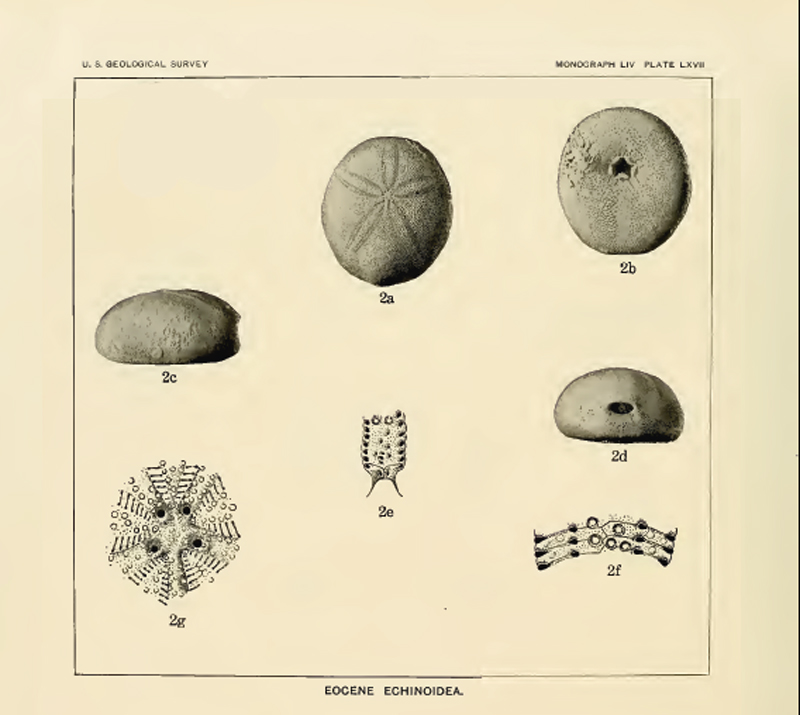
Cassidulus (Pygorhynchus) carolinensis Twitchell, n. sp. Plate LXVII, figures 2a-g. Determinative characters. - Test thin walled, oval in marginal outline, posterior end truncated ; sides and anterior end rounded ; upper surface convex, depressed, slightly more elevated posteriorly than anteriorly and with a rather prominent low, rounded ridge above the periproct ; under surface flat, concave around the peristome ; apex central or slightly excentric posteriorly. Ambulacral areas narrow. A narrow granulated, median band back of the peristome. Apical system excentric anteriorly ; madreporite slightly tumid. Peristome excentric anteriorly, directly beneath apical system, pentagonal, with a floscelle. Periproct elliptical, transverse, supramarginal beneath and overhanging expansion of the test, whose edge is even with the posterior margin. Dimensions. - Length 36 millimeters ; width 32 millimeters ; height 18 millimeters. This specimen is about a fourth larger than the average. Description. - This species occurs in large numbers at several localities in North Carolina, notably in association with Echinolampas appendiculatus. The test is thin walled, regularly oval in marginal outline, the posterior end vertically truncated. The upper surface is uniformly convex, depressed, sides and anterior en rounded, slightly more elevated posteriorly than anteriorly and in the form of a low rounded ridge above the periproct ; under surface flat, tumid near the pargin, concave around the peristome. The apex is central, or slightly excntric posteriorly. The ambulacral areas are narrow, dorsal portions petaloid ; the petals long, rather narrow, nearly closing, the posterior pair slightly longer than the others which are nearly equal in length. The poriferous zones are rather narrow, faintly depressed, outer pores oblong, inner ones round, pairs of pores conjugate. The surface of the test, including the interporiferous areas and the ridges between the pairs of pores, is closely set with small imperforate tubercles set in deep scrobicules. Between the tubercles are minute granules. The tubercles increase in size on the under surface except along a narrow band back of the peristome, which is somewhat smooth but dotted with numerous granulations. The apical system is excentric anteriorly. There are four genital pores, the anterior pair being nearer together than the posterior ; and five perforated radial plates. The madreporite is large, oval and faintly tumid, as are the adjacent portions of the interambulacral areas. The peristome is somewhat large, pentagonal, excentric anteriorly, directly beneath the apical system, surrounded by a floscelle of which the bourrelets are rather prominent, granulated, and together form a nearly circular ring around the peristome. |
The periproct is elliptical, transverse, supramarginal, at the top of the posterior truncation ; beneath a rounded, trnasverse, somewhat protruding expansion of the test, whose edge is just even with the truncated posterior margin. Related forms. - Cassidulus carolinensis is closely related to C. conradi and resembles it in a number of features, notably in the details of the periproct ; but it is to be separated by its less excentric apical system, by its less transverse peristome with the subcircular ring of bourrelets, by being broader, more rounded and less rostrate posteriorly, and by having a more marked concavity around its peristome. C. carolinensis also resembles C. georgiensis but is to be distinguished by the concavity around its peristome, its less obtuse and less angular posterior margin, and its lower and less oblique posterior truncation. Among European forms C. carolinensis greatly resembles Pygorhynchus maveri De Loriol from the Tertiary of Switzerland (more so than does C. conradi), but differs in having its periproct higher up on the posterior surface, and in the failure of the expansion of the test over the periproct to protrude noticeably beyond the posterior margin. In a number of features C. carolinensis is similar to Pygorhynchus grignonensis (Defrance) Agassiz from the Eocene of France, but it can be separated by its more depressed form and the higher relative position of its periproct. Localities. - Smith Creed (type), Rochy Point, and Wilmington, N. C. Geologic horizon. - Castle Hayne limestone, upper Eocene or Oligocene. Collections. - Johns Hopkins University (T 2004) ; U. S. National Museum. Planche LXVII (extrait)
|
Rhyncholampas carolinensis (Twitchell, 1915) - Eocène, Castle Hayne formation, Caroline du Nord, 28 mm |
,%20apical,%20Eocene%20inferieur,%20Castle%20Hayne%20fm,%20Caroline%20du%20Nord,%2028mm.JPG) |
,%20ambital,%20Eocene%20inferieur,%20Castle%20Hayne%20fm,%20Caroline%20du%20Nord,%2028mm.JPG) |
,%20periprocte,%20Eocene%20inferieur,%20Castle%20Hayne%20fm,%20Caroline%20du%20Nord,%2028mm.JPG) |
,%20detoral%20BIS,%20Eocene%20inferieur,%20Castle%20Hayne%20fm,%20Caroline%20du%20Nord,%2028mm.jpg) |
,%20oral,%20Eocene%20inferieur,%20Castle%20Hayne%20fm,%20Caroline%20du%20Nord,%2028mm.JPG) |
|
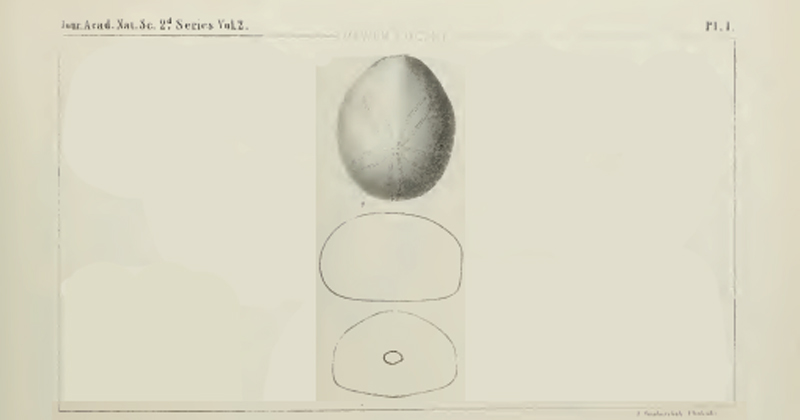
CATOPYGUS, Agas. C. Conradi. Pl. 1, fig.9. - Ovate, longitudinally subangulated in the middle, caused by the slightly flattened surface of the disk ; sides of posterior margins obliquely truncated ; ambulacral pores minute ; anus transversely oval ; extremity truncated ; base slightly concave about the mouth except posteriorly, where it is slightly convex. C. Conradi, Couper. MSS. Locality. Palmyra, Lee county. In white limestone. |
Planche 1 (extrait)
|
|
Rhyncholampas conradi (Conrad,1850) - Eocène, Floride, U.S.A., 51 mm |
,%20apical,%20floride,%20USA,%20Eocène,%2051%20mm.JPG) |
,%20amb,%20floride,%20USA,%20Eocène,%2051%20mm.JPG) |
,%20periprocte,%20floride,%20USA,%20Eocène,%2051%20mm.JPG) |
,%20detoral,%20floride,%20USA,%20Eocène,%2051%20mm.JPG) |
,%20oral,%20floride,%20USA,%20Eocène,%2051%20mm.JPG) |
|
Rhyncholampas conradi (Conrad,1850) - Eocène, Floride, U.S.A., 57 mm |
,%20apical,%20Floride,%20USA,%20Eocène,%2057%20mm.JPG) |
,%20amb,%20Floride,%20USA,%20Eocène,%2057%20mm.JPG) |
,%20periprocte,%20Floride,%20USA,%20Eocène,%2057%20mm.JPG) |
,%20oral,%20Floride,%20USA,%20Eocène,%2057%20mm.JPG) |
|
Rhyncholampas conradi (Conrad,1850) - Eocène, Ocala limestone, Lafayette county, Floride, U.S.A., 51 mm |
,%20apical,%20Lafayette%20county,%20floride,%20USA,%20Ocala%20limestone,%20Eocène,%2047%20mm.JPG) |
,%20amb,%20Lafayette%20county,%20floride,%20USA,%20Ocala%20limestone,%20Eocène,%2047%20mm.JPG) |
,%20periprocte,%20Lafayette%20county,%20floride,%20USA,%20Ocala%20limestone,%20Eocène,%2047%20mm.JPG) |
,%20oral,%20Lafayette%20county,%20floride,%20USA,%20Ocala%20limestone,%20Eocène,%2047%20mm.JPG) |
|
CASSIDULUS
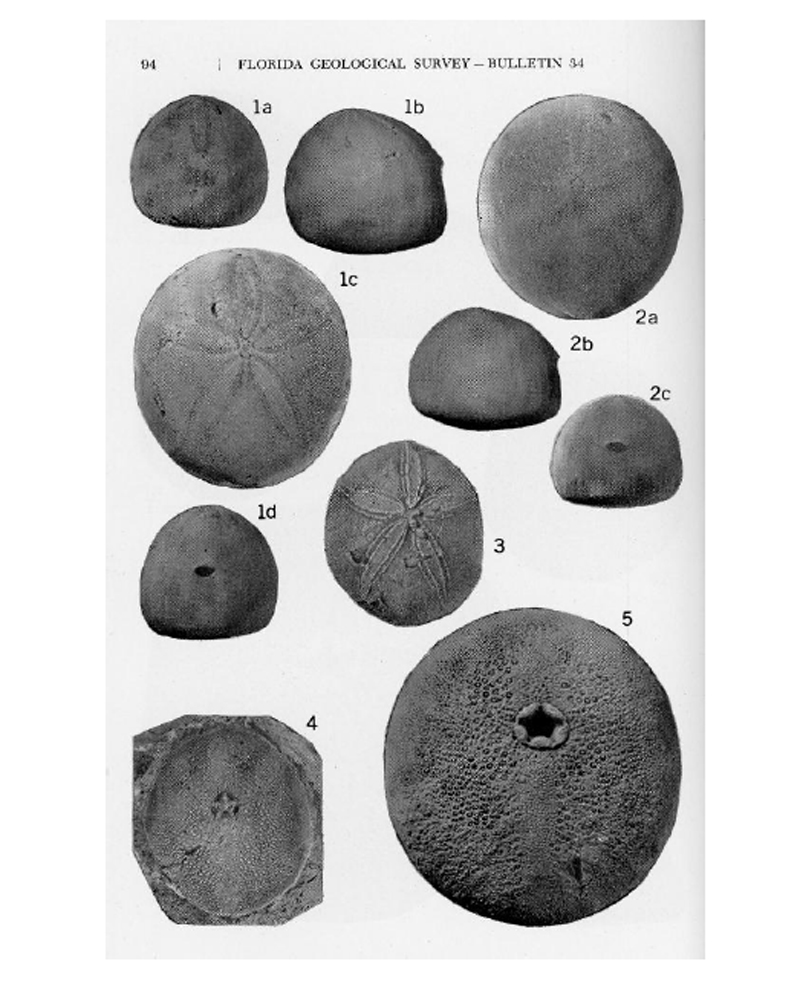
(PARALAMPAS) GLOBOSUS Fischer, n. sp. Description.—Test medium to large for genus, highly inflated. Apical view nearly circular, profile four-fifths to nearly as high as long. Oral surface moderately convex, joining rides at an ill-defined, munded edge of spatulate outline; widest in posterior third. Peristorne and apex anteriorly eccentric. Peristorme pentagonal, transversely elongate, with narrow, beaded bourrelets. Periproct at half height, its arched upper margin projecting, lover margin forrning a broad "V". Test gently rostrate above periproct a flat band vith faint median ridge leads from periproct to mare. Sides of test faintly divided into similar vertical facets, The rides of the test overhang the oral wall on all sides, but much more so in front than in the rear, to produce a forward-leaning appearance. Top and soles of test covered with small scrobicules. On the margins of the oral side these grade into large scrobicules which cover the latter except on the anterior and posterior longitudinal median bands, which are finely beaded. Apical system with four large genital and five small ocular pores and central madreporite. Petals slender, lanceolate, wide open at the ends. On each antero-lateral pelal the posterior row of pores is longer than the anterior row, whereas on each of the posterior tatals the auterior row of pores is longer than the posterior row. Inner pores round to slightly elliptical; outer pores slightly ovoid. The dimensions of the holotype (Fla. G. S. 1-5346-1) are: length, 37.4 mm; width, 33.0 mm; heiht, 32.0 mm; size relationships are shown in figs. 8 and 9. Anomalous specimen,—An odd specimen (Fla. G. S. I-5355) is illustrated on fig. 10; its position on figs. 8 and 9 is indicated by the dot accompanied by a question mark. This specirnen shows the lengthheight relationship to lie expectcd in a C. lyelli grown to unusual size (fig. 8), but the great variation in length-height relationships by C. globosus would admit it into the latter species, as an extreme variant. Its length-width relationships (fig. 9) ally it with C. globosus rather than with C. lyelli. It was not found associated with other specimens of Cassidulus, and appears tu have come from the middle or upper portions of the Inglis member. in the absence of more material the question as to whether it represents an aberrant G. lyelli or G. globosus, or a new species or subspecies, is left undecided. Relationships.—This species appears to be closely related to Paralampas lyelli (Conrad), from which it differs by its greater site, relative height, and inflation ( sec figs. 8-10). Stratigraphic occurrence.—With the exception of the tentativcly included Fla. G S. I-5355, all specimens referred ta this species have corne from the basal bels of the Inglis member, where they have been found in association with Periarchus liyelli floridanus, Agassizia floridana, and Eupatagus sp. |
Occurrence—Fla. G. S. 1-5344: Borrow pit west of U. S. Highway 19 betweeri Gulf Hanarnock and Lebanon Station, Levy County. Fia. G. S. l-5845: Dolomite on north bank of Wacasassa River, just west of U. S. Highway 19, Levy County, Fla. G. S. I-5346: Borrow pit on west sicle of U. S. Highway 19, t-wo miles southeast of Gulf Hammock> southeast quarter of southwest quarter of Section 34, Township 14 south, Range 16 east, Levy County. Fla. G, S. 1-5347: Massive dolomite bed four feet above laminated dolomite of the Avon Park lirnestone below Florida Power Company dam on. Withlacoochee River, Levy County. Fla. G. S. I-5350 (5354): Dredgings in Citrus County on the south bank of the Withlacoochee River, one-quarter mile up and clown the river across from Farts Landing at Crackertown. Fla. G. S. 1-5382: Basal dolomite bed of Inglis member, New Lebanon Quarry, Lev County. Fla, G. S. l-5355: Cassidulus globosus ?; dredgings, north bank of Withlacoochee River, one and one-half miles below Isaac Walton Lodge at Yankeetown, Levy County. Planche 4 (extrait)
|

|
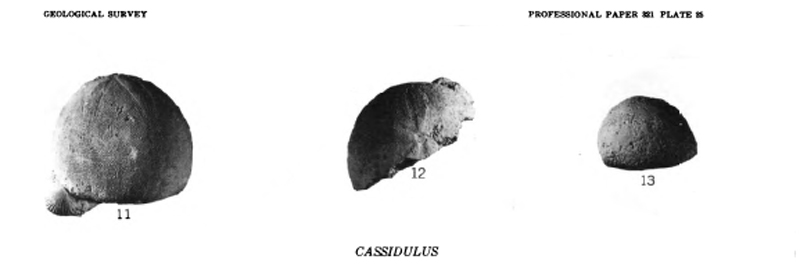
Cassidulus georgiensis globosus Fischer Plate 25, figures 11-13 Cassidulus (Paralampas) globosus Fischer, 1951, Florida Geol. Survey Geol. Bull. 34, pt. 2, p. 71, pl. 4, figs. 1-5 ; text figs. 8-10.
Much more highly inflated than the type of C. georgiensis but little more so than many specimens from Bainbridge, Ga., the type locality of the species. Usually higher in front than behind. Occurence.-Borrow pit on west aide of US Highway 19, 2 miles southwest of Gulf Hammock, SE1/4SW1/4 sec. 34, T 14 S, R 16 E, Levy County (type, Florida Geol. Survey I-5346; USNM 562308, F. S. MacNeil, flgured specimen). Borrow pit west of US Highway 19 between Gulf Hammock and Lebanon Station Levy County (Florida Geol. Survey I-5345). Dolomite on north bank of Waccasassa River just west of US Highway 19, Levy County). Massive dolomite bed 4 feet above laminated dolomite of the Avon Park limestone below Florida Power Company dam on Withlacoochee River, Levy County (Florida Geol. Survey I-5347). Dredged from Withlacoochee River neer Faris Landing at Crackertown (Florida Geol. Survey I-5350). New Lebanon quarry, Levy County (Florida GeoL Survey I-5382). Withlacoochee River 1.5 miles below Isaac Walton Lodge at Yankeetown, Levy County (Florida Geol. Survey I-5355). Borrow pit in sec. 14, T 15 5, R 16 E, about 1.5 miles north of Lebanon Station (USGS 18753, A. G. Fischer). |
Waccasassa River below highway 15, 1.6 miles northwest of Gulf Hammock, Levy County (USGS 187M, A. G. Fischer). Wekiva Springs, E1/2 SE% sec. 12, T 14 S, R 16 E, Levy County (USGS 18752, A. G. Fischer and J. E. Banks). Withlacoochee River, W1/2 sec. 23, T 17 S, R 16 E, Citrus and Levy Counties (USGS 18749, A. G. Fischer and J. E. Banks). Geologic unit.-Late Eocene, Inglis limestone. Type.-Florida Geological Survey I-5346-1. Paratypes Florida Geol. Surv. I-5344, 5346-9, 5346-5. Figured specimens USNM 562307, from USGS 18753, USNM 562308. Planche 25 (extrait)
|
|
Rhyncholampas georgiensis globosus (Fischer,1951) - Priabonien inférieur, Lafayette Cty, Floride, U.S.A., 39 mm |
%20apical,%20Priabonien%20inferieur,%20Lafayette%20Cty,%20Floride,%20USA,%2039%20mm.jpg) |
%20ambital,%20Priabonien%20inferieur,%20Lafayette%20Cty,%20Floride,%20USA,%2039%20mm.jpg) |
%20periprocte,%20Priabonien%20inferieur,%20Lafayette%20Cty,%20Floride,%20USA,%2039%20mm.jpg) |
%20oral,%20Priabonien%20inferieur,%20Lafayette%20Cty,%20Floride,%20USA,%2039%20mm.jpg) |
|
Pygorhynchus Gouldii. Bouvé. Above, conico-convex, a little more sloping posteriorly than anteriorly. Margin somewhat rounded, except, near and under the anus, where by an excavation or depression, it becomes acute. Inferior surface sub-circular. Mouth situated about one third of longitudinal diameter from the anterior margin. Apex sub-central, a little anterior, but not so much so as the mouth. Ambulacra radiating at unequal angles, the interambulacral spaces dividing the three anterior from the two posterior, being wider than the rest. The pores of each diverge considerably from the apex, becoming quite dilated a short distance from it, then converge as they descend, until about two-thirds the distance from the summit to the margin, where they are very limited in width, and where the double rows become single. On the margin they again slightly dilate, and are readily traceable to their termination about the mouth, where they are prominent. The anterior ambulacrum is much narrower than the rest. Anus transverse, and situated at about ont-fifth the distance from the posterior margin to the apex. Whole length, as shown by three individuals examined, 1 7/8 inches, greatest width 1 3/4 inches, height 1 inch. Locality, Baker County, Georgia. Description of characters from specimens in Cabinet of the Society. I take great pleasure in naming this beautiful species after my respected friend, Dr. Augustus A. Gould. |
Professor Agassiz remarked of the rock in which this specimen occurred, that it was the oldest member of the tertiary group, if not, as some supposed, belonging to the cretaceous ; the name of Pisolitic system had been applied to it by Elie de Beaumont. He also pointed out the characters in which his genus Pygorhynchus differs from Clypeaster and Echinolampas. Both have the ambulacra petaloid, and anterior mouth, and posterior anus. Echinolampas has no teeth, and the interior of the body is a simple cavity. Clypeaster has five teeth, and the internal cavity divided by columns. Pygorhynchus is dintinguished by a depression at the anus, the ambulacra elongated and distinct to the margin. The mouth is transverse, but in the other genera direct. He pronounces the species exhibited by Mr. Bouvé decidedly new.
|
|
Rhyncholampas gouldii (BOUVE,1846) - Oligocène, Suwanee Limestone, Suwanee River, 41mm |
,%20apical,%20Suwanee%20limestone,%20Suwanee%20river,%20Floride,%20USA,%2041mm.JPG) |
,%20ambital,%20Suwanee%20limestone,%20Suwanee%20river,%20Floride,%20USA,%2041mm.JPG) |
,%20periprocte,%20Suwanee%20limestone,%20Suwanee%20river,%20Floride,%20USA,%2041mm.jpg) |
,%20oral,%20Suwanee%20limestone,%20Suwanee%20river,%20Floride,%20USA,%2041mm.JPG) |
|
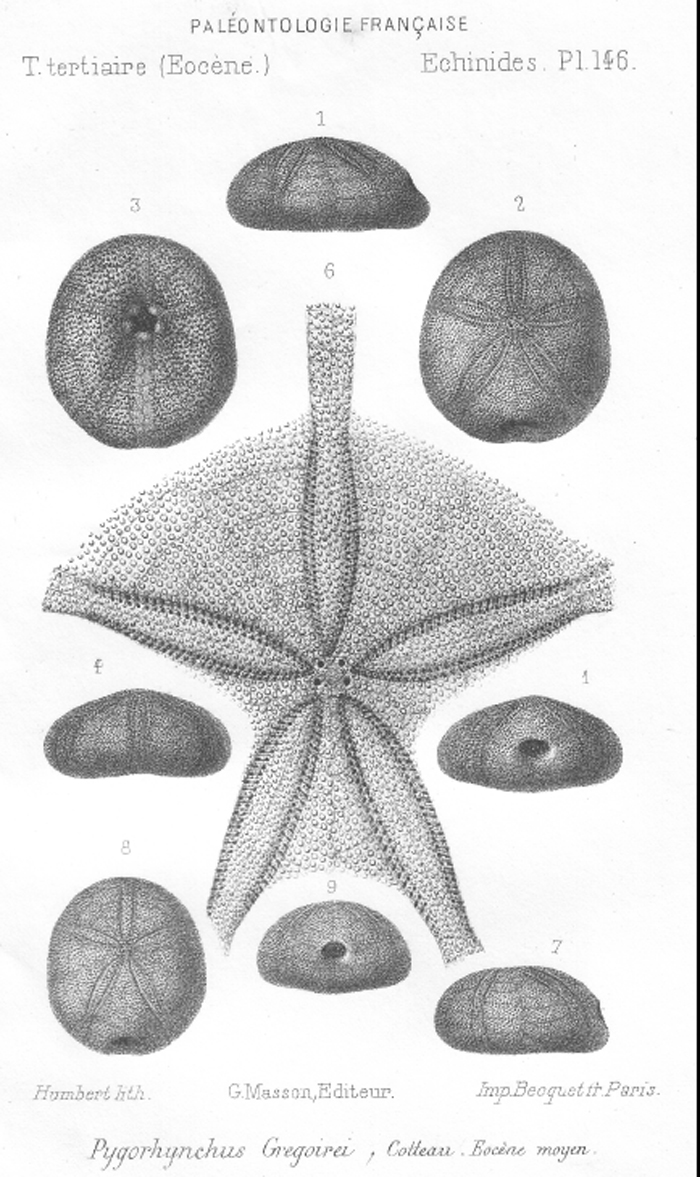
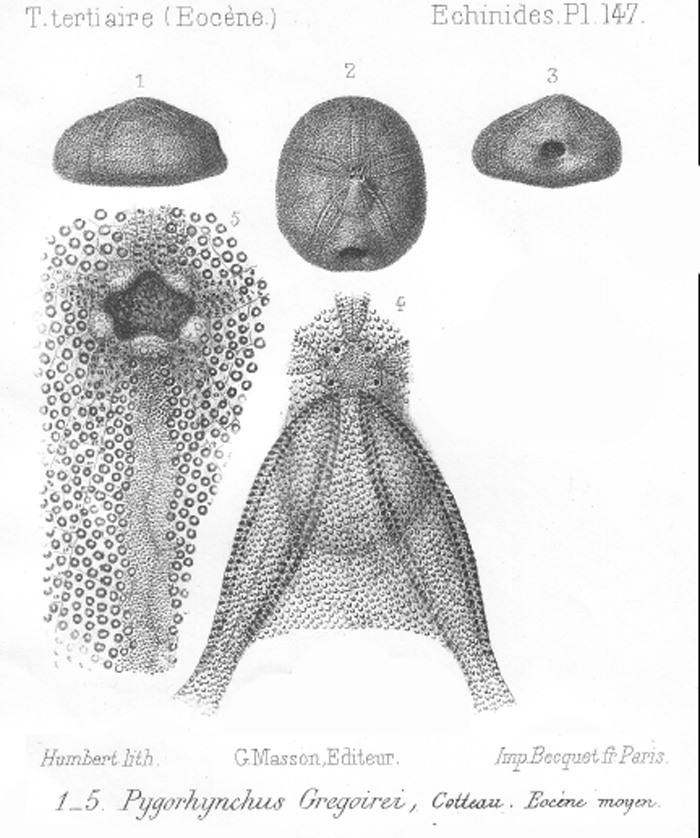
N°134 - Pygorhynchus Gregoirei, Cotteau, 1880. Pl. 146 et 147, fig.1-5.
Espèce de taille moyenne, ovale, allongée, arrondie en avant, un peu dilatée et subtronquée en arrière. Face supérieure médiocrement renflée, uniformément bombée, ayant sa plus grande hauteur à peu près au point qui correspond au sommet apical. Face inférieure subconcave autour du péristome, arrondie et subpulvinée en avant, plus aplatie dans l'aire interambulacraire postérieure. Sommet ambulacraire excentrique en avant. Aires ambulacraires pétaloïdes, subcostulées, lancéolées, effilées, ouvertes à leur extrémité, tout en se rétrécissant sensiblement, inégales, les aires postérieures un peu plus longues que les autres, l'aire antérieure plus courte et plus étroite. Zones porifères peu larges, composées de pores presque égaux, les externes cependant un peu plus allongés que les autres, unis par un sillon, disposés par paires obliques que sépare une bande granuleuse, plus ou moins distincte. Zone interporifère beaucoup plus large que l'une des zones porifères, également effilée à l'extrémité. A quelque distance de l'ambitus, les aires ambulacraires cessent d'être pétaloïdes; les pores deviennent très petits et ne sont plus visibles ; ils reparaissent dans les phyllodes qui entourent le péristome, mais ils sont petits, rapprochés les uns des autres et peu abondants. Tubercules nombreux, homogènes, fortement scrobiculés, fins à la face supérieure, un peu plus gros aux approches da péristome, recouvrant toute la surface du test, à l'exception de la bande granuleuse, qui occupe, à la face inférieure, le milieu de l'aire, interambulacraire postérieure, et se prolonge un peu sur l'aire ambulacraire antérieure. Cette bande, dépourvue de tubercules, indépendamment des granules, présente, sur plusieurs points, et parfaitement distinctes, de petites impressions profondes, inégales, irrégulières et disposées sans ordre. Péristome pentagonal, transversal, très excentrique en avant, s'ouvrant dans une dépression du test, entouré d'un floscelle apparent. Périprocte subtransversal, souvent un peu arrondi, supramarginal, assez éloigné du bord. Appareil apical compact, granuleux, muni de quatre pores génitaux. Un des exemplaires que nous avons sous les yeux, faisant partie de la collection de l'École des mines, offre un cas de monstruosité qu'il importe de signaler : les deux zones porifères internes des aires ambulacraires postérieures sont anormales. Dans l'aire ambulacraire de gauche, les pores de la partie supérieure de la zone porifère interne sont atrophiés, presque simples, irrégulièrement disposés, tandis que dans l'aire ambulacraire de droite, c'est la partie inférieure de la zone porifère interne qui est sensiblement modifiée ; les pores cessent alors d'être unis par un sillon, deviennent simples et sont irrégulièrement disposés. Un renflement particulier de la région supérieure de l'aire ambulacraire postérieure de droite accompagne cette monstruosité, qui n'a du reste, au point de vue organique, qu'Une importance secondaire, et ne paraît pas avoir nui au développement complet et régulier de l'individu. |
Hauteur, 13 millimètres ; diamètre antéro-postérieur, 27 millimètres; diamètre transversal, 24 millimètres. Échantillon de Belgique ( type de l'espèce) : hauteur, 13 millimètres ; diamètre antéropostérieur, 33 millimètres; diamètre transversal,. 30 millimètres. Rapports et différences. — Cette espèce est assurément très voisine du P. grignonensis ; elle nous a paru cependant s'en distinguer par sa taille un peu moins forte, par sa face supérieure beaucoup moins renflée, un peu déclive sur les côtés, quelquefois légèrement carénée dans la région postérieure ; par son sommet ambulacraire plus excentrique en avant ; par ses aires ambulacraires plus larges, plus effilées, plus costulées, moins ouvertes à leur extrémité ; par son périprocte placé plus obliquement et un peu plus éloigné du bord postérieur. Localités. - Vanves, Gentilly, Clamart (Seine); Chaumont (Oise); Fontenay-en-Vexin (Seine-et-Oise) ; Gisors (Eure); Parfondru, la Maison-Rotige à Aubigny (Aisne). Rare. Éocène moyen. École des mines de Paris, coll. de M. Hébert, ma collection. Localités autres que la France. - Saint-Gilles près Bruxelles, Dieghem. Rare. Laekenien. Explication des figures. - Pl. 146, fig. 1, P. Gregoirei, de la station de Clamart, de ma collection, vu de côté; fig. 2, face supérieure ; fig. 3, face inférieure ; fig. 4, face antérieure; fig. 5, face postérieure; fig. 6, portion de la face supérieure grossie; fig. 7, autre exemplaire, variété à aires ambulacraires plus étroites, de Fontenay-enVexin, de la coll. de M. Hébert, vu de côté; fig. 8, face supérieure; fig. 9, face postérieure. — Pl. 147, fig. 1, exemplaire présentant une monstruosité, de Chaumont, de la collection de l'École des mines de Paris, vu de côté ; fig. 2, face supérieure ; fig. 3, face postérieure ; fig. 4, aires ambulacraires postérieures grossies ; fig. 5, péristome et zone longitudinale de la face inférieure, pris sur un autre exemplaire, de Chaumont, de ma collection, grossis. Planches 146 et 147 (extrait)
|
|
|
http://coldb.mnhn.fr/catalognumber/mnhn/f/r62472 spécimen MNHN.F.R62472 crédit RECOLNAT (ANR-11-INBS004) Peter MASSICARD Neraudeau & al.,1997, p.32, pl.1, fig.a |
|
|
|
|

|
Rhyncholampas gregoirei (Cotteau, 1880) - Lutétien inférieur, Cahaignes, Eure, 32 mm |
,%20apical,%20Lutétien%20inférieur,%20Cahaignes,%20Eure,%2032%20mm.JPG) |
,%20ambital,%20Lutétien%20inférieur,%20Cahaignes,%20Eure,%2032%20mm.jpg) |
,%20periprocte,%20Lutétien%20inférieur,%20Cahaignes,%20Eure,%2032%20mm.JPG) |
,%20oral,%20Lutétien%20inférieur,%20Cahaignes,%20Eure,%2032%20mm.jpg) |
|
Rhyncholampas gregoirei (Cotteau, 1880) - Lutétien inférieur, Cahaignes, Eure, 33 mm |
,%20apical,%20Lutetien,%20Cahaignes,%20Eure,%2033%20mm.jpg) |
,%20ambital,%20Lutetien,%20Cahaignes,%20Eure,%2033%20mm.JPG) |
,%20periprocte,%20Lutetien,%20Cahaignes,%20Eure,%2033%20mm.jpg) |
,%20oral,%20Lutetien,%20Cahaignes,%20Eure,%2033%20mm.jpg) |
|
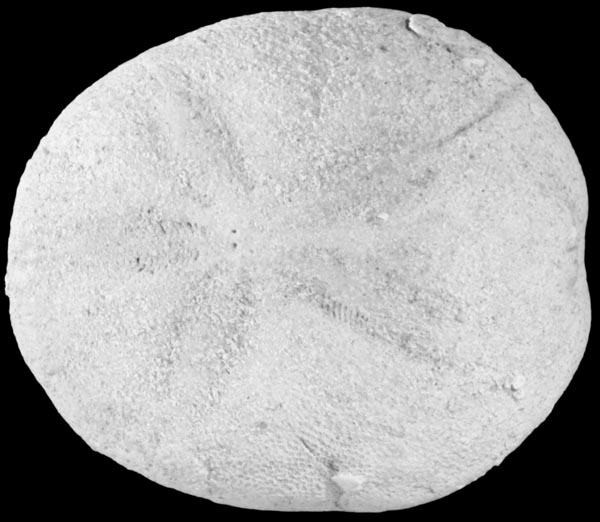
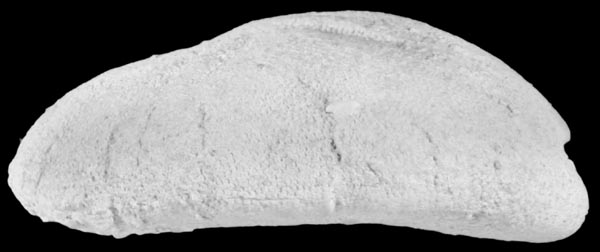
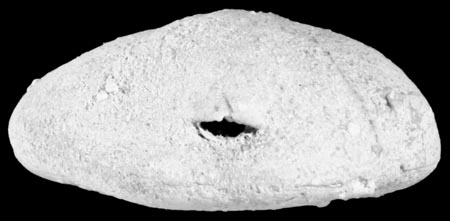
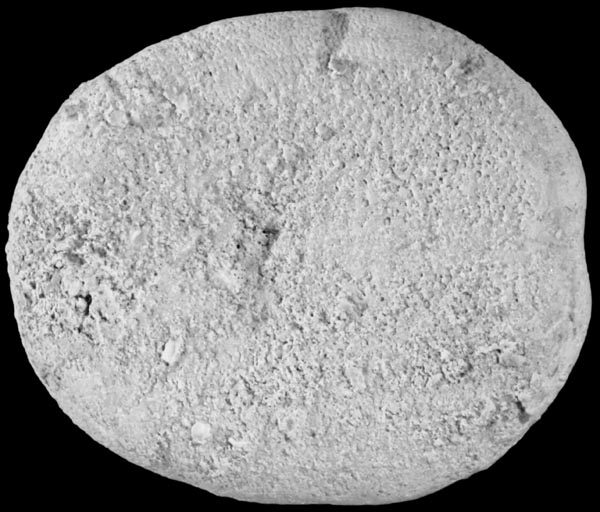
RHYNCHOLAMPAS GRIGNONENSIS (DeFrance) Plate 28, figures 4-8 ; text figures 151, 152 Nucleolites grignonensis DeFrance, 1825. Dict. sci. nat., vol.35, p.214 Material. - Two specimens studied in the collecitons of the U.S. National Museum, and several, including Cotteau's figured specimen, in the Ecole Nationale Supérieure des Mines, Paris. Shape. - Medium size, oval, inflated, greatest width and height posterior to center ; margin gently rounded except for slight posterior truncation, peristome depressed. Apical system. - Anterior, monobasal, madreporite inflated. Ambulacra. - Petals narrow, petal III shorter than others, II and IV extending over two-thirds distance to margin ; petals V and I over one-half distance ; interporiferous zones over twice width poriferous zone ; petals closing distally ; poriferous zones depressed, of unequal length : one more pore pair in right zone of petal III, two more in posterior zones of petals II and IV, six more in outside zones of petals I and V ; this character variable with specimens ; pores conjugate, outer pore elongate transversely, inner smaller and round. |
Adoral interambulacra. - Single plate (text fig.152) at peristome, preceded by two alternating plates, one much larger than the other in interambulacrum 3, smaller plate adjacent to ambulacrum III ; in interambulacra 1 and 4 smaller plate adjacent to ambulacra I and V respectively ; in interambulacrum 5 adjacent to ambulacrum I ; plates preceding these regularly alternating, of approximately equal size. Periproct. - Marginal to slightly supramarginal ; transverse with slight groove at adoral side of opening. Peristome. - Anterior, depressed, pentagonal. Floscelle. - Bourrelets well developed (pl.28, fig.8) ; vertically sided. Phyllodes (text fig.151) windened single pored, two series in each half-ambulacrum ; seven or eight pores in each outer series, four to five in each inner series ; buccal pores, sphaeridia present. Tuberculation. - Adorally, tubercles larger ; naked median band in terambulacrum 5, short length at ambulacrum III. Occurence. - Middle Eocene of France. Location of type specimen. - According to Lambert and Jeannet (1928, p.126) the type is in the Ecole Nationale Supérieure des Mines.
|
|
|
http://coldb.mnhn.fr/catalognumber/mnhn/f/r62472 spécimen MNHN.F.R62472 crédit RECOLNAT (ANR-11-INBS004) Peter MASSICARD Neraudeau & al.,1997, p.32, pl.1, fig.b-c |
|
|
|
|

Rhyncholampas grignonensis (Defrance, 1825) - Eocène moyen, Neubeuern, Rosenheim, Bavière, 29 mm |
,%20apical,%20Eocène%20moyen,%20Neubeuern,%20Rosenheim,%20Bavière,%2029%20mm.jpg) |
,%20ambital,%20Eocène%20moyen,%20Neubeuern,%20Rosenheim,%20Bavière,%2029%20mm.JPG) |
,%20periprocte,%20Eocène%20moyen,%20Neubeuern,%20Rosenheim,%20Bavière,%2029%20mm.JPG) |
,%20oral,%20Eocène%20moyen,%20Neubeuern,%20Rosenheim,%20Bavière,%2029%20mm.jpg) |
Rhyncholampas grignonensis (Defrance, 1825) - Eocène moyen, Neubeuern, Rosenheim, Bavière, 32 mm |
,%20apical,%20Eocène%20moyen,%20Neubeuern,%20Rosenheim,%20Bavière,%2032%20mm.JPG) |
,%20ambital,%20Eocène%20moyen,%20Neubeuern,%20Rosenheim,%20Bavière,%2032%20mm.JPG) |
,%20periprocte,%20Eocène%20moyen,%20Neubeuern,%20Rosenheim,%20Bavière,%2032%20mm.JPG) |
,%20oral,%20Eocène%20moyen,%20Neubeuern,%20Rosenheim,%20Bavière,%2032%20mm.jpg) |
Rhyncholampas grignonensis (Defrance, 1825) - Lutétien moyen, Aisne, France, 33 mm |
 |
 |
 |
 |
|
168; Galerolampas Sorigneti Cotteau, 1889. PI. 201 Espèce de taille moyenne, subcirculaire, arrondie 'et un peu étroite en avant, dilatée et subrostrée en arrière. Face supérieure élevée, rapidement déclive en avant et sur les côtés, subcarénée et légèrement bombée dans la région postérieure. Face inférieure concave, subpulvinée, presque tranchante sur les bords. Sommet ambulacraire excentrique en avant. Aires ambulacraires pétaloïdes, effilées, rétrécies et à peine ouvertes à leur extrémité, presque égales, l'aire antérieure paraissant cependant un peu plus longue et plus étroite que les autres ; les aires ambulacraires postérieures cessent d'être pétaloïdes à une grande distance du bord. Zones porifères subdéprirnées, de médiocre largeur, composées de pores étroits, les externes allongés, les internes plus arrondis, unis par un sillon, disposés par paires obliques que sépare une petite côte finement granuleuse. Zone interporifère légèrement bombée, effilée, comprenant dans sa plus grande largeur un espace au moins double de celui qui est occupé par l'une des zones porifères. Tubercules scrobiculés, homogènes, serrés et très petits sur toute la face supérieure et dans la région inframarginale, un peu plus gros et plus espacés aux approches du péristome, présentant à la face inférieure, au milieu de l'aire interambulacraire postérieure, les traces d'une lande longitudinale dépourvue de tubercules. Péristome pentagonal, anguleux, subtransverse , muni d'un floscelle apparent, très excentrique en avant, plus éloigné du centre que l'appareil apical auquel il ne correspond pas. Périprocte petit, arrondi, subanguleux vers la base, s'ouvrant un peu au-dessus de l'ambitus, sous l'expansion marginale du test. Appareil apical assez grand, subpentagonal ; quatre pores génitaux largement ouverts, placés sur les bords de la plaque madréporiforme qui occupe le centre de l'appareil ; cinq petites plaques ocellaires. Hauteur, 15 millimètres ; diamètre antéropostérieur, 40 millimètres; diamètre transversal, 35 millimètres et demi. Rapports et différences. — Cette espèce, type du genre Galerolampas, sera toujours facilement reconnaissable à sa forme arrendie en avant, dilatée et subrostrée en arrière, à. sa face supérieure élevée, légèrement carénée dans la région postérieure, à sa face inférieure concave, pulvinée, presque tranchante sur les bords, à ses aires ambulacraires effilées, presque égales, à ses zones porifères de même étendue, à son péristome excentrique en avant, muni d'un floscelle bien accusé, à son périprocte petit, arrondi, s'ouvrant un peu au-dessus de l'ambitus, |
au bas de la carène dorsale qui le recouvre en. partie. Nous ne connaissons aucune espèce, parmi les Echinanthus ou les Echinolampas, qui puisse être rapprochée du G. Sorigneti. Localité. — Saint-Gervais par Magny en Vexin (Seine‑et-Oise). Assez rare. Éocène moyen. Institut catholique (coll. Sorignet), collection Cotteau. Explication des figures. — Pl. 201, fig. 1, G. Sorigneti, de la collection de l'Institut catholique , vu dé côté; fig. 2, face supérieure; fig. 3, face inférieure; fig. 4, appareil apical et aire ambulacraire antérieure , grossis ; fig. 5, péristome et portion de l'aire: interambulacraire postérieure, grossis ; fig. 6, pores ambulacraires, fortement grossis. planche 201 (extrait)
|
,%20planche%20201.JPG)
Rhyncholampas sorigneti (Cotteau, 1889) - Yprésien inférieur, Puebla de Roda, Agagon, Espagne, 28 mm |
,%20apical,%20Ypresien%20inferieur,%20Puebla%20de%20Roda,%20Aragoon,%20Espagne,%2028%20mm.jpg) |
,%20ambital,%20Ypresien%20inferieur,%20Puebla%20de%20Roda,%20Aragoon,%20Espagne,%2028%20mm.JPG) |
,%20periprocte,%20Ypresien%20inferieur,%20Puebla%20de%20Roda,%20Aragoon,%20Espagne,%2028%20mm.JPG) |
,%20oral,%20Ypresien%20inferieur,%20Puebla%20de%20Roda,%20Aragoon,%20Espagne,%2028%20mm.jpg) |