Neolampadidae
Lambert, 1918, p.12
Genre type : Neolampas Agassiz, 1869
synonymie succinte :
Pliolampadidae Kier, 1966, p.192 (pars.)
Neolampadina Philip, 1963, p.725
Neolampadoida Durham & Wagner, 1966, p.(U)628
Description succinte de la famille : Appareil apical tetrabasal ou monobasal, avec deux à trois pores génitaux. Présence de bourrelets péristoméaux assez bien marqué



Diagnose originale du genre par Cotteau
Paléontologie française, terrains crétacés, tome VI, Echinodermes irréguliers, p.458
|
18e Genre, OOLOPYGUS, d'Orb., 1857 (2). Catopygus (pars) Agassiz. Caractères. Appareil génital et ocellaire formant un ensemble subcirculaire, composé de quatre plaques génitales très-petites et perforées ; la plaque antérieure de droite est quelquefois marquée d'un trou beaucoup plus petit, elle se prolonge, comme dans les Catopygus, au milieu de l'appareil en protubérance polypiforme; en arrière se montre une cinquième plaque génitale moins développée que les antres et non perforée. Les plaques ocellaires sont presque aussi larges que le% plaques génitales et aboutissent directement sur le corps madréporiforme. Coquille ovale, oblongue, subcylindrique, à sommet excentrique en avant. Dessous plat ou même un peu renflé. Bouche pentagone, allongée dans le sens du diamètre antéro-postérieur, s'ouvrant à fleur du test, entourée de cinq bourrelets saillants , alternant avec les pores buccaux et formant une rosette très-apparente. Anus ovale ou rond, placé tout à fait en arrière, au sommet d'une area verticale droite. Ambulacres subpétaloïdes, très-étroits, composés de pores égaux, arrondis, non conjugués, disposés par paires obliques. Tubercules très-petits, non scrobiculés, plus gros à la face supérieure qu'en dessus, toujours accompagnés de granules fins, serrés, homogènes. Rapports et dilférences. Ce genre a été jusqu'ici confondu avec les Catopygus dont il présente la physionomie générale; il s'en distingue cependant par un caractère important : les pores ambulacraires, au lieu d'être inégaux et conjugués, sont simples, égaux et arrondis comme dans les Caratomus , très-rapprochés les uns des autres et forment par cela même une zone porifère fort étroite. L'appareil génital et ocellaire offre en outre un aspect singulier ; tandis qua trois des pores génitaux sont largement ouverts et entourés d'un bourrelet saillant, le quatrième est |
dépourvu de bourrelet et remarquable par sa petitesse; nous necroyons pas, cependant, devoir insister sur ce caractère qui ne paraît pas se reproduire dans toutes les espèces du genre, mais qui, sans doute, est spécial à l'Oolopygus Bargesii, peut-être même à l'échantillon figuré. Résumé géologique sur les Oolopygus. Les deux espèces d'Oolopygus que nous connaissons sont propres exclusivement aux terrains cretacés moyen et supérieur. L'O. Bargesii provient de l'étage cénomanien et jusqu'à présent est spécial au bassin méditerranéen. L'O. pyriformis appartient à l'étage sénonien et au bassin anglo-parisien. (2) Les notes de d'Orbigny relatives au genre Oolopygus manquent complètement. Nous le regrettons d'autant plus que ce type nouveau ne figure pas dans le tableau des genres de la famille des Echinobrissidées et qu'aucune diagnose n'a été publiée par l'auteur. Nous avons cherché à y suppléer en étudiant avec soin les planches de l'atlas et les échantillons eux-mêmes qui ont été figurés. Mais peut-être quelques-uns des caractères qui avaient engagé d'Orbigny à établir cette nouvelle coupe générique nous ont-ils échappé. (Id.)
|

NB : l'espèce Oolopygus gracilis Lambert,1915 est ici considérée comme un synonyme subjectif plus récent. Toutefois, ce taxon étant souvent représenté dans les collections, je donne également ci-après la description originale de Lambert, à titre d'information.
Description de l'espèce par Cotteau
Paléontologie française, terrains crétacés, tome VI, Echinodermes irréguliers, p.457
|
No 2302.
Oolopygus pyriformis,
d'Orb., 1855.
Longueur, 27 millimètres; largeur, 21 millimètres; hauteur, 16 millimètres. Coquille oblongue, arrondie en avant, anguleuse et subrostrée en arrière, ayant sa plus grande hauteur en arrière du sommet et son plus grand diamètre transversal un peu en deçà du tiers postérieur. Dessus arrondi en avant, subdéprimé au milieu, s'abaissant en courbe régulière jusqu'à l'anus; profil transversal, régulièrement convexe : sommet apicial excentrique en avant. Dessous presque plat, légèrement ondulé par des sillons et des saillies intermédiaires; l'interambulacre postérieur plus renflé que les autres s'abaisse en un rostre qui correspond à l'aréa anale. Bouche pentagone, allongée dans le sens du diamètre antéro-postérieur, entourée de bourrelets et de pores buccaux formant une rosette très-visible. Anus arrondi, placé fort bas, sous une saillie apparente même de la face inférieure. Ambulacres à peine pétaloïdes, très-étroits vers le sommet, s'élargissant d'une manière sensible en se dirigeant vers le pourtour; zones porifères formées de pores égaux, arrondis, très-rapprochés les uns des autres et disposés par paires obliques. Tubercules non scrobiculés, serrés et très-petits à la face supérieure, plus gros et plus espacés en dessous. Rapports et différences. Cette espèce ne saurait être confondue avec l'O. Bargesii ; elle s'en distingue d'une manière bien nette par sa face postérieure anguleuse et rostrée, par son anus placé beaucoup plus bas, par sa base marquée de sillons et de saillies plus ou m'oins apparentes. Localité. Elle est propre à l'étage sénonien et se rencontre à Maestricht associée au Catopygus pyryformis ; elle n'y est pas rare. |
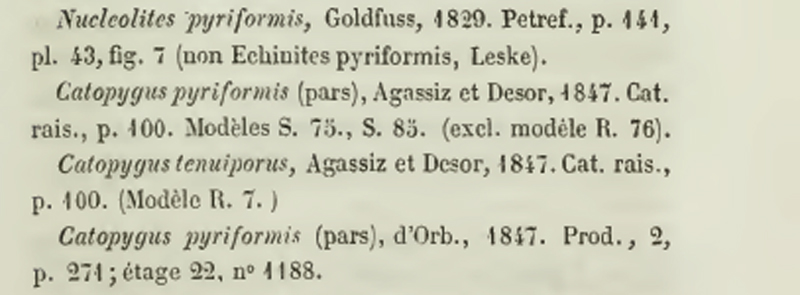
Histoire. Décrite et figurée par Goldfuss sous le nom de Nucleolites pyriformis, cette espèce a reçu plus tard de M. Agassiz la dénomination de Catopygus tenuiporus. En lui restituant le nom le plus ancien, nous en avons fait le type de notre genre Oolopygus. Explication des figures. Pl. 977, fig. 1, grandeur naturelle; fig.. 2, coquille grossie, vue en dessus; fig. 3, dessous ; fig. 4, profil longitudinal; fig. 5, profil transversal ; fig. 6, pores buccaux grossis; fig. 7, moule intérieur grossi, vu en dessus ; fig. 8, le même vu en dessous. De notre collection. planche 977 (extrait)
|

|
|
http://coldb.mnhn.fr/catalognumber/mnhn/f/r62514 spécimen MNHN.F.J01290 crédit RECOLNAT (ANR-11-INBS-0004) Peter MASSICARD d'Orbigny, p. 457 pl. 977 fig. 7 et 8 |
|
|
|
|


|
|
http://coldb.mnhn.fr/catalognumber/mnhn/f/j01290 spécimen MNHN.F.R05843 crédit RECOLNAT (ANR-11-INBS-0004) Peter MASSICARD Lambert, p. 15 pl. 1 fig. 15 et 16 |
|
|
|
|

|
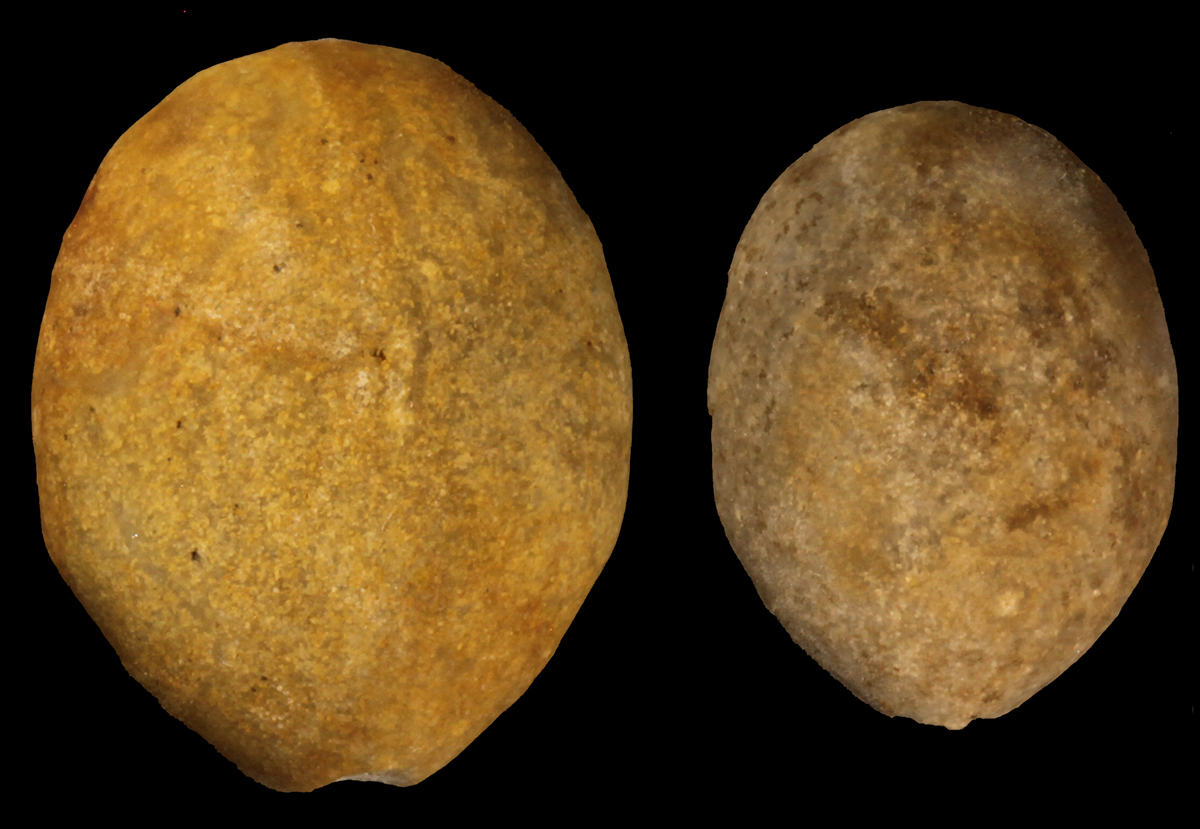
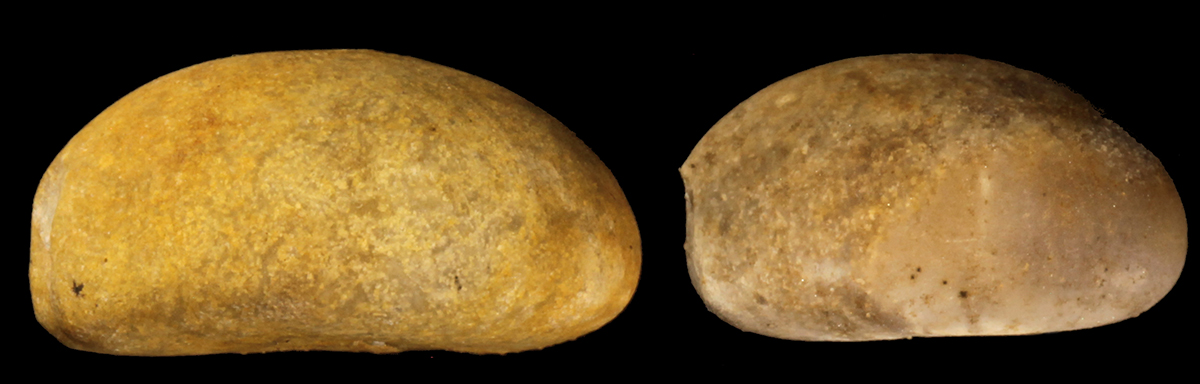
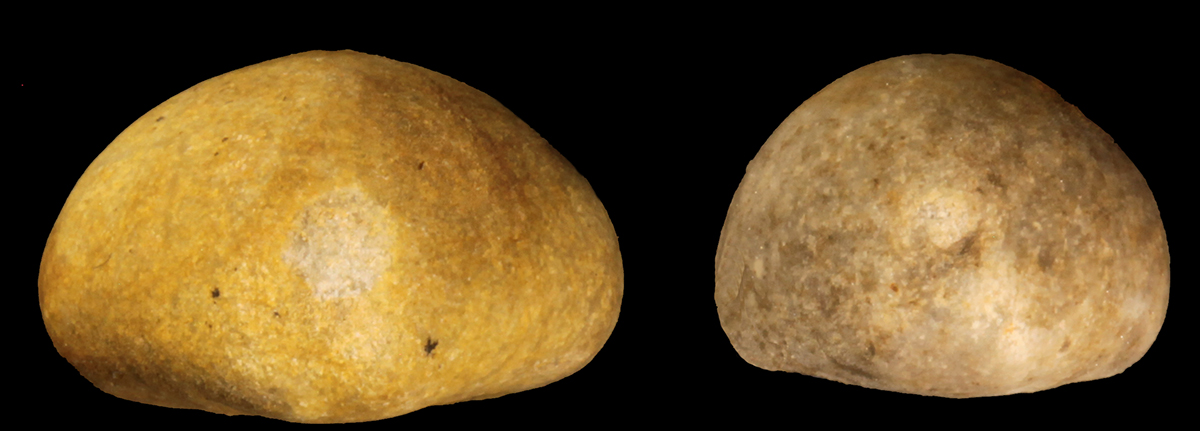
Oolopygus pyriformis (Leske,1778) - Maastrichtien, s'Gravenwoeren, Limburg, Belgique, 20 mm |
 |
 |
 |
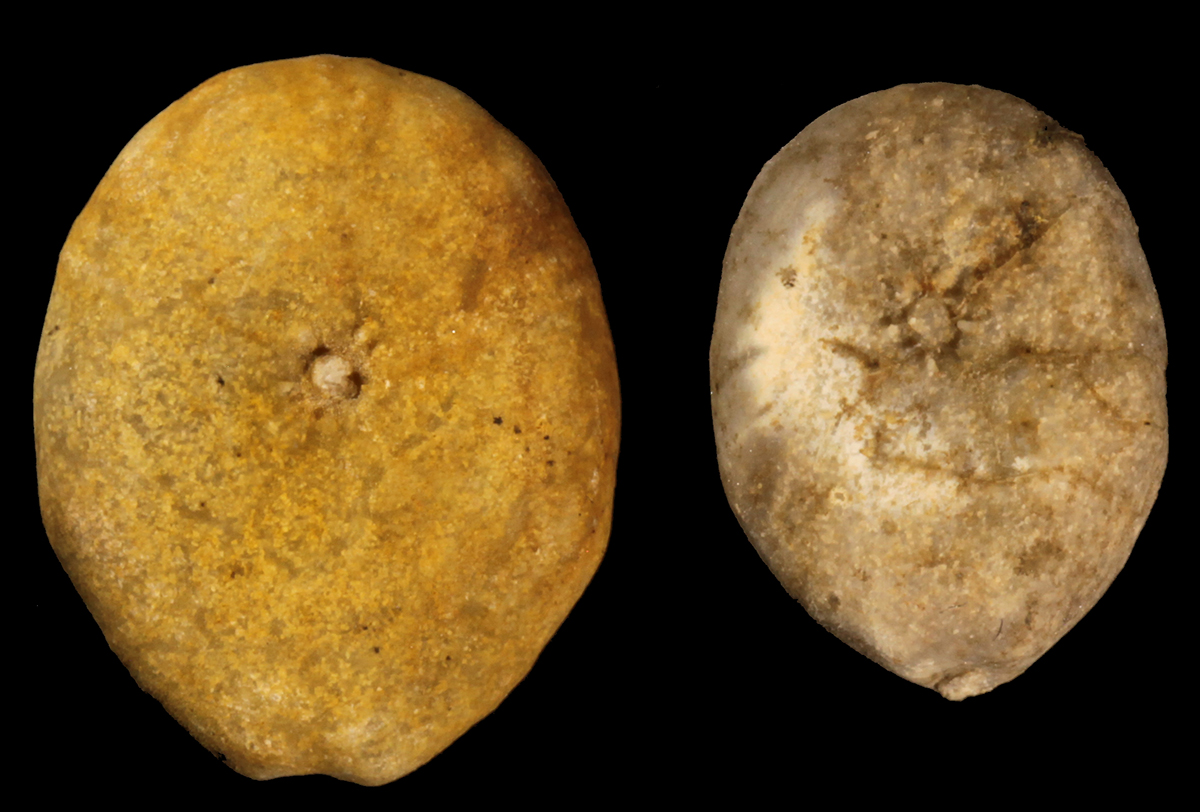 |
|
Oolopygus pyriformis (Leske,1778) - Maastrichtien, Vroenhafen, Limburg, Belgique, 22 mm |
,%20apical,%20Maastrichtien,%20Vroenhafen,%20Limburg,%20Bergique,%2022%20mm.JPG) |
,%20ambital,%20Maastrichtien,%20Vroenhafen,%20Limburg,%20Bergique,%2022%20mm.jpg) |
,%20periprocte,%20Maastrichtien,%20Vroenhafen,%20Limburg,%20Bergique,%2022%20mm.JPG) |
,%20oral,%20Maastrichtien,%20Vroenhafen,%20Limburg,%20Bergique,%2022%20mm.jpg) |
Syn : Oolopygus gracilis Lambert,1910 |
diagnose originale de l'espèce par Lambert, 1910
Liste critique des échinides du Calcaire à Baculites du Cotentin (Etage Aturien), p.20
|
16. Oolopygus gracilis Lambert. Après les détails donnés à l'occasion du O. piriformis, il me reste simplement à rappeler que le type du genre, le Nucleolites pyriformis de Goldfuss ne pouvant conserver ce nom, j'ai dû lui attribuer celui de gracilis. Voici d'ailleurs la synonymie abrégée de cette espèce.
Le O. gracilis se distingue du O. piriformis par sa forme un peu plus étroite, son périprocte situé un peu plus haut, son floscelle moins développé et surtout ses pétales encore plus étroits, composés de pores arrondis, égaux. Parmi les individus de cette espèce recueillis à Fresville, la plupart sont régulièrement ovoïdes ; quelques-uns, plus rétrécis à leur extrémité, rappellent le type de Goldfuss ; d'autres appartiennent à la variété oblongue de Maestricht, dont Quenstedt avait fait sa variété gracilis. |
O. gracilis, qui n'est pas très rares à Fresville, paraît avoir été jusqu'ici confondu avec d'autres espèces et il n'a été cité ni par d'Orbigny, ni par M. Dollfus. planche 1 (extrait)
|
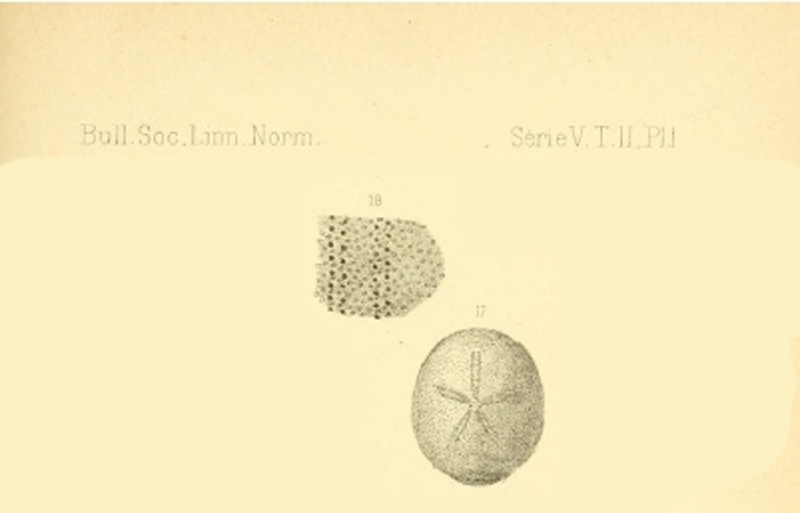
|
|
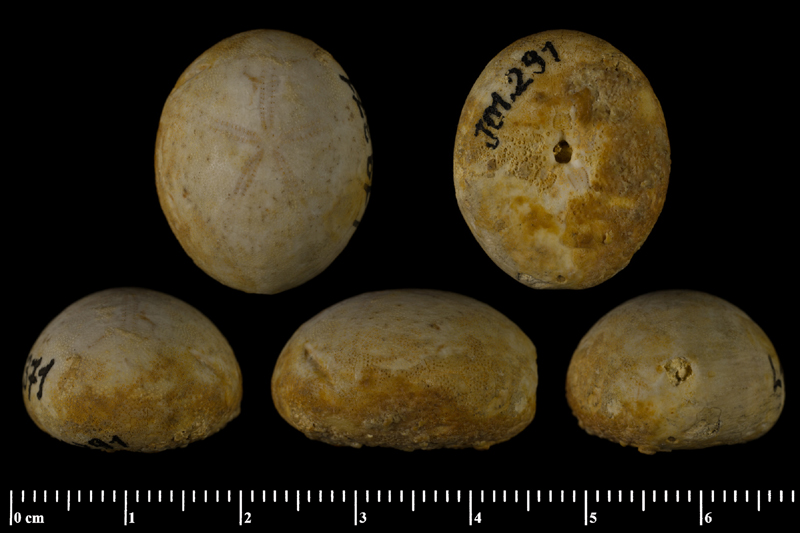
http://coldb.mnhn.fr/catalognumber/mnhn/f/j01291 spécimen MNHN.F.J01291 crédit RECOLNAT (ANR-11-INBS004) Peter MASSICARD ROMAN, p.20, pl.1, fig.17-18 |
|
 |

|
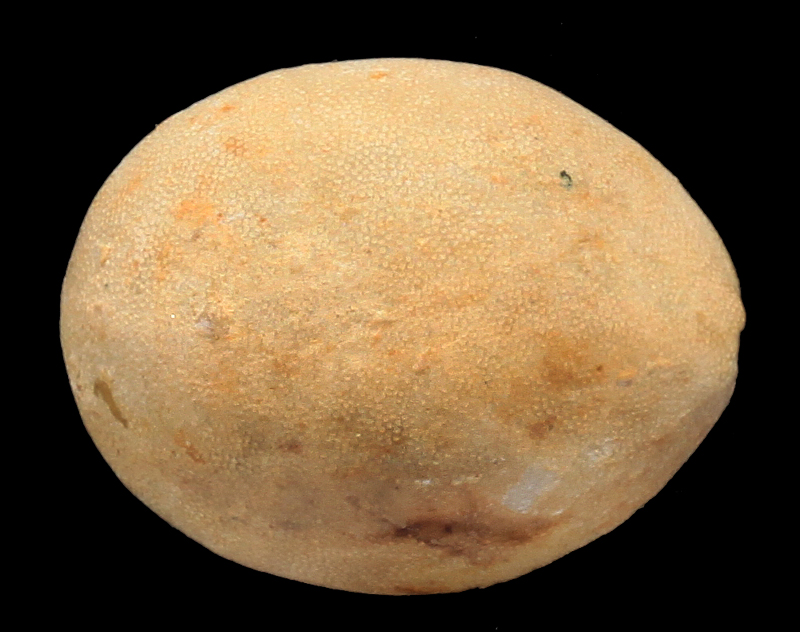
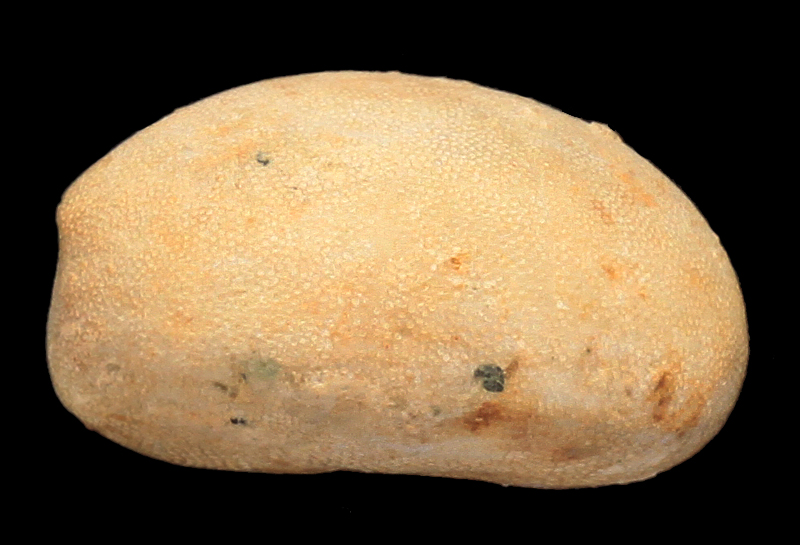
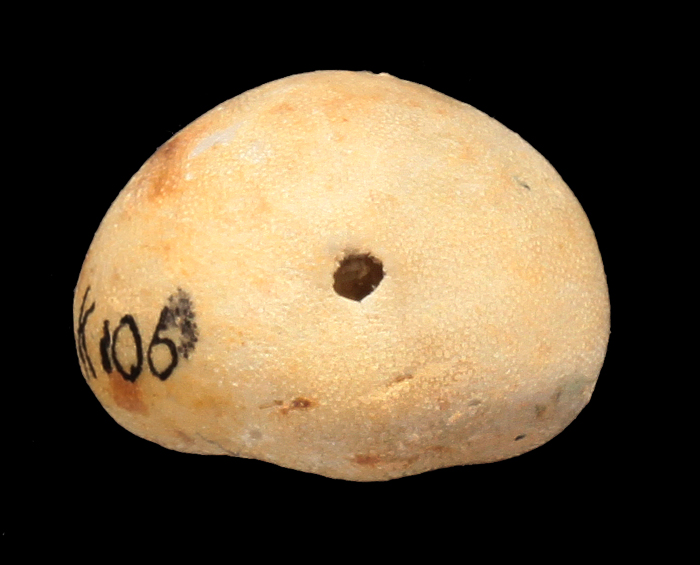
Oolopygus gracilis Lambert,1910 - Maastrichtien, carrière ENCI, Hor. van Lichtenberg, Pays-Bas, 17 mm |
 |
 |
 |
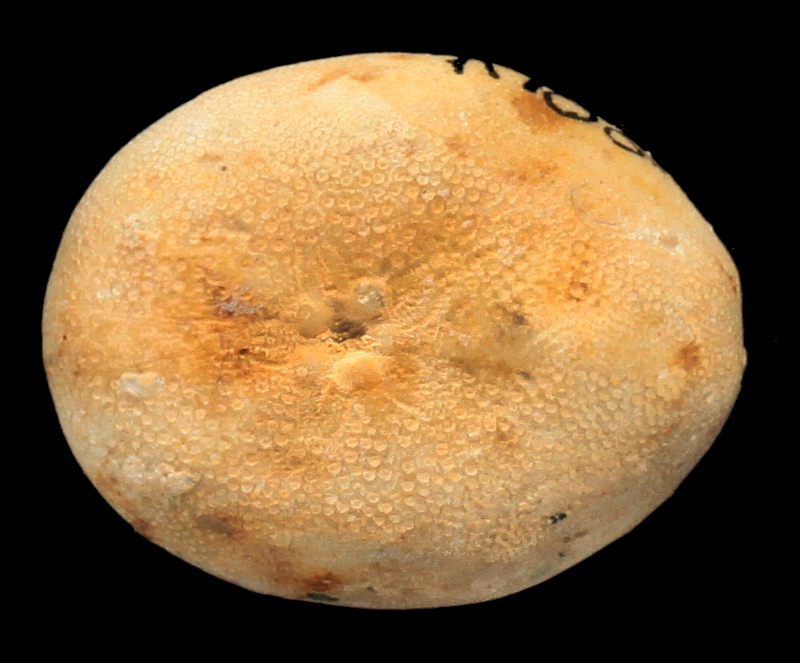 |
Diagnose originale du genre par Pomel,1888
Notes d'échinologie synonymique, p.446
|
6° PLIOLAMPAS, Pomel. Plesiolampas Pom. Genera et Pal. Alg. (non Duncan et Sladen). J 'avais dans mon Genera distrait du type Echinolampas, pour en former une section spéciale sous le nom de Plesiolampas, un Oursin décrit par M. Cotteau sous le nom de E. Gauthieri et dans la 2e livraison des Echinodermes de la Paléontologie Algérienne je l'ai élevé au rang de genre. Son péristome allongé suivant l'axe et bien floscellé, son périprocte transversal inframarginal, mais situé au-dessus du plan inférieur et regardant en arrière, l'atrophie fréquente d'un des quatre pores génitaux, le font facilement reconnaître. A la même époque MM. Duncan et Sladen publiaient un genre Plesiolampas, bien différent du mien dont la priorité devient contestable, d'autant plus que dans le Genera ce nom ne figure qu'avec la valeur de section. Je préfère donc y renoncer et le remplacer par celui de Pliolampas, qui, je l'espère, aura un meilleur sort. Ce nouveau genre a pris depuis sa création une certaine importance par suite de l'adjonction à l'espèce typique d'un. certain nombre d'autres déjà connues sous des désignations génériques qui en indiquent les affinités ou découvertes depuis lors, ainsi que je l'ai établi dans la 2° livraison des Échinodermes de la Paléontologie Algérienne. Leur synonymie devra être rectifiée ainsi : |
1.pliolampas subcylindricus (Ag. sub Pygorhynchus = Plesiolampas subcylindricus Pom., loc., cit. page 123. 2.pliolampas vassali (Wright, sub Pygorhynchus) = Plesiolampas Vassali Pom. loc. cit. page 123. 3.pliolampas elegantulus (Millet, sub. Echinolampas) = Plesiolampas elegantulus Pom. loc. cit. page 122. 4.pliolampas gauthieri (Cott. sub. Echinolampas) = Plesiolampas Gauthieri Pom. loc. cit. page 122. 5.pliolampas delagei (Pom. sub. Plesiolampas, loc. cit. page 123). 6.pliolampas ficheuri (Pom. sub Plesiolampas, loc. cit. page 424). 7.pliolampas welschii (Pom. sub. Plesiolampas, loc. cit. page 125). Toutes ces espèces sont des terrains miocènes..
|
Diagnose originale de l'espèce par Cotteau, 1883
|
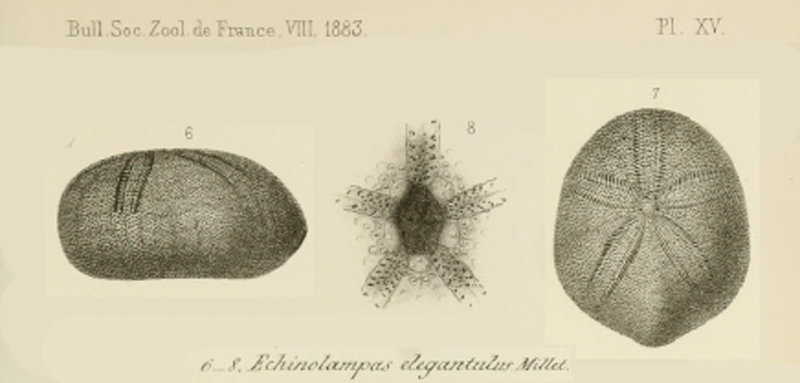
24 Echinolampas elegantulus Millet, 1854. Pl. XV, fig. 6-8
Espèce de moyenne taille, oblongue, étroite et arrondie en avant, un peu élargie, subacuminée et légèrement rostrée en arrière. Face supérieure presque plane, épaisse et renflée sur les bords. Face inférieure déprimée, subpulvinée, à peine concave aux approches du péristome. Sommet ambulacraire très-excentrique en avant. Aires ambulacraires subpétaloïdes, larges, très ouvertes à leur extrémité, inégales, l'aire antérieure droite, un pelus étroite que les autres, les aires paires antérieures recourbées, les postérieurs plus longues. Zones porifères larges, à peu près égales entre elles dans leur largeur et leur longueur, composées de pores très inégaux, les externes allongés, virgulaires, les internes plus étroits et arrondis, unis les uns aux autres par un sillon oblique, subflexueux, très atténué. Tubercules abondants, scrobiculés, très serrés surtout vers l'ambitus, s'espaçant à la face inférieure autour de la bouche. Péristome un peu excentrique en avant, très allongé dans le sens du diamètre antéro-postérieur, pentagonal, granuleux sur les bords, entouré d'un floscelle apparent, s'ouvrant dans une dépression à peine marquée de la face inférieure. Périprocte largement ouvert, irrégulièrement arrondi, un peu ovale, presque à fleur de test, placé immédiatement au-dessus du bord postérieur. Appareil apical grand, pentagonal, stelliforme, remarquable par le développement de la plaque madréporiforme qui se prolonge irrégulièrement au milieu de l'appareil ; trois pores génitaux bien accentués ; le pore génital antérieur de gauche et le pore génital postérieur sont atrophiés ; cinq pores ocellaires. Hauteur, 23mm ; diamètre antéro-postérieur, 42mm ; diamètre transversal, 35mm. Rapports et différences. - Cette jolie espèce, mentionnée pour la première fois par M. Millet, sous le nom d'Echinolampas elegantula, n'a jamais été ni décrite ni figurée. Son périprocte, de forme légèrement ovale, situé un peu au-dessus du bord, au sommet d'un sillon vague et atténué, nous avait d'abord engagé à ranger cette espèce dans le genre Echinanthus ; nous avons pensé depuis que son périprocte large, arrondi au sommet et placé très |
bas l'éloignait un peu des véritables Echinanthus, dont le périprocte est toujours très étroit, aigu à sas partie supérieure et s'ouvre au sommet d'un sillon bien accusé. Aussi avons-nous préféré laisser provisoirement l'espèce parmi les Echinolampas. L'E. elegantulus, parfaitement caractérisé du reste par sa forme générale, par la largeur de ses aires ambulacraires, par son péristome étroit, allongé, nettement pentagonal, par son périprocte un peu ovale, bien développé, supramarginal, par son appareil apical stelliforme, muni de trois pores génitaux seulement, se distinguera toujours facilement de toutes les espèces que renferme le genre Echinolampas. Localités. - Chavagnes, Martigné, Doué (Maine-et-Loire). Très rare. Terrain miocène. Collection de M. l'abbé Bardin. Explication des figures. - Pl. XV, fig. 6, Echinolampas elegantulus, vu de côté ; fig. 7, face supérieure ; fig. 8, péristome grossi. planche XV (extrait)
|

|
Pliolampas elegantulus (Cotteau,1883) - Langhien, Maigné le vicomte, Maine-et-Loire, 32 mm |
,%20apical,%20Meigné%20le%20Vicomte,%20Maine%20et%20Loire,%20Langhien,%2032%20mm.jpg) |
,%20ambital,%20Meigné%20le%20Vicomte,%20Maine%20et%20Loire,%20Langhien,%2032%20mm.JPG) |
,%20periprocte,%20Meigné%20le%20Vicomte,%20Maine%20et%20Loire,%20Langhien,%2032%20mm.jpg) |
,%20oral,%20Meigné%20le%20Vicomte,%20Maine%20et%20Loire,%20Langhien,%2032%20mm.jpg) |
Diagnose originale de l'espèce par Wright
|
Pygorhynchus Vassalli, Wright, n. sp. Test oblong, wider behind than before ; interambulacrum produced into a caudal elongation ; petaloid portions of the ambulacral areas narrow and short ; sides tumid ; anus small, round, nearer the inferior border than the dorsum, with a projecting beak-like process arching over its upper border, and an oblique truncature of the lower part of the border below ; base slightly concave ; mouth pentagonal, nearly central ; oral lobes small ; rays of the poriferous star around the margin short. Dimensions. - Antero-posterior diameter 13/20 inch, transverse diameter 7/10ths of an inch, height nearly 6/10ths of an inch. Most of the specimens average only from one-half to two-thirds of these dimensions. The large specimen before us is the most perfect we have examined. Description. - This small Urchin has an oblong form ; it is rounded before, a little enlarged towards the junction of the middle with the posterior third, which is produced into a caudal process. The sides are tumid, and the upper surface is flattened ; the petaloid portions of the ambulacras areas are nrrow and short, and form only a star on the dorsum ; the single and postero-lateral areas are nearly alike in width and length ; the antero-lateral pair are rather wider and shorter, they are 7/20ths of an inch in length, and are slightly curved forwards and outwards ; their poriferous zones contain eighteen pairs of pores, arranged in narrow rows, and not united by any apparent slit. The postero-lateral areas are 8/20ths of an inch in length, and their zones contain twenty pairs of pores; these areas are directed much backwards, which makes the width of the lateral interambulacra proportionally greater. The apical disc is nearly central, but nearer the anterior border ; it has four large genital pores, and five well-marked eye-holes. The single ambulacrum is almost identicalin length and width with theposterior pair ; the apices of all the ambulacra are rather rounded than landeolate. The lateral interambulacra we have said are very wide, but the single interambulacrum is narrow, and forms a conspicuous prolongation of beak-like process, which arches over the upper border of the round anal opening, situated rather below the middle of the posterior border, in an oblique truncature of the test : this beak-like process |
is not seen in the small specimens before us ; it would therefore appear to be a character of the adult condition only. The base is slightly concave towards the mouth, which is situated nearer the anterior border ; it has a pentagonal form, with five small oral lobes covered with tubercles ; between them, the temrinations of the ambulacra form five short poriferous petals. The tubercles on the upper surface are small and irregularly disposed on the plates ; those on the base are a little larger, especially in the vicinity of the mouth. Affinities and differences. - This species resembles Catopygus fenestratus from the upper chalk of Ciply, Belgium, but is distinguished from it by having the sides more tumid and the upper surface flatter ; the posterior border is likewise more produced ; it distinctly differs from it however in having the base slightly concave, and the oral lobes less developed. It differs from Nucleolites (Pygorhynchus) subcarinatus, Goldf., from the middle tertiaries of Bünde, in having more tumid sides, a less concave base, and a different form of the anal opening. From the very brief notice of Catopygus conformis, Desor, from the tertiaries of Orglande, it is impossible to form any idea how far it may resemble that form, at it is neither figured nor described, but merely entered in the "Catalogue raisonné" with this remark : "Mais l'anus est un peu plus bas, et la face supérieure plus surbaissée." Locality and stratigraphical position. - Collected from bed No. 1, Malta, where it is extremely rare. Specimens are in the collection of the Geological Society, the Jermyn Street Museum, and the cabinet of Earl Ducie. We dedicate this species to Dr. Vassalo of Malta, under whose judicious care and continued research the public collection of Maltese fossils has been greatly enriched.
|
|
Pliolampas vassalli (Wright, 1855) - Lower Globigerina limestone, Malte, 21 mm |
,%20apical,%20Lower%20Globigerina%20Limestone,%20Malte,%2021%20mm.JPG) |
,%20ambital,%20Lower%20Globigerina%20Limestone,%20Malte,%2021%20mm.JPG) |
,%20periprocte,%20Lower%20Globigerina%20Limestone,%20Malte,%2021%20mm.JPG) |
,%20oral,%20Lower%20Globigerina%20Limestone,%20Malte,%2021%20mm.JPG) |
|
Pliolampas vassalli (Wright, 1855) - Miocene, Albacete, Espagne, 22 mm |
,%20apical,%20Miocene,%20Albacete,%20Espagne,%2022mm.jpg) |
,%20ambital,%20Miocene,%20Albacete,%20Espagne,%2022mm.jpg) |
,%20periprocte,%20Miocene,%20Albacete,%20Espagne,%2022mm.jpg) |
,%20oral,%20Miocene,%20Albacete,%20Espagne,%2022mm.jpg) |
|
Pliolampas vassalli (Wright, 1855) - Miocene, Albacete, Espagne, 25 mm |
,%20apical,%20Miocene,%20Albacete,%20Espagne,%2025mm.JPG) |
,%20ambital,%20Miocene,%20Albacete,%20Espagne,%2025mm.JPG) |
,%20periprocte,%20Miocene,%20Albacete,%20Espagne,%2025mm.JPG) |
,%20oral,%20Miocene,%20Albacete,%20Espagne,%2025mm.JPG) |
|
Pliolampas vassalli (Wright, 1855) - Pliocene, Norna, Albacete, Espagne, 22 mm |
%20apical,%20Pliocène,%20Norna,%20Albacete,%20Espagne,%2022%20mm.jpg) |
%20ambital,%20Pliocène,%20Norna,%20Albacete,%20Espagne,%2022%20mm.jpg) |
%20periprocte,%20Pliocène,%20Norna,%20Albacete,%20Espagne,%2022%20mm.jpg) |
%20oral,%20Pliocène,%20Norna,%20Albacete,%20Espagne,%2022%20mm.jpg) |
|
A revision of the genera and great groups of the Echinoidea, p.185 Espèce type Catopygus elegans Laube, 1869, par monotypie. Ueber einige fossile Echiniden von den Murray Cliffs in Sud-Australien, p.8 Extension stratigraphique (bibliographique, non vérifiée) : Oligocène - Actuel Syn. |
description du genre par Kier
Revision of the cassiduloid echinoids, p.216 (extrait de)
|
Genus STUDERIA Duncan Studeria Duncan, 1891. Journ. Linn. Soc. (Zool.), vol. 23, p. 185. Type species by monotypy, Catopygus elegans Laube. Synonyms : Hypselolampas Clark ; Phaleropygus De Loriol ; Tristomanthus Bittner. generic description Small to medium, elongate, smoothly rounded anterior margin, pointed or slightly truncated posterior, adorally depressed around peristome, moderately inflated ; apical system anterior, monobasal, three genital pores, no pres in left anterior genital plate ; petals long, straight, extending almost to margin, open, adjacent pore pairs widely spaced, ambulacral plates beyond petals single pored ; periproct marginal, longitudinal, slight groove extending adorally ; peristome anterior, slightly higher than wide ; bourrelets very strongly developed, inflated ; phyllodes slightly widened, single pored, with few pores ; buccal pores present ; tubercles slightly larger adorally, no naked, granular zone in interambulacrum 5. Comparison with other genera. - Studeria is very similar to Pliolampas, as both genera have open petals, usually three genital pores with no pore in the left anterior genital plate, similar phyllodes, and a higher than wide peristome. Studeria |
differs in having a marginal periproct, and more developed bourrelets. Perhaps these differences are not of sufficient importance to warrant maintenance of Studeria. Remarks. - Mortensen (1948, p. 234), along with many earlier workers, considered Studeria recens A. Agassiz as the type species of Studeria. However, as Duncan mentions only one species, S. elegans, in his original description of this genus, S. elegans must be the type species by monotypy. I have been unable to find any specimens of the type species but include below a description of a very similar species, S. subcarinatus (Goldfuss). Range and distribution. - Oligocene to Recent of Europe, Egypt, and Australia.
|
diagnose originale de l'espèce par Laube, 1869
Uber einige fossile Echiniden von den Murray cluffs, Süd Australien, p;190
|
Catopygus elegans Laube (Fig.7) NDR, fig.8 Kleine Körper von eigörmiger Gestalt, vorn zugerundet, etwas schmäler, hinten etwas breiter une zugespitzt. Die Oberseite ist zugerundet oben flach, zwischen den hinteren Petaloidien etwas höher asl vorn und in eine schwache Kante ausgezogen, welche über dem Periproct in einem kurzen stumpfen Schnäbelchen endiget. Die Petaloidien sind nicht vertieft, das Stirnpetaloid ist länger als eines des vorderen une hinteren Paares. Die äusseren Poren stehen etwas shief gegen die inneren, beide sind schwach conjugirt. Das vordere Paar macht einen offenen, das hintere einen spitzen Winkel zusammen. Auf dem Scheitel bemerkt man fünf Ocellaröffnungen une drei auffallend grosse Oviducalöffnungen. Die Basis ist am Rande gewulstet, in der Mitte concav. Zwischen dem Peristom une Hinterrande der Basis tritt ein fast Plastron-ähnliches, dreieckiges Stück aus der Fläche hervor. Das Peristom ist fünfseitig, von einem wohlentwickelten Floscelle umgeben, dans durch starke Lippenknoten in die einselnen Blätter getheilt wird. Der schräg nach aufwärts gebohrte After mündet ziemlich hoch auf der Hinterseite, une hat unter sich eine schmale dreiseitige Fläche, welche nach oben hin in die Periproctal-öffnung ausgehöhlt ist. Das Geschlecht Catopygus, welches bisher in Europa nur aus den Ablagerungen der Kreideformation bekannt war, hat sich in vorstehend beschriebener Art zweifellos in den tertiären Ablagerungen von Murray cliffs erhalten, und es ist aus dem Aussehen der vorliegenden Exemplare auch gar nicht anzunehmen, dieselben könnten etwa älteren oder anderen Ablagerungen angehören. Äussert auffällig ist die grosse Ähnlichkeit der Art mit Catopygus carinatus Ag. aus der cenomenen Kreide ; ausser einem etwas vershieden Umriss, une einer bei C. elegans mehr gegen di Mitte gelegenen Periproct lässt sich kaum ein Unterschied finden, so dass man fast an die Fort-dauer der Art aus der Kreide in die Tertiärzeit zu glauben geneigt ist. Als Grössenverhältnisse ergaben sich : Länge 23 Mm. grösste Breite 20 Mm., Höhe über den Steitel 13 Mm., Länge des Stirn-petaloides 9 Mm., Länge der übrigen Petaloidien 7 Mm. |
,%20apical,%20Villajoyosa,%20Alicante,%20Espagne,%20Oligocène,%2021%20mm.JPG) |
,%20amb,%20Villajoyosa,%20Alicante,%20Espagne,%20Oligocène,%2021%20mm.JPG) |
,%20ant,%20Villajoyosa,%20Alicante,%20Espagne,%20Oligocène,%2021%20mm.jpg) |
,%20periprocte,%20Villajoyosa,%20Alicante,%20Espagne,%20Oligocène,%2021%20mm.JPG) |
,%20oral,%20Villajoyosa,%20Alicante,%20Espagne,%20Oligocène,%2021%20mm.JPG) |
|
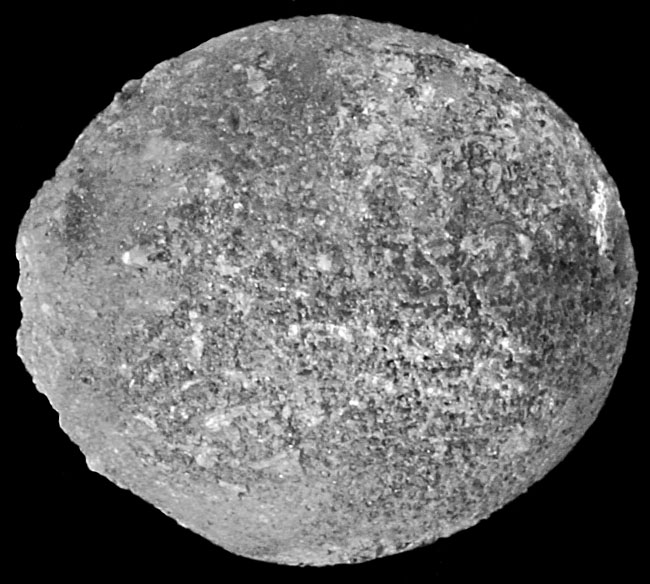
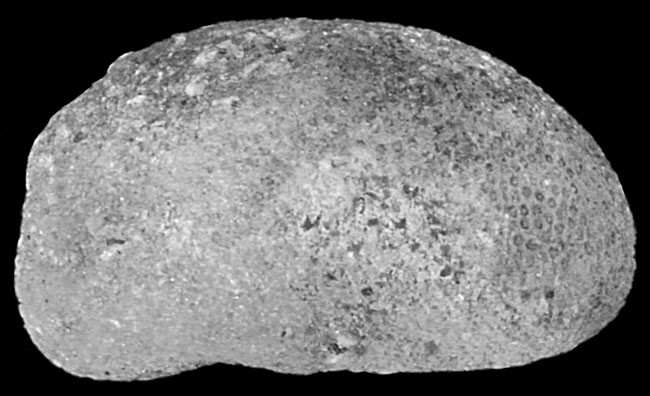
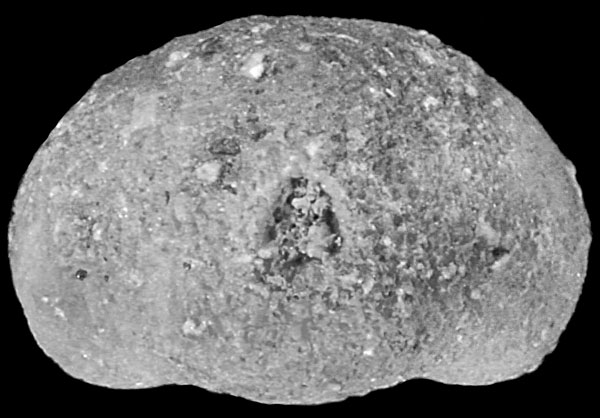
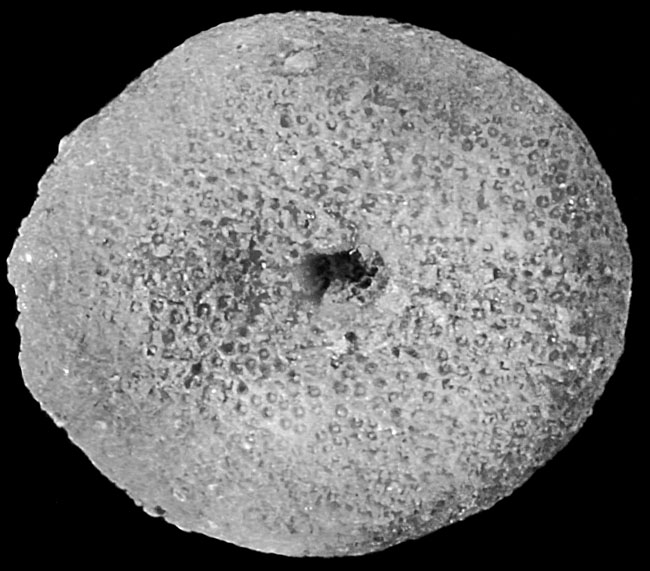
Studeria elegans (Laube, 1869) - Miocène inférieur, Mannum formation, Mypolonga, Australie du Sud, 16 mm |
 |
 |
 |
 |
|
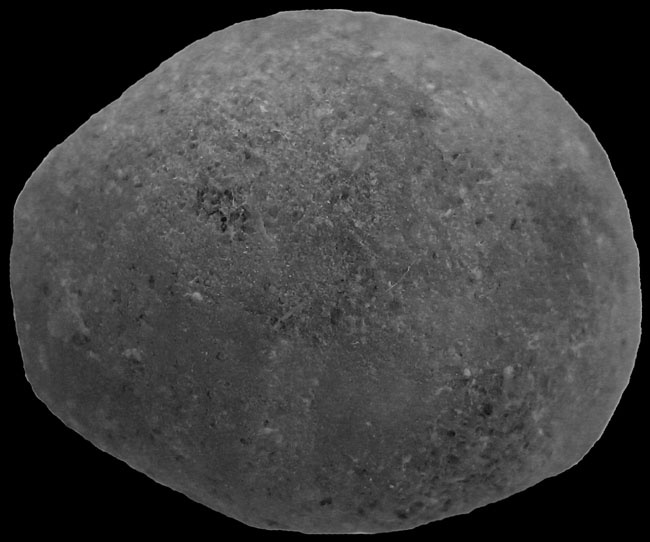
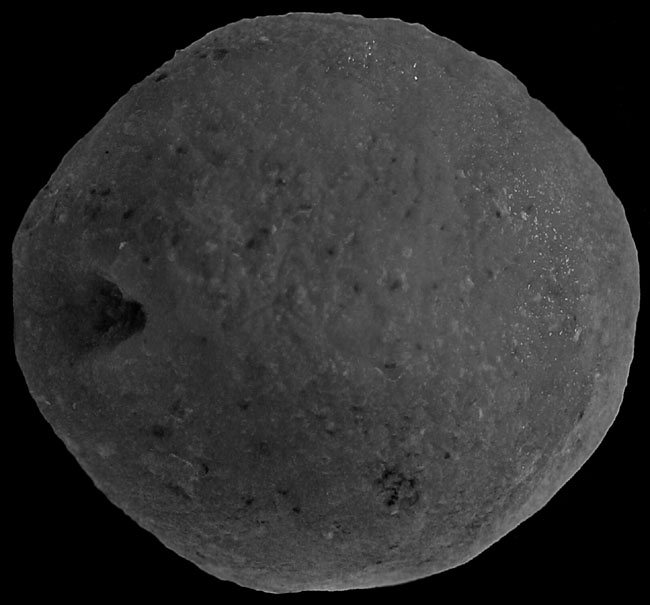
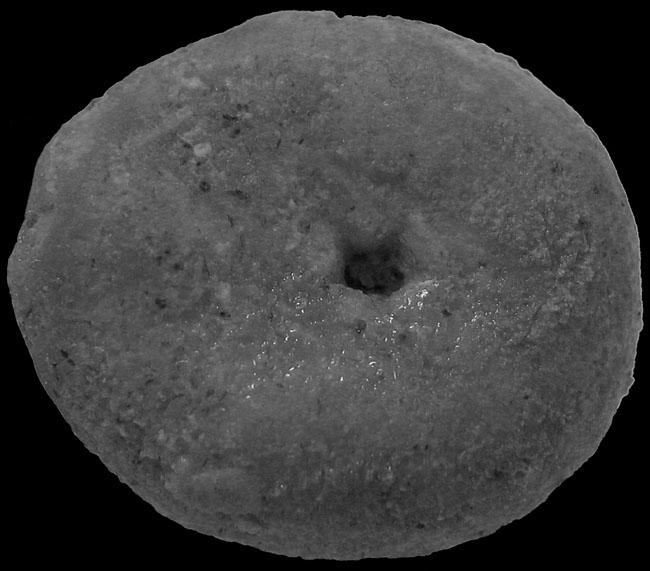
(Coll. J.F. D.) Studeria elegans (Laube, 1869) - Miocène inférieur, Mannum formation, Murray River, Australie du Sud, mm |
spécimen central incliné : vue plongeante 3/4
 |
 |
 |
|
Studeria elegans (Laube, 1869) - Oligocène, Alicante, Espagne, 25 mm |
,%20apical,%20Oligocene,%20Alicante,%20Espagne,%2025mm.JPG) |
,%20ambital,%20Oligocene,%20Alicante,%20Espagne,%2025mm.JPG) |
,%20periprocte,%20Oligocene,%20Alicante,%20Espagne,%2025mm.JPG) |
,%20oral,%20Oligocene,%20Alicante,%20Espagne,%2025mm.JPG) |
description de l'espèce par Desor, 1856
Synopsis des échinides fossiles, p.296
|
subcarinatus Syn, Nucleolites subcarinatus Goldf. p. 142. Tab. XLIII. fig 10. — Pygorhynchns subcarinatus Agass. cat. syst. p. 5 — Petite espèce ondulée, voutée, subcarénée en arrière. Périprocte à la face postérieure. Pètales distincts, droits, étroits, les zônes porifères égalant en largeur l'espace interporifère. Dessous très concave. Péristome légèrement excentrique, entouré d'us floscelle très distinct, Q. 57. Tertiaire supérieur (Pliocène) de Biinde. Abondant. |
|
Studeria subcarinata (Goldfuss,1826) - Oligocène, Alicante, Espagne, 24 mm |
,%20apical,%20Oligocene,%20Alicante,%20Espagne,%2024mm.JPG) |
,%20ambital,%20Oligocene,%20Alicante,%20Espagne,%2024mm.JPG) |
,%20periprocte,%20Oligocene,%20Alicante,%20Espagne,%2024mm.JPG) |
,%20oral,%20Oligocene,%20Alicante,%20Espagne,%2024mm.JPG) |
|
Studeria subcarinata (Goldfuss,1826) - Oligocène, Alicante, Espagne, 22 mm |
,%20apical,%20Oligocène,%20Alicante,%20Espagne,%2022mm.JPG) |
,%20ambital,%20Oligocène,%20Alicante,%20Espagne,%2022mm.JPG) |
,%20periprocte,%20Oligocène,%20Alicante,%20Espagne,%2022mm.JPG) |
,%20oral,%20Oligocène,%20Alicante,%20Espagne,%2022mm.JPG) |
|
Studeria subcarinata (Goldfuss,1826) - Oligocène, Westphalie du Nord, Allemagne, 31 mm |
,%20apical,%20Oligocene,%20Westphalie%20du%20Nord,%20Allemagne,%2031mm.JPG) |
,%20detapical,%20Oligocene,%20Westphalie%20du%20Nord,%20Allemagne,%2031mm.JPG) |
,%20ambital,%20Oligocene,%20Westphalie%20du%20Nord,%20Allemagne,%2031mm.JPG) |
,%20periprocte,%20Oligocene,%20Westphalie%20du%20Nord,%20Allemagne,%2031mm.JPG) |
,%20oral,%20Oligocene,%20Westphalie%20du%20Nord,%20Allemagne,%2031mm.JPG) |
,%20detoral,%20Oligocene,%20Westphalie%20du%20Nord,%20Allemagne,%2031mm.JPG) |
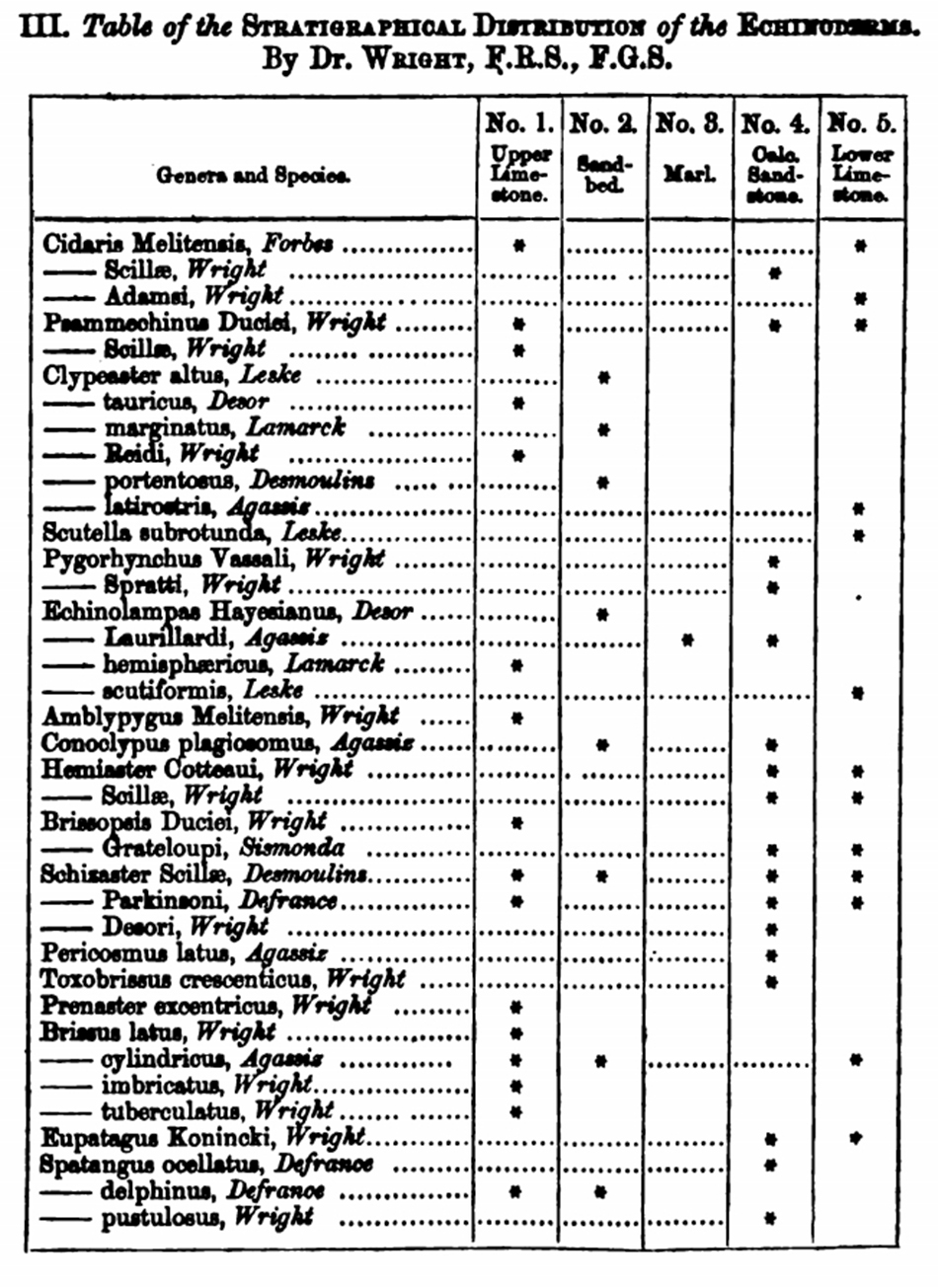
"diagnose" de l'espèce par Wright, 1864
On the fossil echinidae of Malta, p.490
 |
description de l'espèce par Cottreau, 1913
Echinides néogènes du bassin méditerranéen, p.113
|
Tristomanthus
Spratti Wright (Pygorynchus).
L'espèce, simplement figurée par Wright, a été décrite sous le nom de Studeria Spratti par M. J.-W. Gregory. M. J. Lambert [260] à fait remarquer qu'il s'agissait, en réalité, d'un Tristomanthus.
Tristomanthus Spratti Wr. n'était jusqu'ici connu que dans le
Burdigalien (Globigerina Limestone) de Malte. J'ai trouvé également,
cette espèce en Corse, à Saint-Florent, dans une mollasse blanche à
éléments plus ou moins granitiques, comparable aux mollasses, dites,
inférieures (zone à Clypeaster de Cotteau et Locard), des environs de
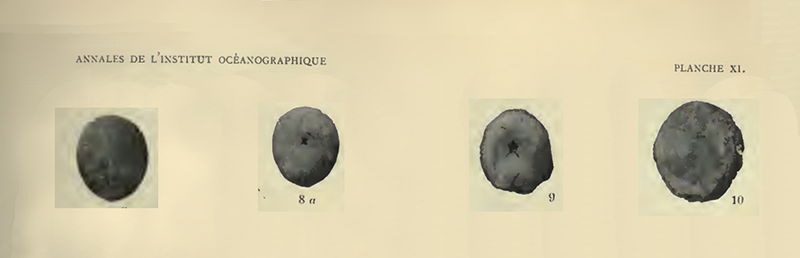
Bonifacio et, comme elles, d'âge Burdigalien. Je figure, pi. XI, fig.
9, 10, deux échantillons provenant de Saint-Florent : mes exemplaires
de Corse sont tous plus ou moins déformés, mais présentent,
manifestement, tous les caractères de l'espèce maltaise. Niveau.—Tristomanthus Spratti Wr. se trouve dans le Burdigalien à Malte et en Corse. A Saint-Florent, il est assez commun ; je l'ai recueilli avec la variété minor du Pericosmus latus Ag., espèce qui l'accompagne également à Malte dans le Globigerina Limestone. Les Tristomanthus Spratti Wr. du Globigerina Limestone de Malte sont souvent épigénisés en phosphate, tel l'échantillon figuré planche XI, fig. 8, 8 a. planche XI (extrait)
|
|
Studeria spratti (Wright,1864) - Upper Globigerina limestone, Phosphorite conglomerate bed, Malte, 15 mm |
,%20apical,%20upper%20globigerina%20lmst,%20phosphorite%20conglom%20bed,%20Malte,%2015mm.JPG) |
,%20ambital,%20upper%20globigerina%20lmst,%20phosphorite%20conglom%20bed,%20Malte,%2015mm.JPG) |
,%20periprocte,%20upper%20globigerina%20lmst,%20phosphorite%20conglom%20bed,%20Malte,%2015mm.JPG) |
,%20oral,%20upper%20globigerina%20lmst,%20phosphorite%20conglom%20bed,%20Malte,%2015mm.JPG) |
|
Studeria spratti (Wright,1864) - Miocène, Gozo, Malte, 24 mm |
%20apical%20Miocene%20Gozo%20Malte%2024%20mm.jpg) |
%20ambital%20Miocene%20Gozo%20Malte%2024%20mm.jpg) |
%20periprocte%20Miocene%20Gozo%20Malte%2024%20mm.jpg) |
%20oral%20Miocene%20Gozo%20Malte%2024%20mm.jpg) |