Pygasteridae
Lambert, 1899
Genre type : Conulus Klein, 1734
Description succinte de la famille : Périprocte en contact direct avec le disque apical.



diagnose originale du genre par Agassiz
Prodrome d'une monographie des radiaires ou echinodermes, 1836, p.185.
|
2.
Pygaster Ag. (Nucleolites
et Clypeus Auct.) - Disque circulaire ; ambulacres convergeant
uniformément vers le sommet ; orifice de l'anus grand, à la face
supérieure du disque. Espèces toutes fossiles, du Jura et de la Craie. P. semisulcatus Ag. (Clypeus semisulc. Phil.) - P. depressus Ag. (Nucleolites depr. Munst.) |

diagnose originale de l'espèce par Desor
Monographies d'échinodermes, Echinites, Famille des Clypéastroides, Troisième monographie, des Galérites, p. 79-80 (en fin de description de P. laganoides)
|
III. Pygaster laganoides Ag. Tab. 11, fig. 5-7
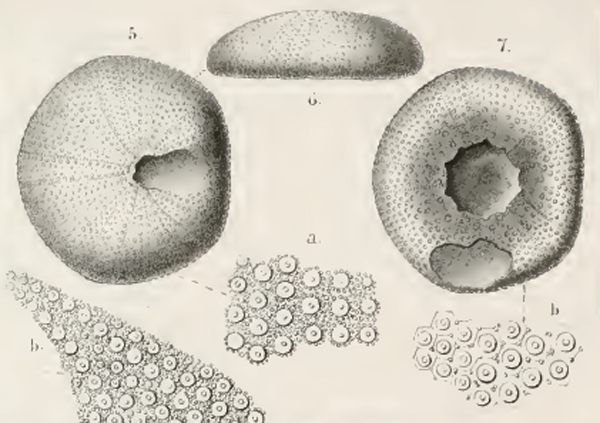
Cette espèce est proportionnellement très-aplatie. Sa hauteur égale à peine le tiers de sa longueur. Son diamètre longitudinal et son diamètre transversal sont à-peu-près égaux ; la plus grande largeur correspond aux aires ambulacraires antérieures. L'ouverture buccale est très-grande , car elle occupe à-peu-près le tiers du diamètre du test ; elle est en outre légèrement concave , et son pourtour présente des entailles fort distinctes. L'anus parait aussi avoir eu des dimensions considérables ; cependant, comme il n'est pas entièrement conservé dans l'exemplaire figuré, je ne saurais indiquer son pourtour d'une manière rigoureuse. Les détails du test sont admirablement conservés , et permettent d'étudier d'une manière fort exacte les tubercules. La simple inspection des fig. 5 , 6 et 7 montre leur disposition sériale. J'en compte douze séries dans les aires interambulacraires , et quatre dans les aires ambulacraires. La différence de grosseur entre les tubercules de la face supérieure et ceux de la face inférieure est peu sensible ; mais la manière dont ils sont entourés par les tubercules miliaires n'a pas la moindre ressemblance. Il suffira de comparer, à cet égard, les fig. 5 a et 7 b , qui représentent, la première, une portion de la face supérieure, et l'autre, une portion de la face inférieure, vues à la loupe. Dans la première , les tubercules sont entourés d'une infinité de tubercules miliaires très-serrés (fig. 5 a) , parmi lesquels il y en a de différentes grandeurs , entre autres, quelques-uns qui sont intermédiaires entre les tubercules principaux et les tubercules miliaires : dans la |
seconde, ils sont extrêmement rares et ne se trouvent qu'aux angles des gros tubercules qui sont juxtaposés de manière à présenter des figures hexagonales (fig. 7 b). Je ne connais jusqu'ici qu'un exemplaire parfaitement caractérisé de cette espèce ; il provient du calcaire à polypiers de Banville en Normandie , et a été communiqué à M. Agassiz par M. Eudes Deslongschamps. M. Agassiz, l'envisageant comme identique avec certains fragmens d'une espèce trouvée par M. Gressly dans le portlandien du Jura suisse, fit restaurer, d'après ce modèle , les figures qu'il a publiées dans sa Description des Echinodermes fossiles de la Suisse. Après avoir comparé de nouveau ces différens exemplaires entre eux , j'avoue qu'il m'est resté des doutes sur l'identité admise par M. Agassiz. Les exemplaires du portlandien suisse m'ont paru être plus renflés et avoir les tubercules plus gros et plus serrés à la face supérieure ; et comme ce sont précisément les plus petits exemplaires qui ont les plus gros tubercules, on ne peut guère attribuer cette différence à une variété d'âge; car, dans ce cas, ce serait l'inverse qui devrait avoir lieu. Je penche par conséquent à envisager l'espèce suisse comme distincte de celle de Normandie. On pourrait l'appeler P. Gresslyi Des. |

description de l'espèce par Cotteau
Paléontologie française, terrain jurassique, tome IX, échinides irréguliers, p.484
|
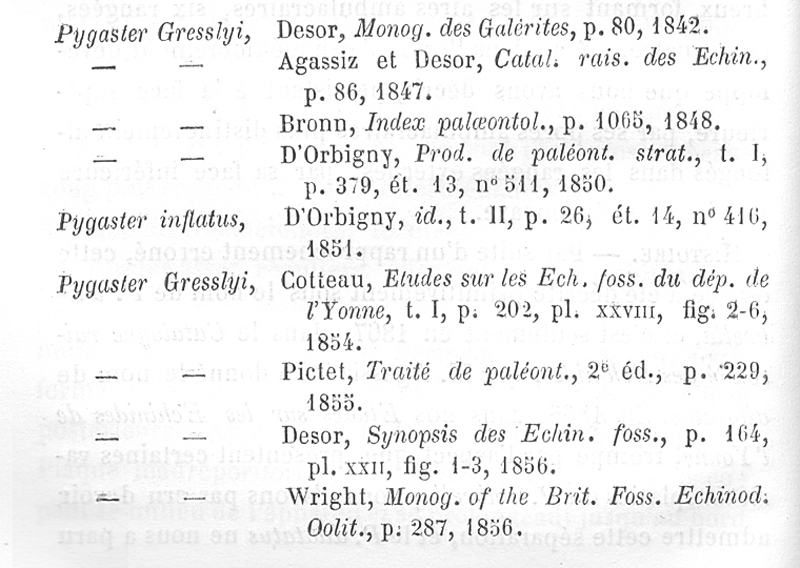
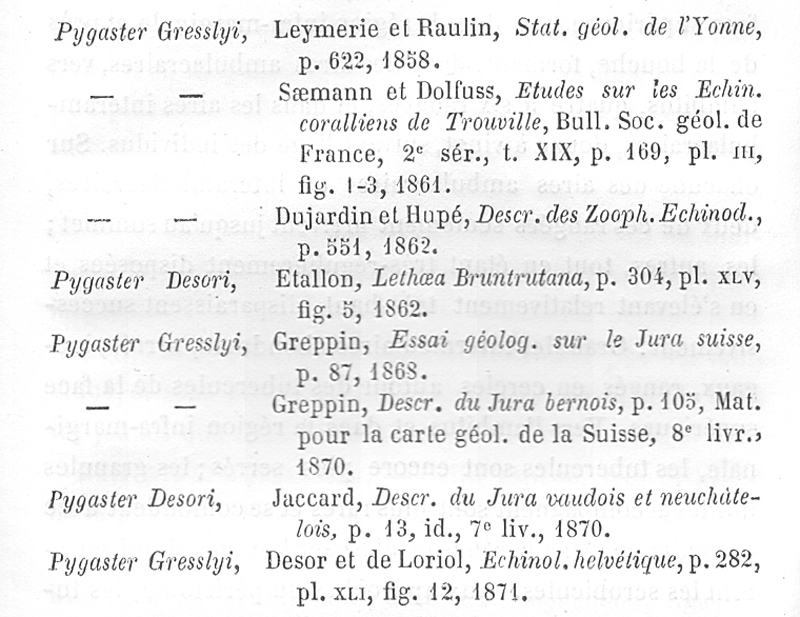
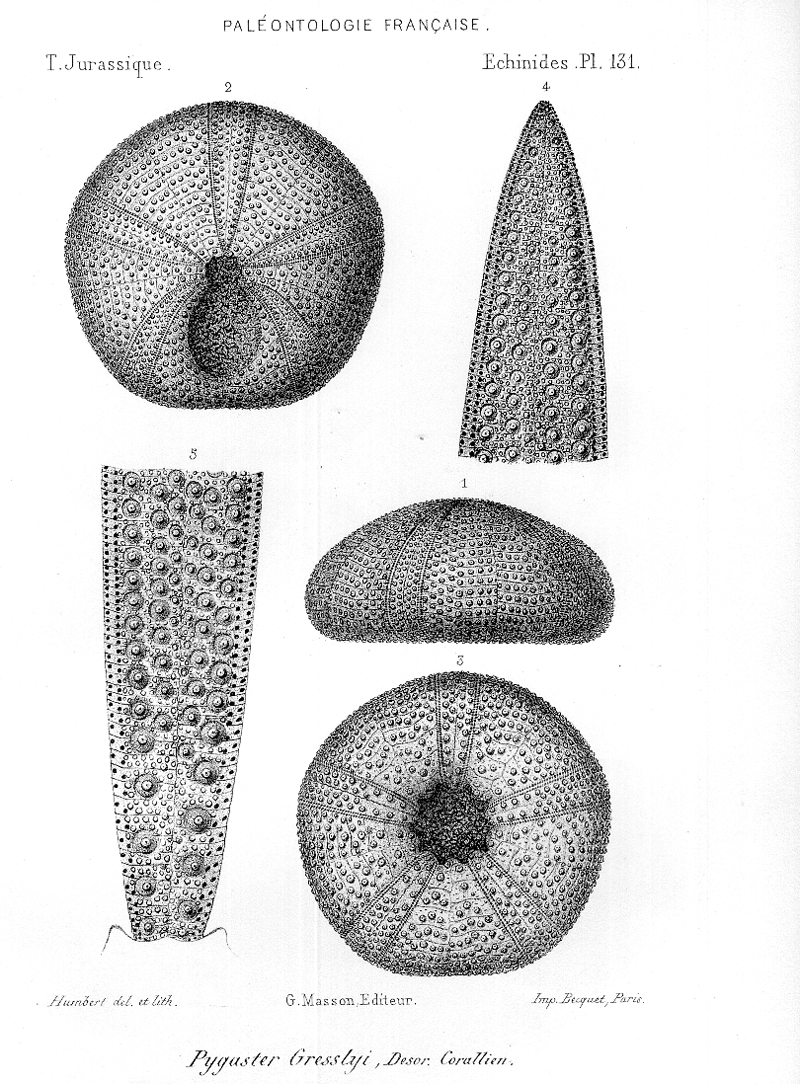
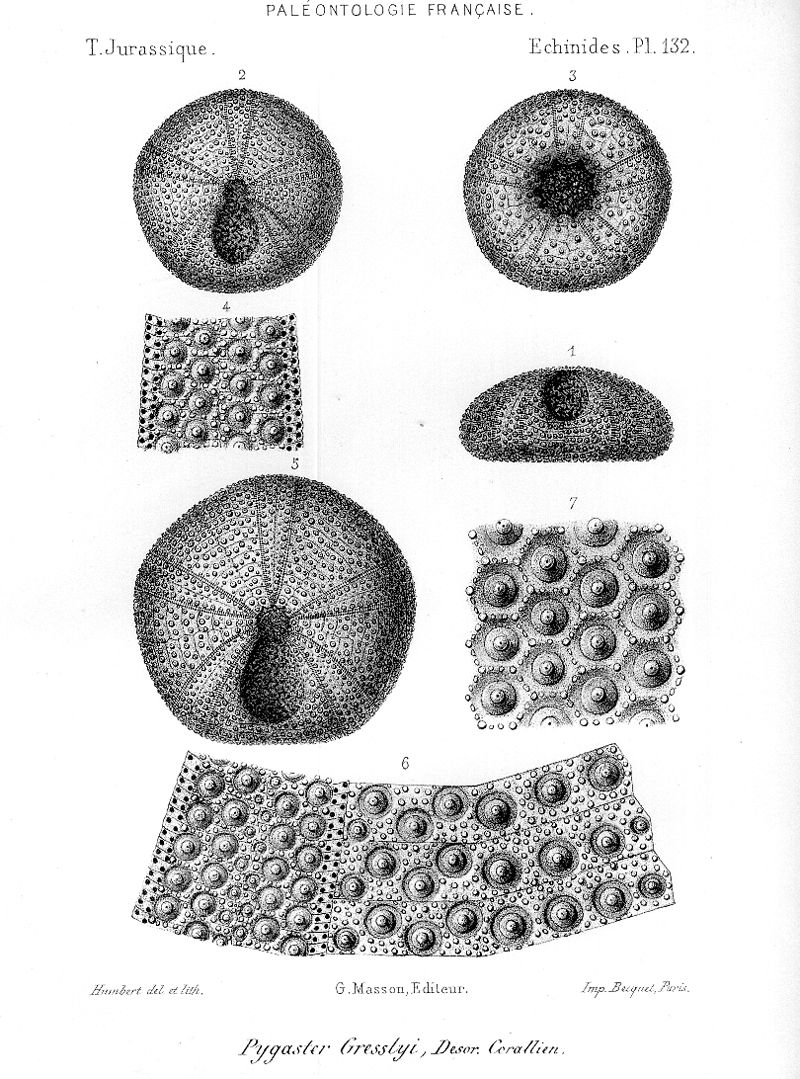
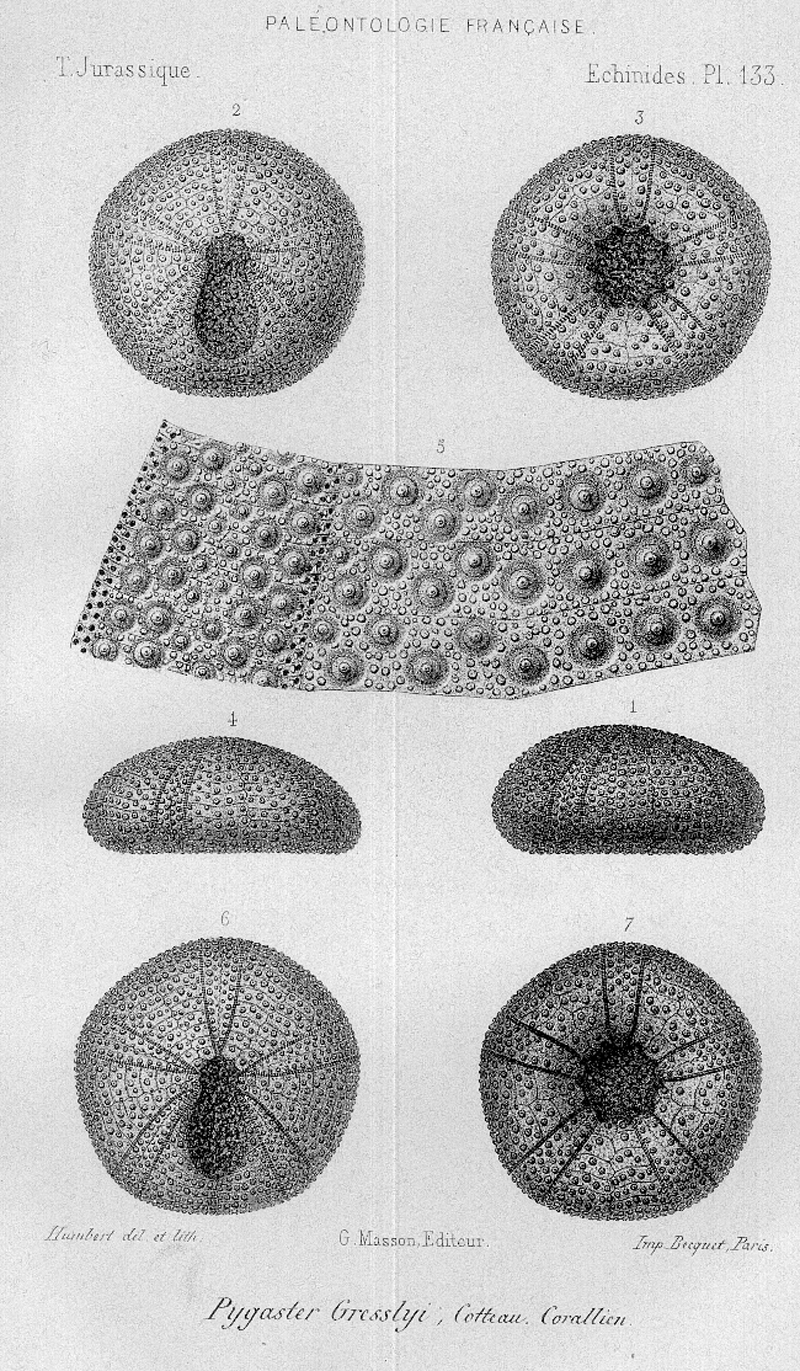
N° 116. - Pygaster Gresslyi, Desor, 1842. Pl. CXXXI, CXXXII et CXXIII.
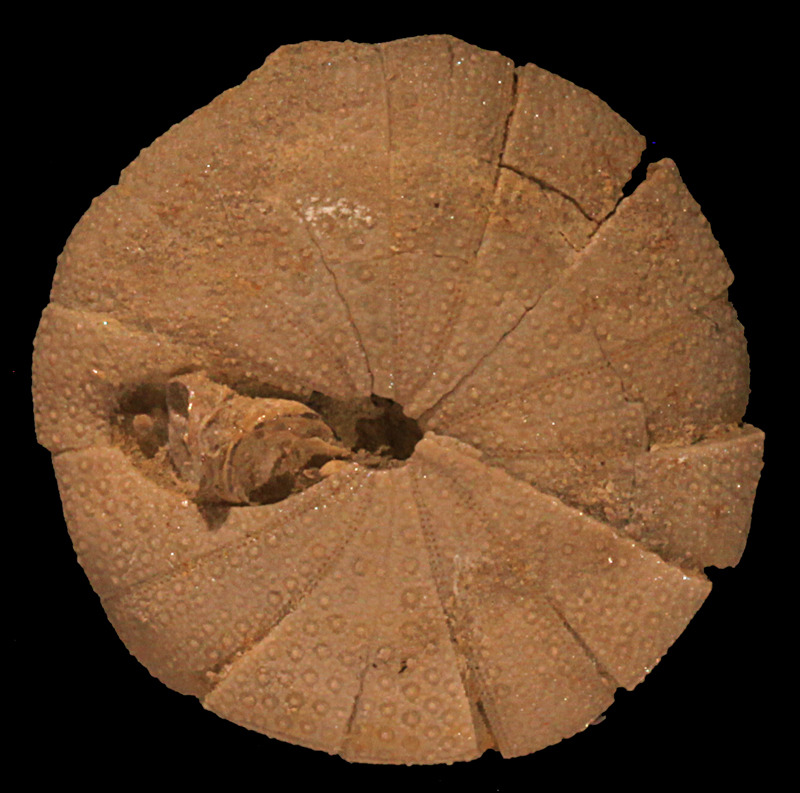
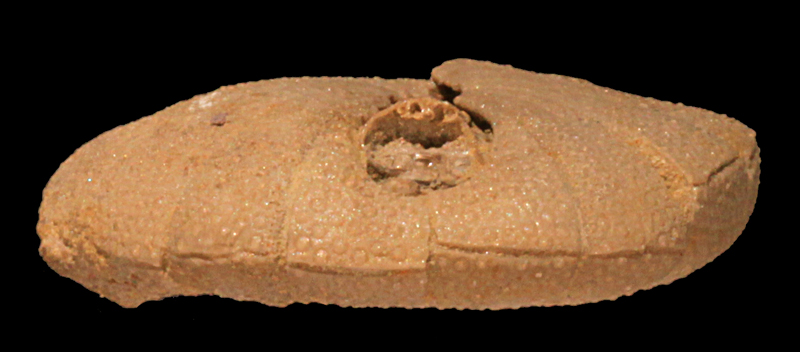
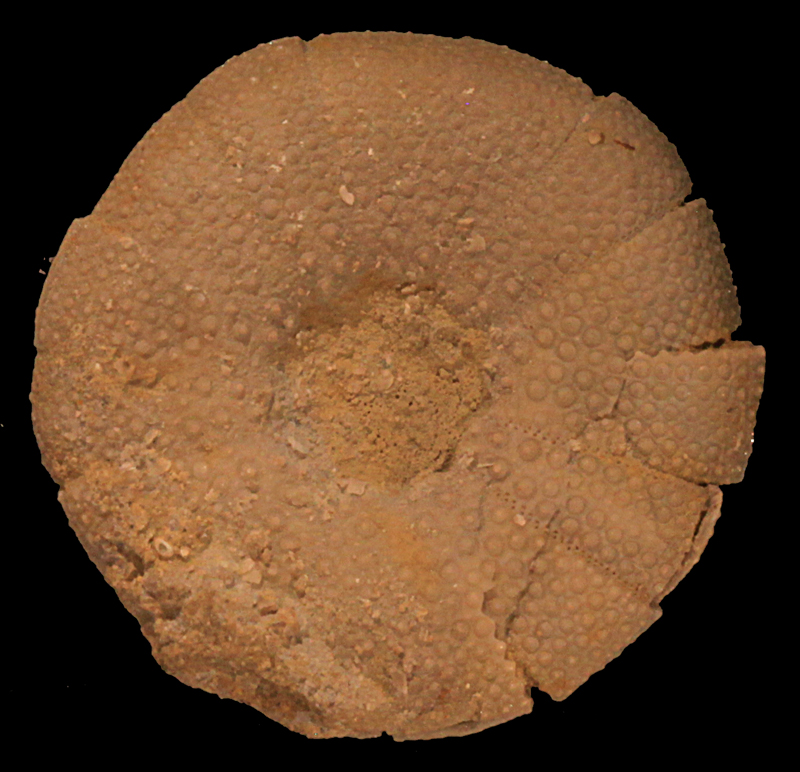
Espèce de taille moyenne, sub-circulaire, légèrement pentagonale, un peu plus large que longue ; face supérieure uniformément bombée, très-épaisse sur les bords, un peu déclive dans la région postérieure; face inférieure concave au milieu, sub-pulvinée sur les bords. Sommet ambulacraire un peu excentrique en arrière. Aires ambulacraires légèrement renflées, s'élargissant un peu en se rapprochant de l'ambitus, inégales, les postérieures moins longues que les autres et un peu recourbées à leur extrémité. Zones porifères droites, composées de pores égaux, arrondis, serrés, disposés horizontalement et très-régulièrement à la face supérieure. Aux approches du péristome les paires de pores s'espacent et deviennent plus obliques, sans dévier cependant de la ligne droite. Tubercules perforés et non crénelés, très-abondants, serrés, fortement scrobiculés, relativement assez développés, presque aussi gros à la face supérieure que dans la région infra-marginale et près de la bouche, formant, dans les aires ambulacraires, vers l'ambitus, quatre à six rangées, et dans les aires interambulacraires, douze à vingt, suivant l'âge des individus. Sur chacune des aires ambulacraires et interambulacraires, deux de ces rangées seulement arrivent jusqu'au sommet ; les autres, tout en étant très-régulièrement disposées et en s'élevant relativement très-haut, disparaissent successivement. Granules intermédiaires abondants, serrés, inégaux, rangés en cercles autour des tubercules de la face supérieure. Vers l'ambitus et dans la région infra-marginale, les tubercules sont encore plus serrés ; les granules qui les accompagnent sont plus rares et se confondent avec de petits cordons carénés et d'aspect hexagonal qui séparent les scrobicules. Aux approches du péristome, les tubercules devenant plus rares et plus espacés, les granules reprennent la forme qu'ils avaient à la face supérieure. Péristome sub-circulaire, médiocrement développé, muni d'entailles apparentes. Périprocte grand, large, pyriforme, arrondi à l'extrémité, occupant au moins les deux tiers de l'espace compris entre le sommet et le bord postérieur. Appareil apical sub-circulaire, dentelé sur les bords, compacte à en juger par l'empreinte qu'il a laissée. Hauteur, 27 millimètres; diamètre transversal, 54 millimètres 1 /2; diamètre antéro-postérieur, 52 millimètres. Individu jeune : hauteur, 15 millimètres ; diamètre transversal, 25 millimètres ; diamètre antéro-postérieur, 23 millimètres. Cette jolie espèce éprouve avec l'âge quelques variations que nous allons signaler : chez les individus les plus jeunes, le contour du test est sub-circulaire, et c'est seulement en vieillissant qu'il prend une forme légèrement pentagonale et s'allonge un peu transversalement ; la hauteur est en moyenne égale à la moitié de la longueur; un peu plus forte dans les jeunes, elle diminue au fur et à mesure que le test grossit, Les aires ambulacraires, dans le jeune âge, sont parfaitement à fleur du test, plus lard elles font une légère saillie à la surface du test ; dans les individus très-jeunes elles sont relativement beaucoup plus larges que chez les exemplaires adultes; le péristome et le périprocte se modifient également suivant Page des individus, et sont proportionnellement plus développés dans les jeunes que dans les adultes. Rapports et différences. - Cette espèce, très-distincte de la plupart de ses congénères par sa forme générale et la disposition toute particulière de ses tubercules, offre beaucoup de ressemblance avec le P. laganoides, Agassiz, qui caractérise un horizon beaucoup plus inférieur. Nous ne reviendrons pas sur les différences assez peu apparentes mais très-réelles qui séparent les deux espèces, et que nous avons indiquées plus haut, en décrivant le P. laganoides. |
Histoire. - Confondue dans l'origine avec le P. laganoides de Normandie, celte espèce en a été séparée pour la première fois par M. Desor qui l'a désignée, dans la Monographie des Galérites, sous le nom de P. Gresslyi qu'elle a conservé depuis. Nous lui réunissons le P. inflatus, d'Orbigny, et le P. Desori, Etallon. Nous avons sous les yeux les types mêmes qui ont servi à établir ces espèces, et il n'est pas douteux pour nous qu'ils ne doivent être réunis au P. Gresslyi. Localités. - Trouville (Calvados); Tonnerre (Yonne), Selongey (Côte-d'Or); Bazoches (Nièvre); Saulces-aux-Bois (Ardennes); la Rochelle (Charente-Inférieure), Roedersdorff (Haut-Rhin). Etage corallien. Ecole des mines, Muséum de Paris, coll. de la Sorbonne, coll. Martin, ma collection. Localités autres que la France. — Erschwyl (canton de Soleure); Montchaibeux, BI auen, Hartzberg près Raimeux (Jura bernois) ; Ste-Croix, Vaud (Suisse). Etage séquanien. Explication des figures. — PI. CXXXI, fig. 1, P. Gresslyi, du coral-rag de Trouville, de ma collection, vu de côté ; fig. 2, face supérieure; fig. 3, face inférieure ; fig, 4, aire ambulacraire prise à la partie supérieure, grossie; fig. 5, aire ambulacraire prise à la partie inférieure, grossie. — PI. CXXXII, fig. 1, autre individu de taille plus petite, du copal rag de Trouville, de ma collection, vu sur la région anale; fig. 2, face supérieure ; fig. 3, face inférieure ; fig.4, portion d'une aire ambulacraire grossie, prise vers l'ambitus ; fig. 5, autre exemplaire du coral rag de Tonnerre, vu sur la face supérieure, de ma collection ; fig. 6, plaques ambulacraires et interambulacraires grossies; fig. 7, tubercules grossis pris dans la région infra-marginale. — Pl. CXXXIII, fig. 1, autre exemplaire du coral rag des Ardennes, type du P. inflatus, d'Orbigny, vu de côté ; fig. 2, face supérieure ; fig. 3, face inférieure ; fig. 4, plaques ambulacraires et interambulacraires grossies ;fig. 5, autre exemplaire du coral rag de Roedersdorff (Haut-Rhin), type du P. Desori, Etallon, de la collection de M. Perron, vu de côté; fig. 6, face supérieure; fig. 7, face inférieure. Extrait planches CXXXI, CXXXII & CXXIII
|
|
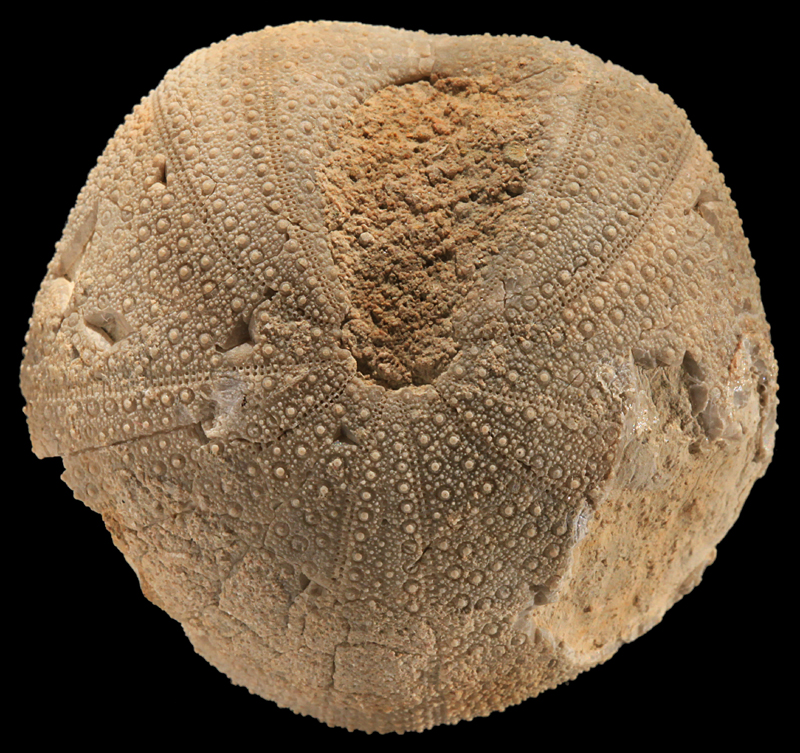
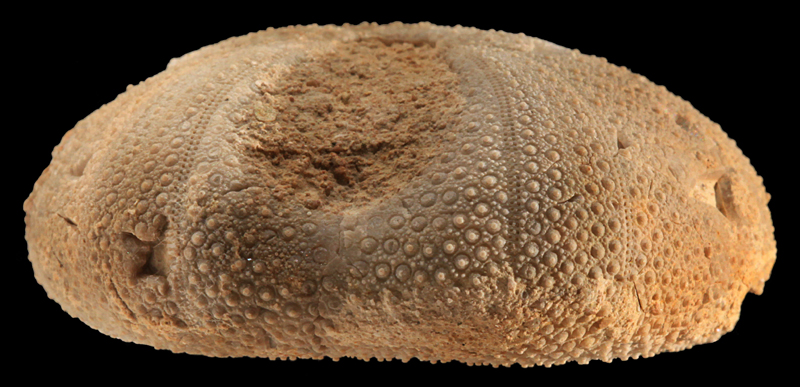
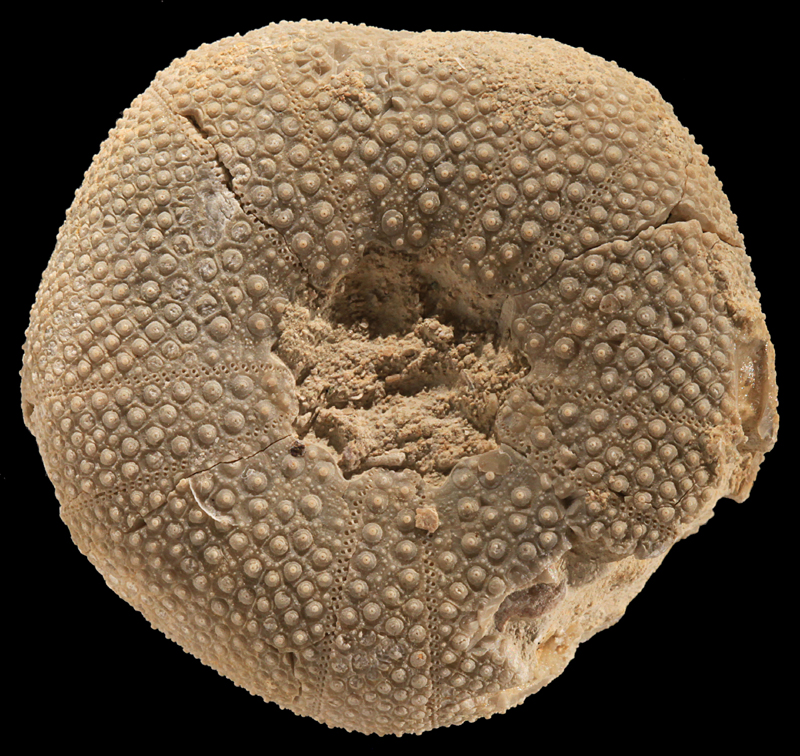
Pygaster gresslyi DESOR,1842 - Kimmeridgien, Châtelaillon plage, Charente Maritime, 35 mm |
 |
 |
 |
|
Pygaster gresslyi DESOR,1842 - Kimmeridgien, Châtelaillon plage, Charente Maritime, 27 mm |
 |
 |
 |
diagnose originale de l'espèce par Agassiz
Monographies d'échinodermes vivans et fossiles, p. 79
|
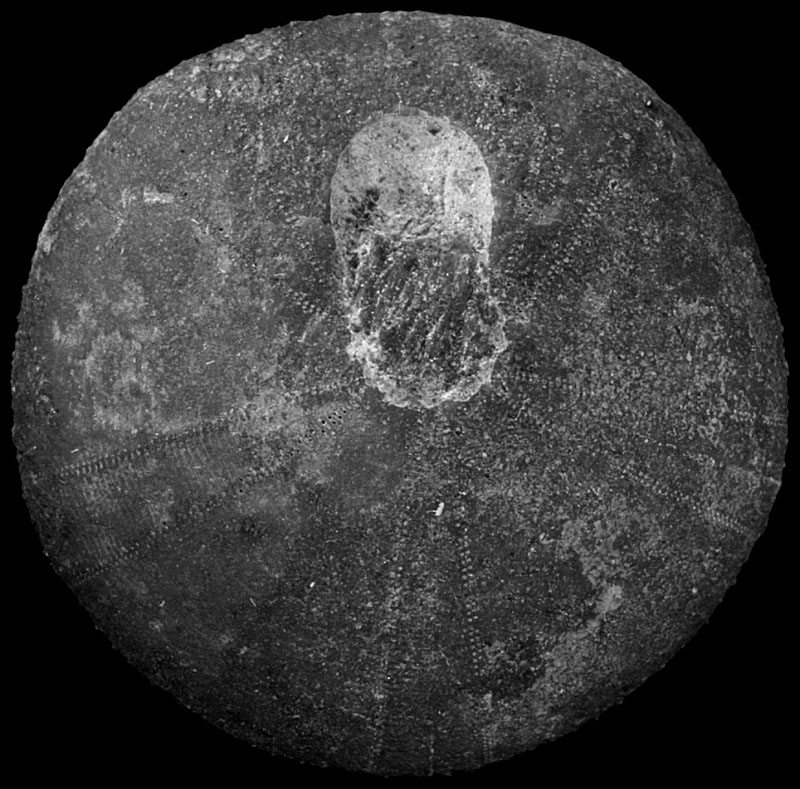
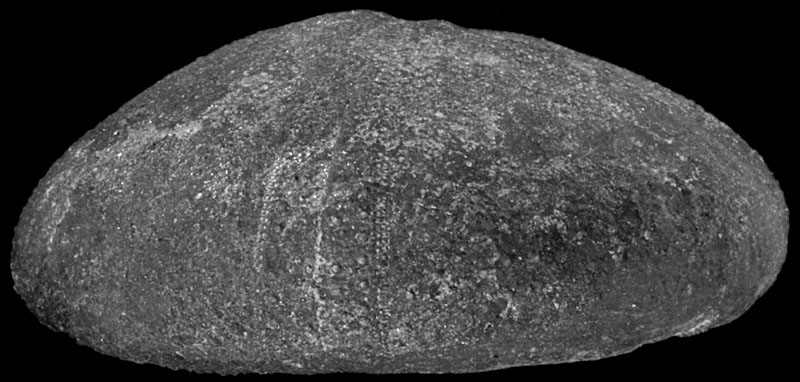
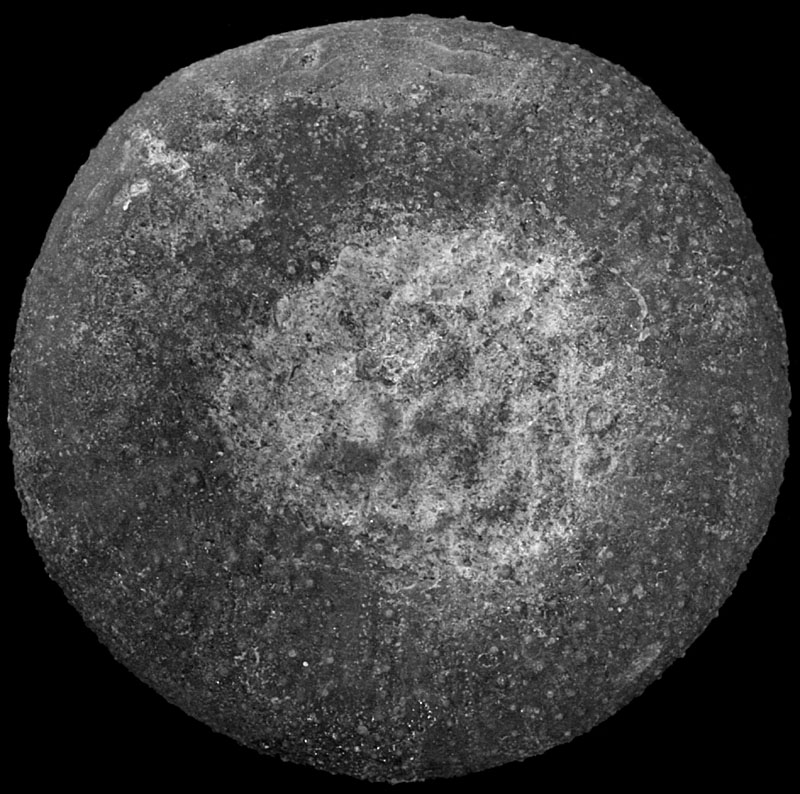
III. Pygaster laganoides Ag. Tab. 11, fig. 5-7. Syn. Pygaster laganoïdes Ag. Descr. des Ech. foss. de la Suisse 1re partie p. 81. Tab. 12, fig. 13-16. - Catal. syst. Ectyp. etc., p. 7. Cette espèce est proportionnellement très-aplatie. Sa hauteur égale à peine le tiers de sa longueur. Son diamètre longitudinal et son diamètre transversal sont à-peu-près égaux ; la plus grande largeur correspond aux aires ambulacraires antérieures. L'ouverture buccale est très-grande, car elle occupe à-peu-près le tiers du diamètre du test ; elle est en outre légèrement concave, et son pourtour présente des entailles fort distinctes. L'anus paraît aussi avoir eu des dimensions considérables ; cependant, comme il n'est pas entièrement conservé dans l'exemplaire figuré, je ne saurais indiquer son pourtour d'une manière rigoureuse. Les détails du test sont admirablement conservés, et permettent d'étudier d'une manière fort exacte les tubercules. La simple inspection des fig. 5, 6 et 7 montre leur disposition sériale. J'en compte douze séries dans les aires interambulacraires, et quatre dans les aires ambulacraires. La différence de grosseur entre les tubercules de la face supérieure et ceux de la face inférieure est peu sensible ; mais la manière dont ils sont entourés par les tubercules miliaires n'a pas la moindre ressemblance. Il suffira de comparer, à cet égard, les fig. 5 a et 7 b, qui représentent, la première, une portion de la face supérieure, et l'autre, une portion de la face inférieure, vues à la loupe. Dans la première, les tubercules sont entourés d'une infinité de tubercules miliaires très-serrés (fig. 5 a), parmi lesquels il y en a de différentes grandeurs, entre autres, quelques-uns qui sont intermédiaires entre les tubercules principaux et les tubercules miliaires : dans la seconde, ils sont extrêmement rares et ne se trouvent qu'aux angles des gros tubercules qui sont juxtaposés de manière à présenter des figures hexagonales (fig. 7 b). |
Je ne connais jusqu'ici qu'un exemplaire parfaitement caractérisé de cette espèce ; il provient du calcaire à polypiers de Ranville en Normandie, et a été communiqué à M. Agassiz, l'envisageant comme identique avec certains fragmens d'une espèce trouvée par M. Gressly dans le portlandien du Jura suisse, fit restaurer, d'après ce modèle, les figures qu'il a publiées dans sa Description des Echinodermes fossiles de la Suisse. Après avoir comparé de nouveau ces différens exemplaires entre eux, j'avoue qu'il m'est resté des doutes sur l'identité admise par M. Agassiz. Les exemplaires du portlandien suisse m'ont paru être plus renflés et avoir les tubercules plus gros et plus serrés à la face supérieure ; et comme ce sont précisément les plus petits exemplaires qui ont les plus gros tubercules, on ne peut guère attribuer cette différence à une variété d'âge, car, dans ce cas, ce serait l'inverse qui devrait avoir lieu. Je penche par conséquent à envisager l'espèce suisse comme distincte de celle de Normandie. On pourrait l'appeler P. Gresslyi Des. Extrait planche 11
|
|
Pygaster laganoides Agassiz, 1839 - Bajocien supérieur, Maroc, 29 mm |
 |
 |
 |
 |
IMPORTANT : nous classons ici ce taxon à part, car il est connu chez les collectionneurs comme étant une espèce différente, particulièrement par les spécimens provenant de Pologne, très bien conservés et trouvés dans le kimmeridgien. A priori seul le nombre de rangées de tubercules ambulacraires et interambulacraires les sépare. Toutefois, à l'instar des auteurs récents, nous le mettons en synonymie avec le Pygaster laganoides. Merci donc de ne pas tenir compte de cette pseudo coupure taxinomique qui n'a pas de sens dans la classification, mais est là uniquement pour aider les collectionneurs amateurs à retrouver leurs spécimens.
description de l'espèce par Wright here synonymized with P. laganoides as in the recent litterature (cf. supra)
British fossil echinodermata of the oolitic formations, p.280
|
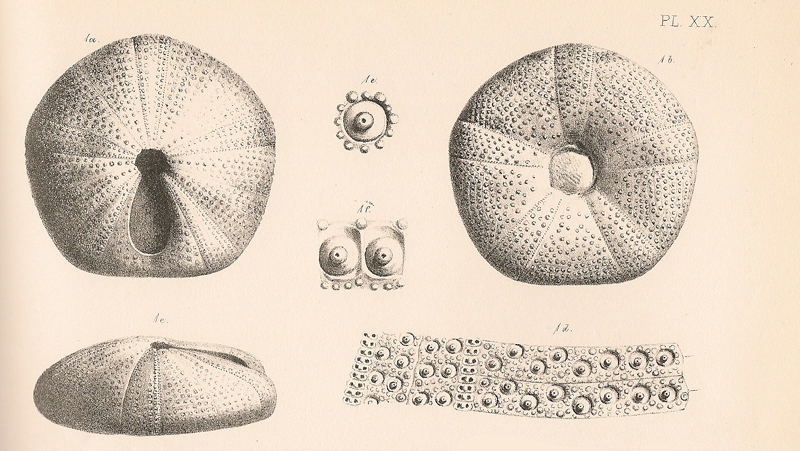
Pygaster Morrisii, Wright. Pl. XX, fig. 1 a, b, c, d, e, f.
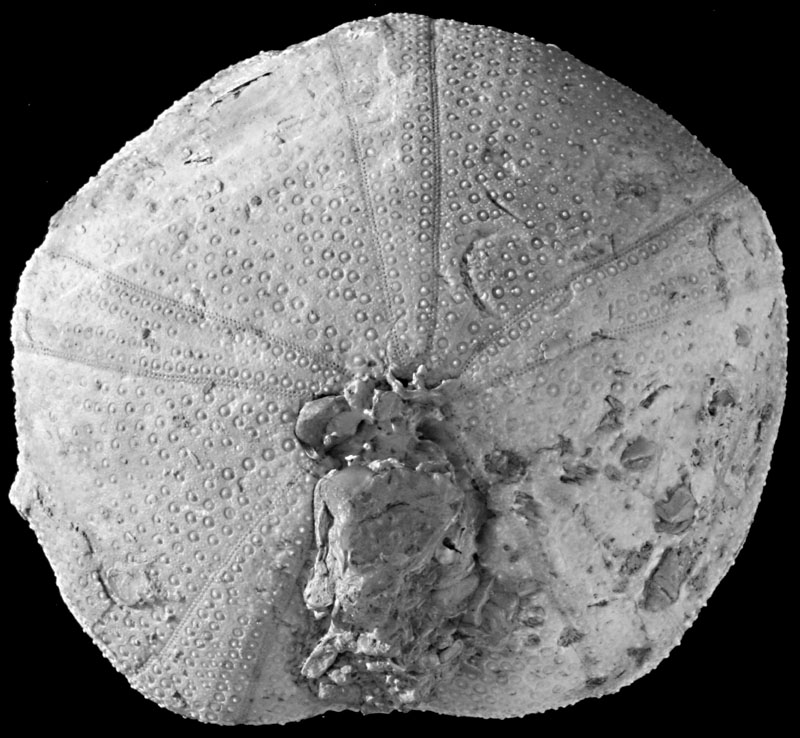
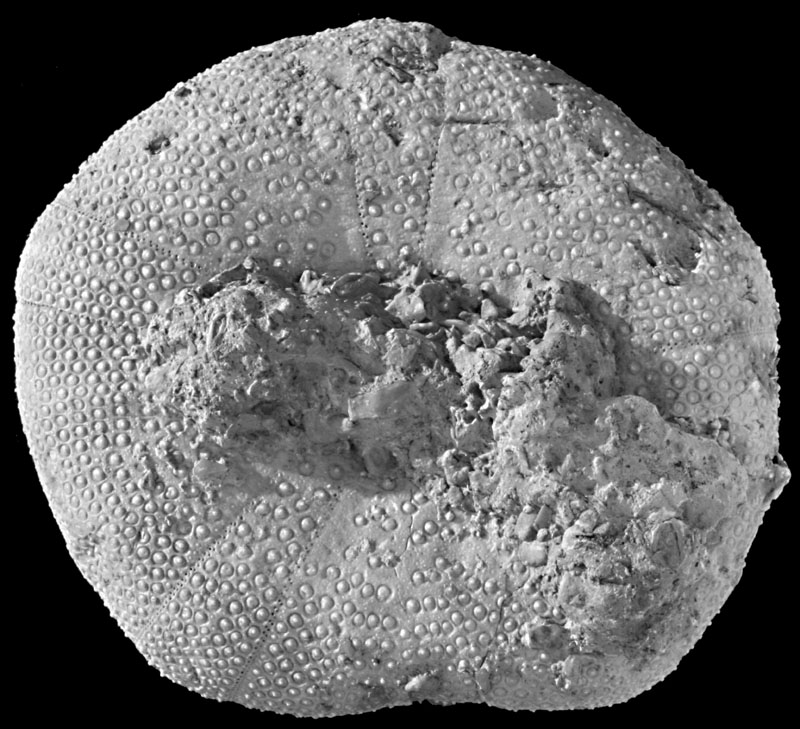
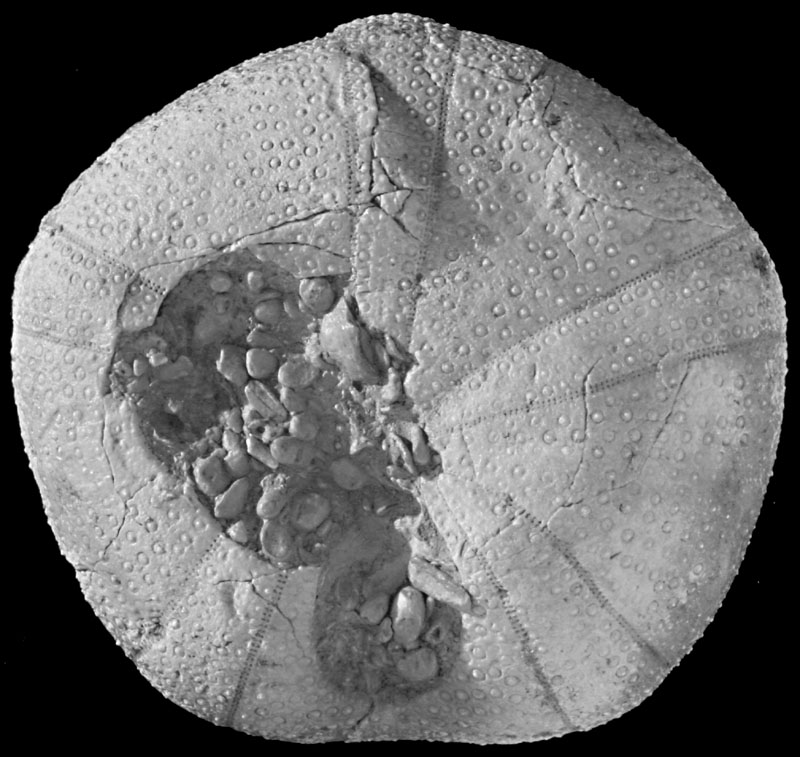
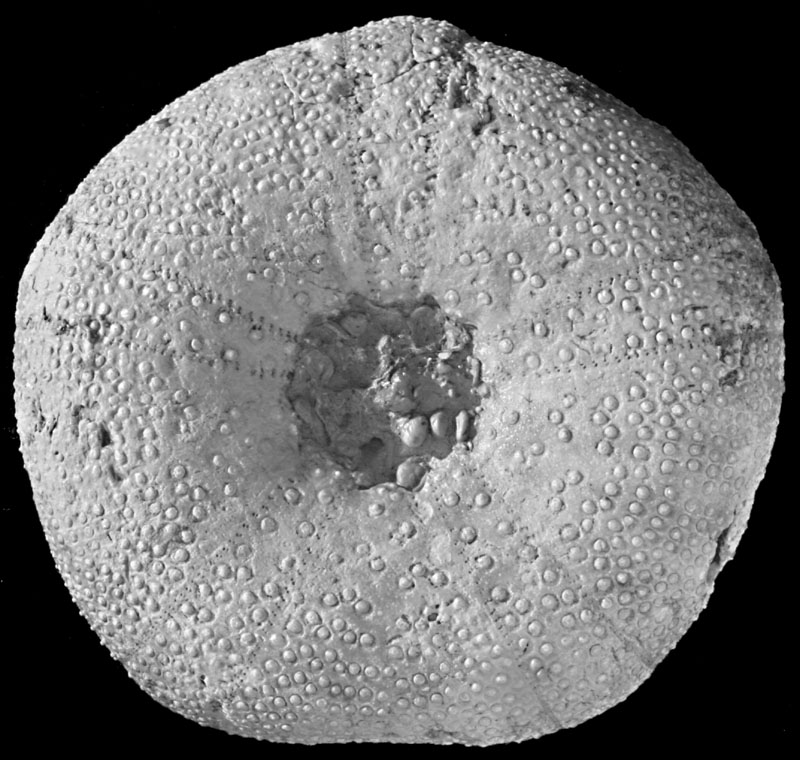
Test pentagonal, depressed ; marginal fold very tumid ; single inter-ambulacrum much trucated ; ambulacral areas wide, convex, and prominent, with six rows of tubercles ; inter-ambulacr'al areas wide, with rather large tubercles, in very regular vertical and horizontal rows, from twenty to twenty-two in each space on the same horizontal line at the equator ; base falt, concave towards the mouth opening, which is small ; anal opening long, pyramidal, occupying two thirds of the upper surface of the inter-ambulacrum. Dimensions. - Height, eight tenths of an inch ; antero-posterior diameter, two inches and three twentieths of an inch ; transverse diameter, two inches and a quarter of an inch. Description. - This is one of our rarest Pygasters, and the spécimen figured is the only one I know. It has a thick test, with a very perntagonal outline, is much depressed on the dorsal surface, has a flat base, tumid sides, is remarkable for the size of its tubercles, and for the regularity of their arrangement in vertical and horizontal rows. The ambulacral areas are wide, convex, and prominent, and form an exception to the generalisation of M. Agassiz, that in the genus Pygaster the ambulacra ar furnished with only four rows of tubercles, for in this species at the widest part of the area there are six rows of well-developed tubercles (fig. 1 a, b) ; the two marginal rows, with about forty-five tubercles in each row, extend from the peristome to the disc ; the second rows commence at a short distance from the mouth, and extend two thirds of the length of the upper surface ; the third rows commence at the base, about half an inch from the border, and extend to about the same distance up the sides of the area (fig. 1 b). The poriferous zones are straight, the pores have moderately thin septa, with only slight elevations on the surface, and there are four pairs of pores opposite each interambulacral plate (fig. 1 d). The inter-ambulacral areas are three times the width of the ambulacral ; at the circumference they are furnished with twenty-two rows of tubercles, which attain a greater size and are arranged with more regularity than in any other English species ; each plate above the circumference has from eight to nine tubercules developed on its surface (fig. 1 d) ; those on the half of the plate nearest the centro-suture are arranged horizontally on the same line, whilst the tubercles nearest the zones form double rows in oblique pairs. The tubercles are raised on prominent bosses, and surrounded by wide, sharply defined, sunken areolas (fig. 1 d) ; each areola is surrounded by a circle of granules (fig. 1 e) ; there are thirty-six pairs of plates in each area, twenty-one of which are dorsal and fifteen are basal. The tubercles attain their greatest development at the base, where they are so uniformly arranged, and so closely set together, that they appear to arise from hexagonal spaces (fig. 1 b) ; the areolas are deeply excavated (fig. 1 f), and have a square or hexagonal figure, two sides being bounded by granules, the other |
two by sharp elevations of theareolar border (fig. 1 f) ; of the twenty-two rows of tubercles which occupy the area at the circumference, only six, and these the three central rows of each column, extend from the peristome to the disc, the others disappear at shorter distances, the length of the rows being in proportion to their distance from the margin of the columns. Although the upper surface of this urchin is much depressed, its sides are tumid, as is well seen in the profile (fig. 1 c). The single inter-ambulacrum is much truncated (fig. 1 a), and the large anal opening, which has an oblong shape, occupies the upper three fourths of this area ; the discal opening is small, and the plates are all absent. The marginal angle is obtuse, the outer half of the base is convex, and the inner half concave ; the small mouth opening, which is about one sixth the diameter of the test, lies in a deep depression. The spines are short, stout, needle-shaped bodies, marked with fine longitudinal lines. Affinities and differences. - This species resembles P. laganoides, Agassiz, in its depressed form, obtuse basal angle, and truncated single inter-ambulacrum ; but P. morrisii has a greater number of tubercles in the ambulacral and inter-ambulacral areas, P. laganoides having four rows in the ambulacral and fourteen in the inter-ambulacral areas, whilst P. Morrisii in the same region of the corresponding area possesses six rows and twenty-two rows. P. Morrisii resembles P. Gresslyi, Desor, in its general form, in the size and disposition of its tubercles, and in their surrounding granulation, but P. Morrisii is more depressed, has a larger anal opening, and more rows of tubercles in both areas. Locality and Stratigraphical position. - This rare species was collected by Mr W. Buy from the Forest Marble or Cornbrashnear Stanton, Wilts. The specimen figured (Pl. XX, fig. 1) is the only one I know. I have seen a Pygaster from the Great Oolite near Cirencester, which resembles my urchin ; but the specimen was crushed, and not otherwise determinable ; it had the same number of tubercles in the areas as P. Morrisii. I dedicate this species to my friend Profesor John Morris, to whose valuable labours British palaeontologists are under so many lasting obligations. Extrait planche XX
|
|
Pygaster morrisi Wright, 1851 - Kimméridgien, Pologne, 78 mm |
 |
 |
 |
|
Pygaster morrisi Wright, 1851 - Kimméridgien, Pologne, 69 mm |
 |
 |
IMPORTANT : ne disposant pas de l'ouvrage de Murchison, nous ne sommes pas capables de donner ici la diagnose originale de cette espèce dont la synonymie est assez chaotique. En effet, une confusion a régné pendant longtemps avec P. semisulcatus. Les relations avec P. trigeri et P. umbrella sont également assez compliquées. Au XIXe siècle, il était d'usage, suite à une mauvaise interprétation taxinomique, d'utiliser le nom semisulcatus pour les espèces du jurassique moyen et le nom umbrella pour les espèces du "corallien". Je renvoie au travail de Barras (2006, p.40) pour des explications très précises de l'historique et de l'utilisation de ces noms. Afin d'illustrer et de donner une description tout de même, nous reproduisons celle qu'à donnée McCoy (1848) pour son P. brevifrons, que nous mettons donc en synonymie avec P. ornatus.
description de l'espèce par McCOY (as P. brevifrons)
On some new Mesozoic Radiata, 1848, p.414
|
Pygaster brevifrons (M'Coy). Sp. Char. Subpentagonal, much elevated (length 3 inches 2 lines, width 3 inches 3 lines, height 1 inch 8 lines) ; posterior margin slightly less convex than the others ; anus large, pyriform, close to the vertex, which is nearer to the anterior than to the posterior margin, so that in the profile the anterior side is considerably shorter and more steeply inclined than the posterior ; mouth small, deeply impressed ; primary tubercles large, scattered. This species in size and form of the base resembles the P. umbrella (Lamk. sp.) (Clypeus semisulcatus, Phil.), but is more elevated ; and while in the profile of that species the posterior side is much the shortest and most highly inclined, the proportions of the present fossil |
are precisely reversed, a character which also separates it from the other known species. The tuberculation is as large, but more scattered than that of the P. patelliformis (Ag.). Not uncommon in the inferior oolite of Dundry. (Col. University of Cambrige.) |
Holotype, conservé au Sedgwick Museum of Earth Sciences, University of Cambridge
|
|
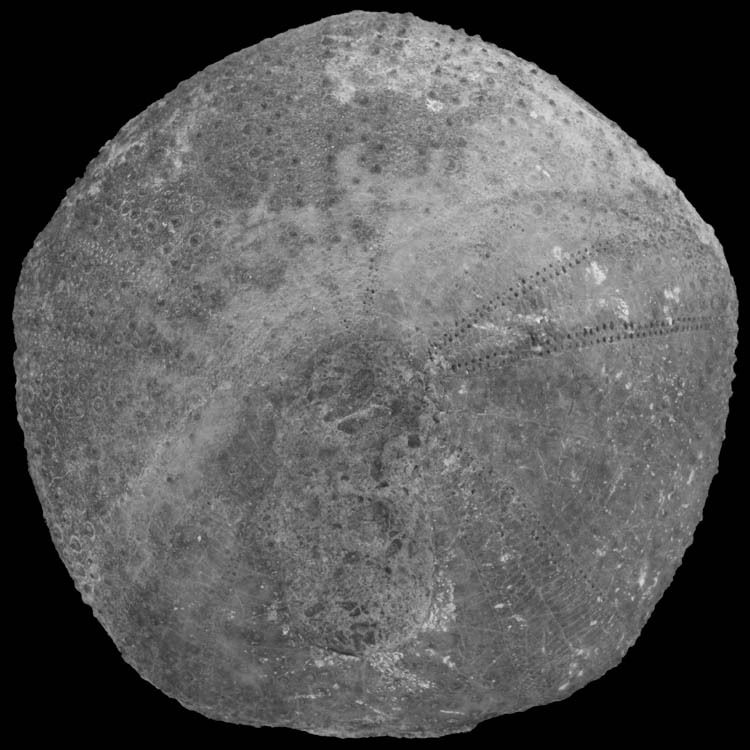
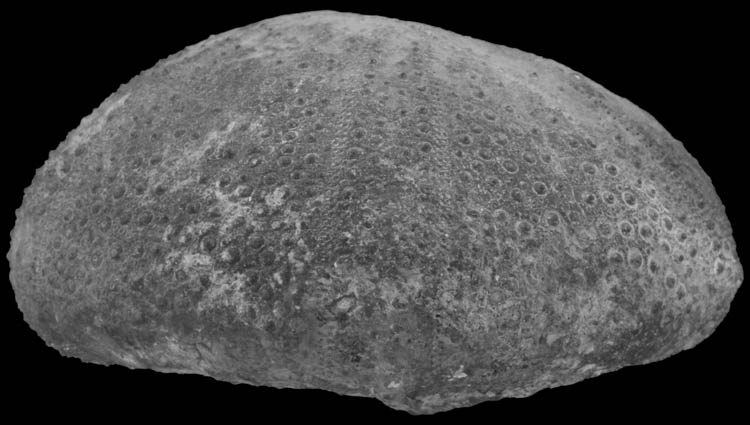
http://www.3d-fossils.ac.uk/fossilType.cfm?typSampleId=20006895crédit British Geological Survey, NERCspecimen SM J 34962 Buckman in Murchison, 1845, Outline of the geology of the neighbourhood of Cheltenham |
|
|
|
|

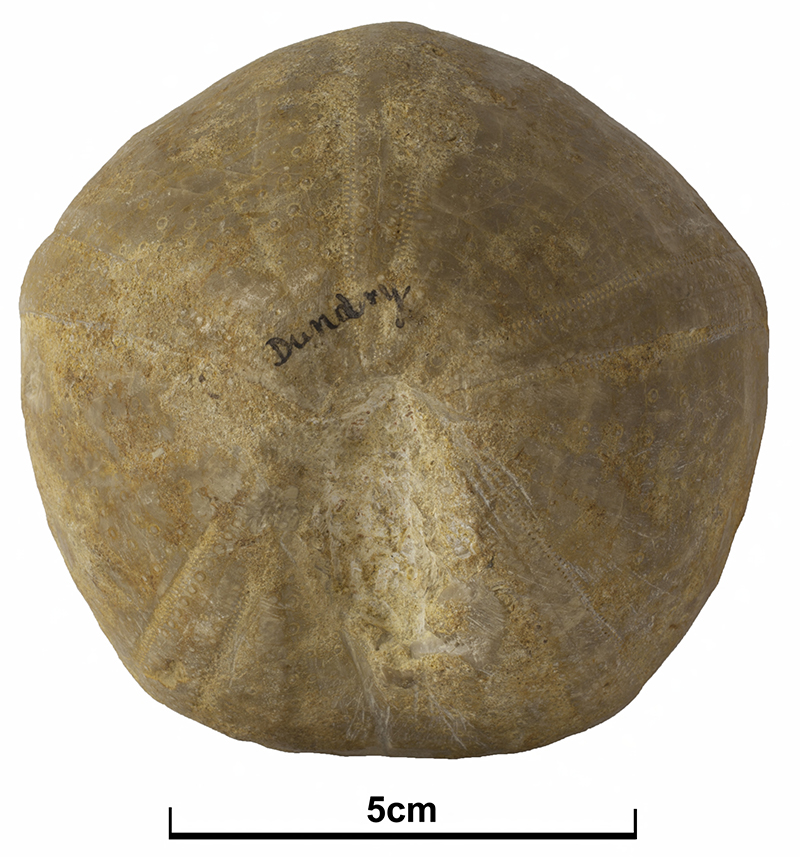
Holotype de P. brevifrons, conservé au Sedgwick Museum of Earth Sciences, University of Cambridge
|
|
http://www.3d-fossils.ac.uk/fossilType.cfm?typSampleId=20006895crédit British Geological Survey, NERCspecimen SM J 34962 McCoy 1848. On some new species of Mesozoic RadiataAnnals and Magazine of Natural History n. ser. (2) ii p.414 |
|
|
|
|
,%20McCoy,%20holotype.jpg)
|
Pygaster ornatus (Buckman in murchison,1845) - Bajocien supérieur, Talsinte, Maroc, 33 mm |
| plaque madréporique en place |
,%20apical,%20Bajocien,%20Talsinte,%20Maroc,%2033%20mm.JPG) |
,%20detapical,%20Bajocien,%20Talsinte,%20Maroc,%2033%20mm.JPG) |
,%20amb,%20Bajocien,%20Talsinte,%20Maroc,%2033%20mm.JPG) |
,%20oral,%20Bajocien,%20Talsinte,%20Maroc,%2033%20mm.JPG) |
|
Pygaster ornatus (Buckman in murchison,1845) - Bajocien supérieur, Talsinte, Maroc, 27 mm |
,%20apical,%20Bajocien,%20Talsinte,%20Maroc,%2027%20mm.JPG) |
,%20ambital,%20Bajocien,%20Talsinte,%20Maroc,%2027%20mm.JPG) |
,%20ambital,%20Bajocien,%20Talsinte,%20Maroc,%2027%20mm.jpg) |
|
Pygaster ornatus (Buckman in murchison,1845) - Bajocien supérieur, Maroc, 48 mm |
 |
 |
|
Pygaster ornatus (Buckman in murchison,1845) - Aalénien, Orne, 30 mm |
,%20apical,%20Aalenien,%20Orne,%2030mm.JPG) |
,%20ambital,%20Aalenien,%20Orne,%2030mm.JPG) |
,%20oral,%20Aalenien,%20Orne,%2030mm.JPG) |
|
Pygaster ornatus (Buckman in murchison,1845) - Bajocien, Maroc, 52 mm |
,%20apical,%20Bajocien,%20Maroc,%2052mm.JPG) |
,%20ambital,%20Bajocien,%20Maroc,%2052mm.JPG) |
,%20oral,%20Bajocien,%20Maroc,%2052mm.JPG) |
|
Pygaster ornatus (Buckman in murchison,1845) - Bajocien, Maroc, 52 mm |
%20apical,%20Bajocien,%20Maroc,%2052mm.JPG) |
|
Pygaster ornatus (Buckman in murchison,1845) - Bajocien, Maroc, 69 mm |
,%20apical,%20Bajocien,%20Maroc,%2069mm.JPG) |
|
Pygaster ornatus (Buckman in murchison,1845) - Bajocien, Talsinte, Foum Slimane, Maroc, 50 mm |
,%20apical,%20Bajocien,%20Talsinte,%20Foume%20Slimane,%20Maroc,%2050%20mm.JPG) |
,%20periprocte,%20Bajocien,%20Talsinte,%20Foume%20Slimane,%20Maroc,%2050%20mm.JPG) |
,%20oral,%20Bajocien,%20Talsinte,%20Foume%20Slimane,%20Maroc,%2050%20mm.JPG) |
diagnose originale de l'espèce par Desor in Reynes, 1868
Essai de géologie et de paléontologie aveyronnaises, p.80
|
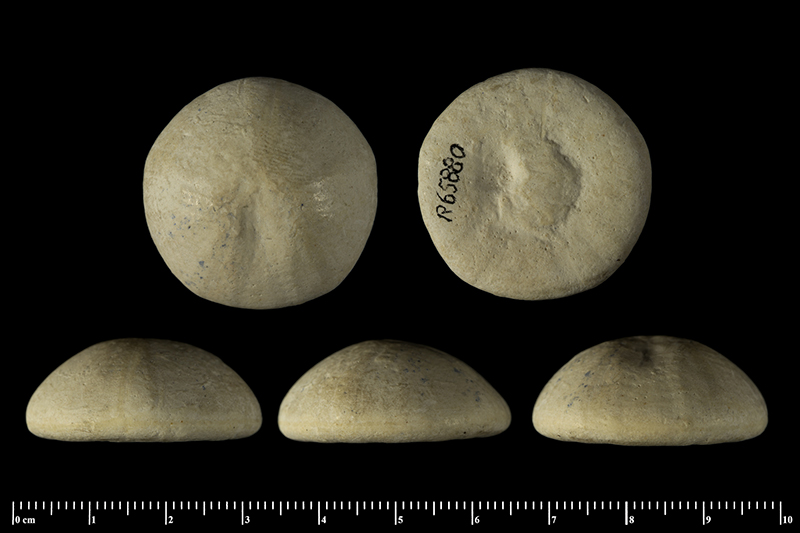
Pygaster Reynesi, Desor. Coquille subpentagonale, concave en dessous, presque anguleuse à l'ambitus. Zônes porifères droites, à l'exception des deux postérieures que le périprocte fait légèrement dévier. Pores disposés par simples paires, obliques ; ambulacres un peu renfléss, ornés de tubercules perforés, non crénelés, scrobiculés, formant à la face inférieure et à l'ambitus 4 rangées, dont les deux externes seulement persistent jusqu'au sommet. Interambulacres ornés de 12 rangées de tubercules à l'ambitus, qui se réduisent à 4 en approchant du sommet. Péristome circulaire ; periprocte postérieur, ovale, asssez large, s'étendant jusqu'à l'appareil apical. |
Diamètre 30 millimètres - hauteur, 43 centièmes du diamètre. Localité : Cabanous, près Saint-Georges (Aveyron) ; zône à Ammonites margaritatus.
|
|
|
http://coldb.mnhn.fr/catalognumber/mnhn/f/r65880 spécimen MNHN.F.R65880 crédit RECOLNAT (ANR-11-INBS-0004) Peter MASSICARD REYNES, p. 89 |
|
|
|
|


|
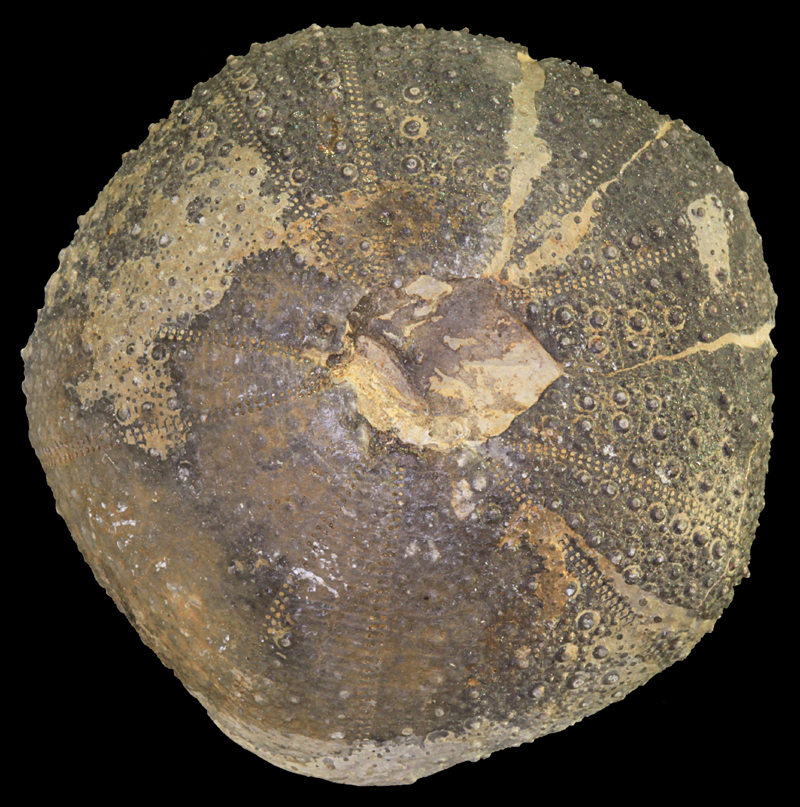
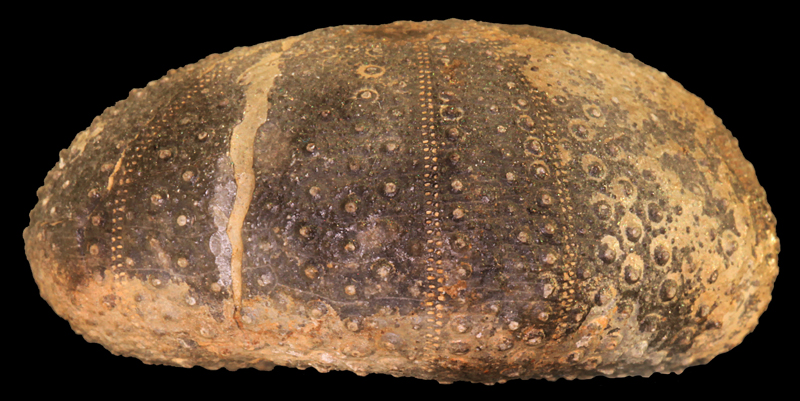
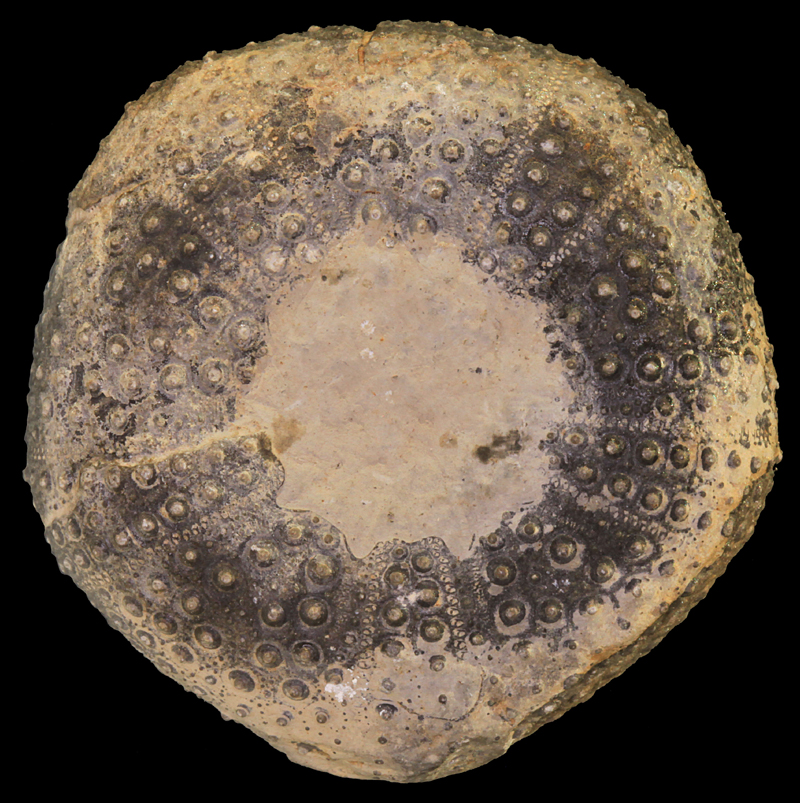
Pygaster sp. aff. reynesi Desor in Reynes,1868 - Bajocien, Guersif, Bni Kabl, Maroc, 40 mm |
 |
 |
 |
diagnose originale de l'espèce par Agassiz
Monographies d'échinodermes vivans et fossiles, p. 80
|
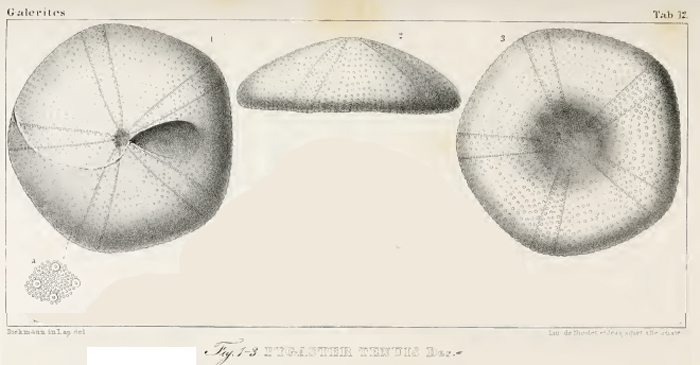
IV. Pygaster tenuis Ag. Tab. 12, fig. 1-3. Syn. Pygaster tenuis Ag. Descr. des Ech. foss. de la Suisse 1re partie p. 83. M. Agassiz mentionne cette espèce dans sa Descr. des Ech. foss. de la Suisse, comme étant voisine du Pyg. patelliformis ; mais il n'en donna pas de figures, faute d'exemplaires assez bien conservés. Quoique les exemplaires dont je dispose soient loin d'être parfaits, il m'ont cependant permis d'étudier les principaux caractères de l'espèce, et je me suis assuré qu'elle diffère à plusieurs égards de l'espèce ci-dessus. Et d'abord, le test est beaucoup plus mince à la face supérieure et à la face inférieure ; les tubercules sont aussi plus petits et plus nombreux ; il y en a au moins vingt rangées dans les aires interambulacraires ; les aires ambulacraires n'en ont guère que six. A la face supérieure, les tubercules sont bien moins serrés qu'à la face inférieure ; on peut même dire qu'ils y sont clair-semés. L'espace intermédiaire entre les tubercules principaux est occupé par une immense |
quantité de tubercules miliaires qui, vus à la loupe, présentent l'aspect de fig. 1 a. Je n'ai pu mettre à découvert le pourtour de la bouche et ne puis par conséquent indiquer ses dimensions relatives. L'anus est très-rapproché du sommet ; il m'a paru être plus allongé que dans l'espèce précédente ; mais ses contours ne sont pas non plus intacts. Les seuls exemplaires qui me sont connus de cette espèce ont été recueillis par M. Gressly dans le terrain à chailles du Jura suisse, au Fringeli, dans le canton de Soleure. Extrait planche 12
|
|
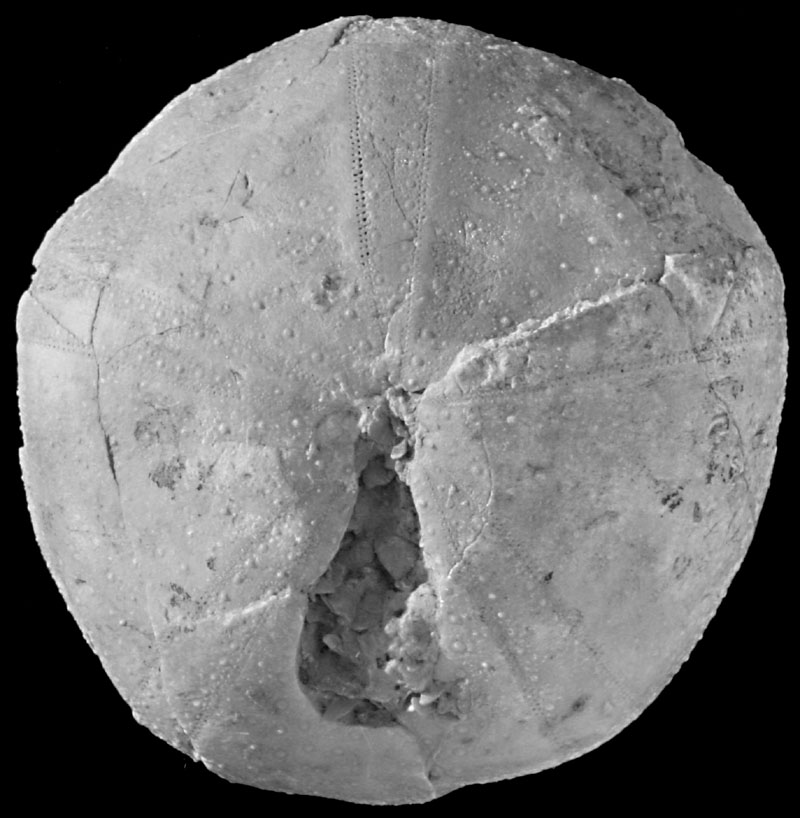
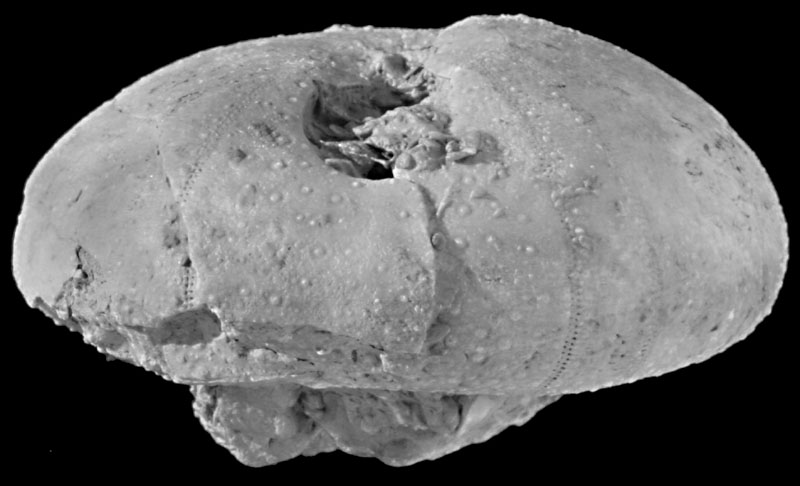
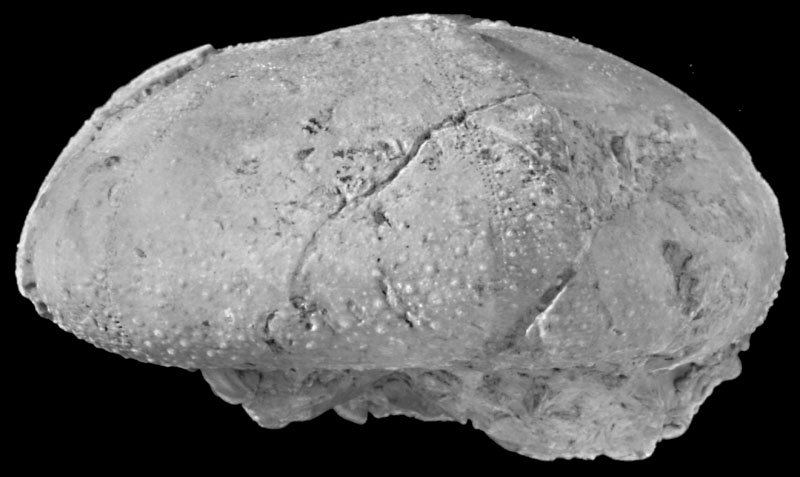
Pygaster tenuis Agassiz,1839 - Kimméridgien, Pologne, 44 mm |
 |
 |
 |
 |
diagnose originale de l'espèce par Cotteau,1857
Echinides du départemenet de la Sarthe, p.35
|
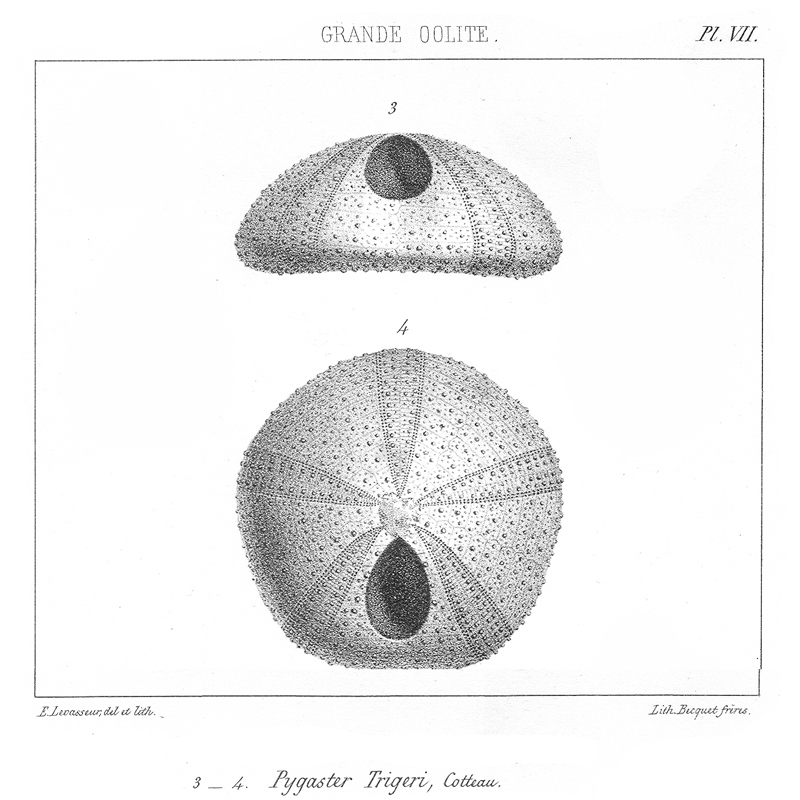
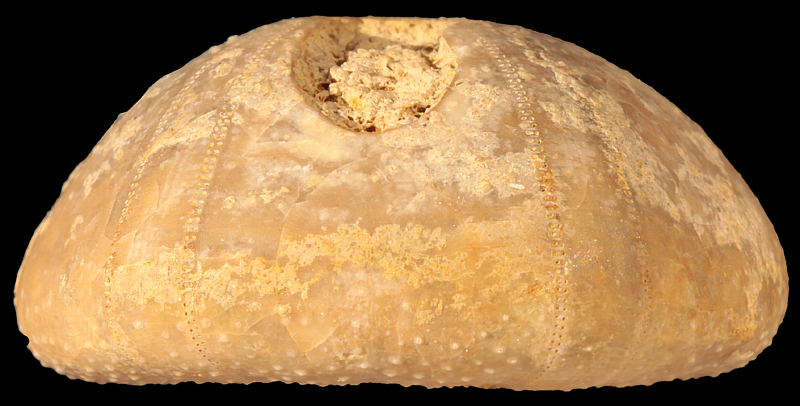
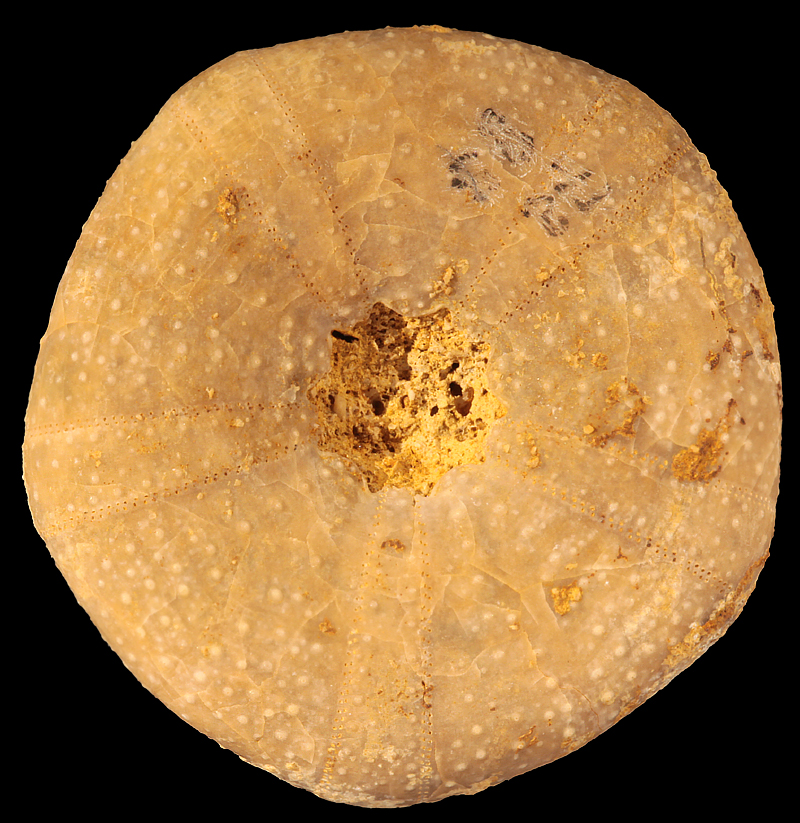
N° 14, PYGASTER TRIGERI, Cotteau, 1857. PI. VII, fig. 3 et 4. Hauteur, 17 millimètres; diamètre transversal, 48 millimètres 1/2 ; diamètre antéro-postérieur, 47 millimètres. Espèce de taille moyenne, pentagonale, un peu plus large que longue, légèrement renflée en dessus, subconcave en dessous. Tubercules interambulacraires petits et espacés à la face supérieure, beaucoup plus développés vers l'ambitus et sur les bords de la face inférieure, où ils forment des séries horizontales assez régulières. Granules intermédiaires inégaux, le plus souvent disséminés au hasard, affectant cependant à la face inférieure, autour de chaque tubercule, une disposition hexagonale qu'on retrouve chez presque tous les Pygaster. Ambulacres garnis de petits tubercules identiques à ceux des aires interambulacraires , mais plus régulièrement disposés, formant, vers l'ambitus, quatre séries distinctes ; les doux externes s'élèvent seules jusqu'au sommet. Pores simples, rangés en lignes parfaitement droites, à l'exception cependant des ambulacres postérieurs qui s'inclinent légèrement au-dessus de l'anus. Anus pyriforme, large, très-grand, occupant à peu près les trois quarts de l'aire interambulacraire impaire. Péristome décagonal, s'ouvrant au centre de la face inférieure, dans une dépression très-sensible. Rapports et différences. — Cette espèce est voisine du Pygaster umbrella, Agassiz, elle nous a paru cependant s'en distinguer par sa taille beaucoup plus petite, ses tubercules relativement plus gros à la face inférieure, ses granules à scrobicules moins déprimés, ses ambulacres légèrement inclinés au sommet, son anus très-grand et descendant plus bas encore que celui du Pygaster umbrella. La grandeur de son ouverture anale et la petitesse de ses |
tubercules largement espacés à la face supérieure nous ont empêché de réunir cette espèce au Pygaster semisulcatus, Wright, qu'on rencontre en Angleterre à peu près au même horizon. Elle ne saurait non plus être confondue avec le Pygaster Morrisii, Wright, dont elle s'éloigne par sa forme plus élevée au sommet , moins renflée sur les bords, par ses tubercules plus petits et beaucoup moins nombreux. Loc. — Ferme de Soisey (commune de la Perrière) bords du ruisseau. Très-rare. Tabl. de M. Triger, Forest Marble, ass. n° 1. Col. Triger. Expl. des fig. — PI. VII, fig. 3, Pygaster Trigeri, vu décote, de la coll. de M. Triger, — Fig. 4, le même, vu sur la face supérieure. Extrait planche VII
|
|
|
https://explore.recolnat.org/occurrence/459247934A124C9AB25E62EDF27BFDC9
spécimen
MHNLM
2003.1.4571
identifiant
Recolnat
459247934A124C9AB25E62EDF27BFDC9
|
|
|
|
|

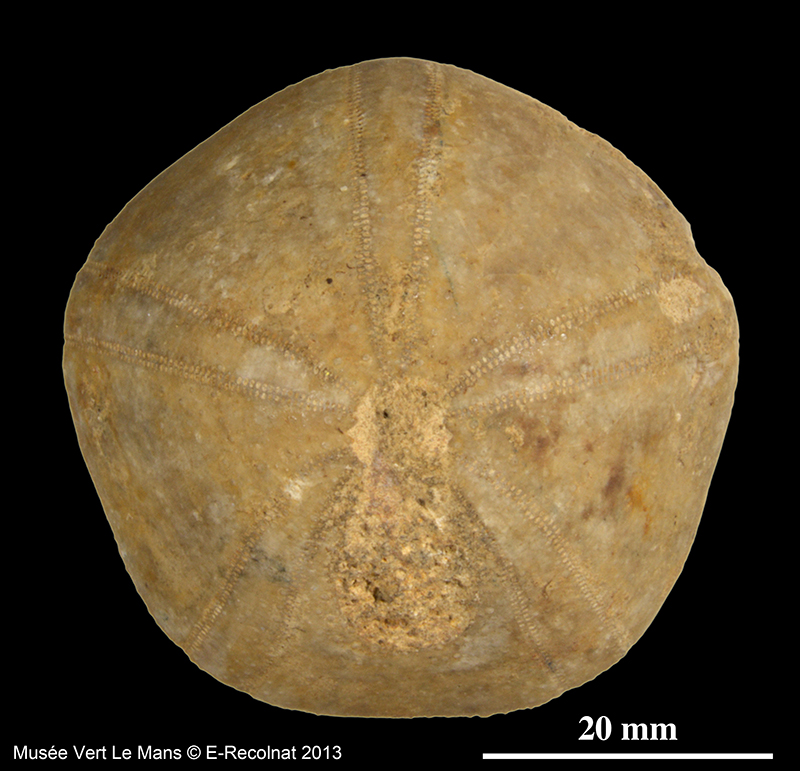
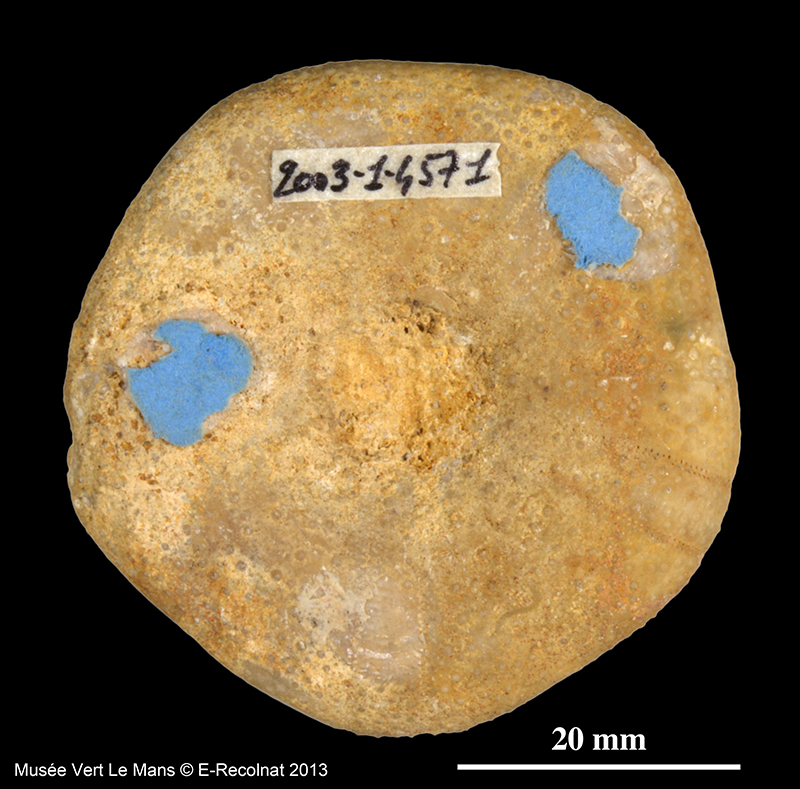
|
Pygaster trigeri Cotteau,1857 - Callovien moyen, Chauffour-Notre-Dame, Sarthe, 29 mm |
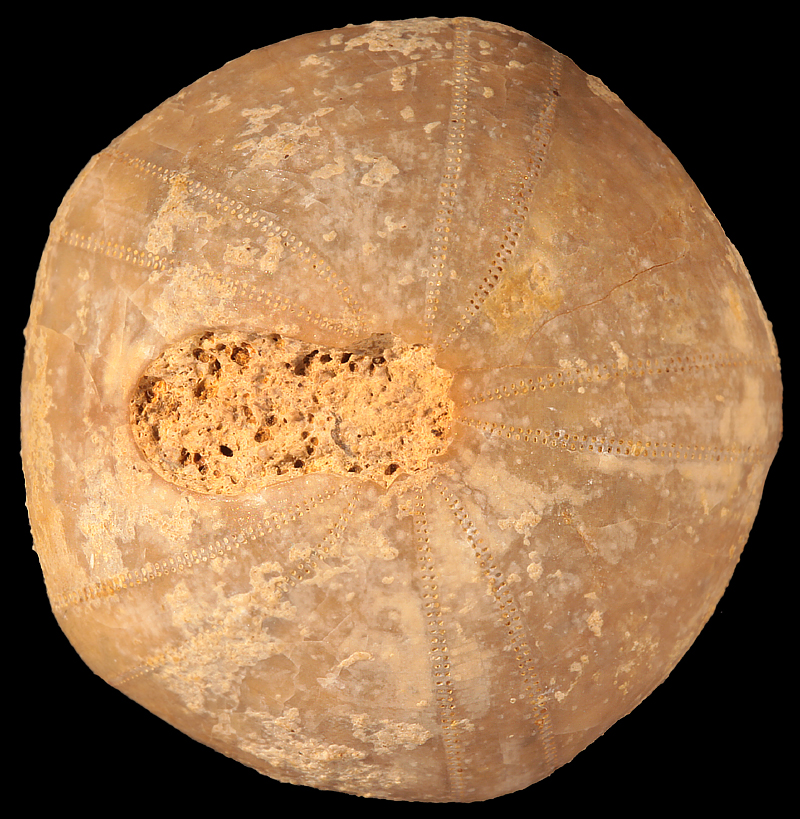 |
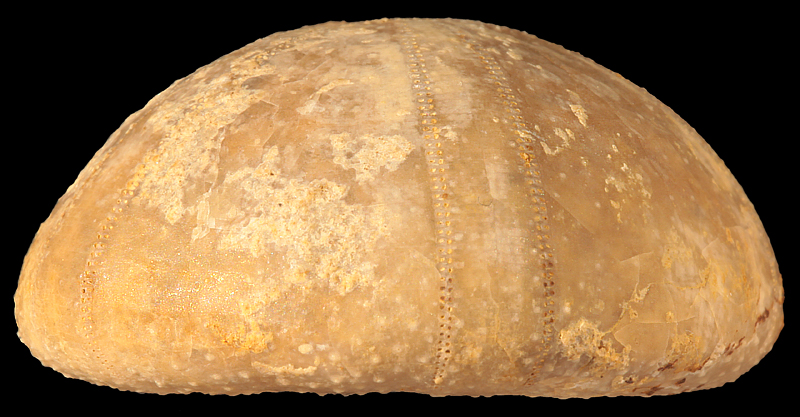 |
 |
 |
|
Pygaster trigeri Cotteau,1857 - Callovien moyen, Chauffour-Notre-Dame, Sarthe, 30 mm |
 |
 |
 |
 |